- English
- French
- German
- Portuguese
- Spanish
- Russian
- Japanese
- Korean
- Arabic
- Greek
- German
- Turkish
- Italian
- Danish
- Romanian
- Indonesian
- Czech
- Afrikaans
- Swedish
- Polish
- Basque
- Catalan
- Esperanto
- Hindi
- Lao
- Albanian
- Amharic
- Armenian
- Azerbaijani
- Belarusian
- Bengali
- Bosnian
- Bulgarian
- Cebuano
- Chichewa
- Corsican
- Croatian
- Dutch
- Estonian
- Filipino
- Finnish
- Frisian
- Galician
- Georgian
- Gujarati
- Haitian
- Hausa
- Hawaiian
- Hebrew
- Hmong
- Hungarian
- Icelandic
- Igbo
- Javanese
- Kannada
- Kazakh
- Khmer
- Kurdish
- Kyrgyz
- Latin
- Latvian
- Lithuanian
- Luxembou..
- Macedonian
- Malagasy
- Malay
- Malayalam
- Maltese
- Maori
- Marathi
- Mongolian
- Burmese
- Nepali
- Norwegian
- Pashto
- Persian
- Punjabi
- Serbian
- Sesotho
- Sinhala
- Slovak
- Slovenian
- Somali
- Samoan
- Scots Gaelic
- Shona
- Sindhi
- Sundanese
- Swahili
- Tajik
- Tamil
- Telugu
- Thai
- Ukrainian
- Urdu
- Uzbek
- Vietnamese
- Welsh
- Xhosa
- Yiddish
- Yoruba
- Zulu
How Does a Urea Doser Pump Improve Emission Control
A urea doser pump dramatically improves emission control by precisely injecting Diesel Exhaust Fluid (DEF) into the exhaust stream, enabling the Selective Catalytic Reduction (SCR) system to convert up to 90% of harmful nitrogen oxides into harmless nitrogen and water vapor. This precise metering capability represents the cornerstone of modern diesel emission compliance strategies.
Modern diesel engines face unprecedented regulatory scrutiny across global markets. Procurement managers, R&D engineers, and technical stakeholders understand that emission control technology directly impacts competitive positioning, regulatory compliance, and operational profitability. Within SCR aftertreatment systems, the dosing pump functions as the critical interface between emission reduction targets and practical achievement. Meeting stringent standards like EPA 2010, Euro VI, and China VI requires not just adequate technology but precision-engineered components that deliver consistent performance across millions of operational cycles.
This comprehensive guide examines how DEF dosing pumps enable regulatory compliance while simultaneously improving fuel economy, extending catalyst lifespan, and reducing total cost of ownership. We address the technical fundamentals, procurement criteria, troubleshooting protocols, and emerging innovations that define best-in-class emission control solutions for heavy trucks, construction equipment, agricultural machinery, generator sets, and industrial applications throughout the United States market.
Understanding Urea Doser Pumps and Their Role in Emission Control
Core Function and Operating Principles
The urea doser pump module uses solenoid mechanisms that are managed electrically to add the exact right amount of aqueous urea solution to the exhaust gases before the SCR catalyst. DEF breaks down into ammonia when it comes in contact with hot exhaust at temperatures between 300°C and 550°C. Ammonia then reacts with nitrogen oxides on the catalyst surface. This chemical process lowers NOx pollution while keeping the engine's performance levels the same. In modern systems, injection pressures can reach 50 bar, which makes fine atomization patterns that make surface touch and reaction efficiency better.
Pump Technologies and Configurations
The business market is mostly made up of three main styles. Diaphragm pumps make pressure bursts by using mechanical or hydraulic action, and they work well in heavy-duty situations. With peristaltic designs, flexible tubing is compressed to move fluid without putting corrosive urea solutions directly on mechanical parts. This means that maintenance intervals are longer. Plunger designs allow for very accurate dosing at high pressures, which makes them ideal for tough OEM uses that need to stick to tight tolerances. Electric solenoid-driven versions respond quickly and can be connected to engine control units, which lets them make urea doser pump changes in real time based on data like load, speed, and exhaust temperature.
Material Engineering for Durability
The materials used in components have a direct effect on how well they work and how long they last. Stainless steel housings are better at resisting corrosion from crystalline urea deposits. This is especially useful in applications that go through a lot of temperature changes or long periods of inactivity. Modern polymer seals can handle being exposed to chemicals and still stay flexible at temperatures ranging from -40°C to +90°C. More and more, manufacturers ask for materials that meet automotive-grade standards to make sure that industrial vehicles can last for 500,000 kilometers.
Real-World Application Sectors
Urea doser pumps are important for transportation companies that use Class 8 trucks to stay in compliance with EPA rules for interstate trade. To get project permits, construction equipment used in cities has to show that its pollution are legal. Manufacturers of agricultural equipment use SCR technology to meet Tier 4 Final standards without lowering the power-to-weight ratios that are important for field work. Generator sets are used in mines, power plants, and backup installations. They need to be very reliable and need very little service over long periods of time.
Key Benefits of Using Urea Doser Pumps in SCR Systems
Precision urea doser pump technology has benefits that can be measured throughout the span of the equipment. When procurement teams know about these benefits, they can use recorded business gains and regulatory risk mitigation to support the initial investment.
Regulatory Compliance Assurance
Emission rules are getting stricter in all areas. The EPA's Heavy-Duty Greenhouse Gas Phase 2 rules set NOx reduction goals that can't be met just by improving the way engines burn fuel. The urea doser pump lets makers get their goods approved for sale, and it helps fleet operators stay in line during random checks and regular emissions tests. By using internal diagnostics to record how the SCR system works, you can show that you are following the rules and avoid fines and limits on your operations.
Operational Efficiency Gains
The best way to use catalysts is to inject them correctly. This lowers the cost of usage while keeping conversion efficiency high. Dosing algorithms stop both over-injection, which wastes fluid, and under-injection, which sets off engine derating protocols. When systems are working properly, vehicles with SCR systems get 3–5% better gas mileage than vehicles without SCR systems. This is because engineers can optimize combustion for power and efficiency instead of reducing emissions. When ammonia is delivered precisely, it makes catalysts last longer, which lowers replacement costs that can be more than $4,000 per unit in commercial settings.
System Integration Advantages
Modern urea doser pumps can talk back and forth with engine control systems, which lets them do predictive tests and schedule repair based on conditions. Real-time system health data from built-in temperature sensors, pressure transducers, and flow tracking lets fleet managers schedule service for planned breaks instead of having to deal with breakdowns that happen out of the blue. This connection helps telematics platforms collect performance data from a large group of vehicles, showing patterns that help with buying choices and judging the performance of suppliers.
Environmental Impact Reduction
Besides following the rules, lowering emissions has real environmental benefits that can be measured. When equipped with working SCR systems, a single heavy-duty truck that travels 100,000 miles a year stops about 2,500 pounds of NOx pollution. When you add up all the diesel equipment in all the fleets, this means that the air quality is much better in port areas, urban corridors, and industrial zones. Documented reductions in emissions are becoming more important in corporate environmental reports. This improves the brand's image and builds trust among stakeholders.

Common Challenges and Troubleshooting Guide for Urea Doser Pumps
Identifying Performance Issues
Finding urea doser pump system problems early on keeps catalysts from getting damaged and keeps companies from not following the rules. Warning lights on the dashboard that show problems with the SCR system need to be fixed right away because continuing to use the vehicle may cause the engine to lose power, which is meant to force the repair. Less DEF use compared to fuel use could mean that the right amount is not being added, while too much use could mean that there is a leak or a problem with the balance. Strange exhaust smells that smell like ammonia are a sign of over-injection, which wastes fluid and could damage catalyst substrates.
Crystallization Management
Urea crystallization represents the most common problem with maintenance. Solid deposits form in injector nozzles, supply lines, or pump chambers when DEF dries. These deposits stop flow and make dosing less accurate. Because of incomplete thermal cycling, crystallization rates are higher in situations where there are a lot of short trips or long periods of inactivity. Regularly clearing the system using the steps recommended by the maker, making sure that the quality of the DEF meets ISO 22241 standards, and storing it in a way that keeps it from getting contaminated or breaking down are all preventative measures. During routine maintenance, technicians should look at the spray patterns of injectors and clean or replace parts that show reduced flow.
Calibration and Diagnostic Procedures
Dosing accuracy decreases over time because parts wear out, so calibration needs to be checked on a regular basis. Engine control units let diagnostic scan tools get problem codes from memory, watch urea doser pump rates in real time, and run tests on pump functions. If the amount of injection that was ordered doesn't match up with what actually happened, it means that there is mechanical wear or a problem with the electrical control system that needs to be fixed. As part of quality assurance procedures, feed lines should be tested for pressure, sensor readings should be compared to known standards, and calibration parameters should be written down so that degradation trends can be tracked.
Maintenance Best Practices
To make a urea doser pump last longer, it's important to stick to maintenance schedules that are in line with how the equipment is being used. For heavy-duty uses, inspection times should be 50% shorter than usual. When filter elements are changed, particles that speed up wear on precision measuring parts are kept from getting into the system. By looking at electrical connections visually, you can find corrosion or mechanical damage before they break. Keeping detailed service records lets you make decisions based on data about whether to replace a part or fix it. This is especially helpful when comparing the total cost of ownership across different suppliers.
How to Choose the Right Urea Doser Pump for Your SCR System
Technical Specification Matching
Urea doser pump entry standards must be clearly stated for procurement to go well. Flow rate capacity must be able to handle the most NOx that the engine can make at full load, which is usually between 5 and 25 liters per hour depending on the engine's displacement and power output. Specifications for injection pressure make sure that the atomization is good within the mixing length that is allowed between the injector and catalyst outlet. Temperature operating ranges need to include the normal conditions in the target markets. This is especially important for equipment that will be used in harsh climates. Integration difficulty and commissioning time are based on how well the control interface works with existing engine management systems.
Electric Versus Pneumatic Actuation
Electric urea doser pumps are most common in modern use because they are easy to set up, respond quickly, and can be controlled precisely without the need for compressed air. Solenoid-driven designs work well with electronic control architectures, which lets them use complex dosing algorithms that can adjust to changing operating conditions. There are pneumatic options that can be used in some industrial settings where compressed air is available or where explosion-proof standards mean that air-operated designs are better. Each technology has its own upkeep needs and spare parts store needs, which affect the overall cost of ownership.
Material Selection Criteria
When urea doser pumps are used in mobility equipment, they have to be able to handle shaking, changes in temperature, and dirt and grime from the road while still keeping their seals intact and their sizes stable. Stainless steel parts are the best at resisting rust, but they cost more at first than engineered polymer substitutes. Buyers should think about how long a material will last, how hard it will be to use, and how much it will cost to replace. OEM partnerships often help choose materials by using data from similar uses that have been used in the field.
Supplier Evaluation Framework
Certification credentials show that a company can make good products and follow the rules. IATF 16949 certification shows that a management system meets the needs of the car industry, and ISO 9001 certification gives basic process control guarantee. Environmental certifications, such as REACH and RoHS compliance, prove that chemicals are safe and that materials can be tracked.
In addition to the initial buy price, how quickly technical help responds, how good the documentation is, and how easy it is to get replacement parts are all very important selection factors. Long-term supply agreements should cover managing obsolescence, how to let people know about design changes, and performance warranty terms that keep things from breaking down too soon.
Brand Landscape Analysis
Established companies like Bosch, Cummins, and Siemens stay at the top of the market thanks to a lot of field testing and OEM ties. These suppliers usually charge higher prices because they have a lot of technical information, service networks that reach all over the world, and a history of being reliable. New suppliers offer options that are affordable, with aggressive pricing and the ability to customize, which is useful for specific uses or large-scale purchases. Aftermarket parts are a cheap way to replace worn-out equipment, but the quality can vary, so suppliers need to be carefully vetted and incoming parts need to be inspected.
Enhancing Emission Control Efficiency with Advanced Urea Doser Pumps
Smart Technology Integration
Modern urea doser pumps are connected to the internet of things (IoT), which lets them be monitored from afar and allows for predictive maintenance and analysis of fleet-wide performance. Cloud-based platforms collect operational data from groups of spread equipment, finding patterns of failure and ways to improve things that individual workers wouldn't see. Machine learning algorithms look at how doses are distributed based on load profiles, weather conditions, and the fuel's properties to keep improving injection strategies. With these features, controlling emissions goes from being about following the rules to being about managing performance proactively.
Precision Calibration Methods
Advanced monitoring technologies raise the accuracy of doses from ±5% to ±2%, which greatly increases the efficiency of catalyst use. Automated calibration procedures cut down on the time needed for commissioning and get rid of the human error sources that are common in manual adjustment protocols. Self-learning algorithms adapt to the wear and tear of parts, keeping performance at its best between service intervals. Real-time diagnostic feedback lets workers know about degradation trends before they happen, which lets them use condition-based replacement methods to cut down on unplanned downtime.
Performance Case Studies
A big company that makes construction equipment put precision urea doser pumps on all of their excavators and saw a 12% drop in DEF use while keeping the NOx conversion rate above 92%. Over 18-month evaluation periods, fleet operators who replaced old aftermarket parts with OEM-specified pumps saw a 23% drop in SCR-related service events. Generator set integrators that used industrial-grade systems in continuous-duty power generation achieved 99.7% uptime over three years, which was a lot better than the performance of older technologies.
Future Development Trajectories
Emission control technology keeps getting better because regulations are moving toward zero-emission requirements. Next-generation systems will have more advanced sensor arrays that will give real-time feedback on how well the catalyst is working. This will allow closed-loop dosing control that adjusts to the effects of catalyst age and sulfur poisoning. Miniaturization trends make SCR technology useful in small pieces of equipment that it wasn't able to work with before. Sustainability efforts stress recycling and using less energy in manufacturing, which changes the choices of materials and production methods all along the supply chain.
Conclusion
The urea doser pump is an important part of modern diesel emission control strategies because it helps factories follow the rules, makes them more efficient, and is better for the environment. Before making a purchase choice, you need to carefully look at the technical specs, the supplier's skills, and the long-term costs. Knowing about different types of pumps, how to maintain them, and new technologies helps engineers and purchasing teams choose the best options for each application and the company's goals. As emission standards keep getting stricter, the quality and dependability of dose systems will become more and more important in global markets.
FAQ
What maintenance frequency ensures optimal dosing pump performance?
Manufacturers usually suggest that the urea doser pump should be inspected every 500 to 1,000 hours of use, and that parts should be replaced based on how they're doing instead of on a set schedule. Heavy-duty applications need to be checked more often, especially in places with high contamination levels or extreme temperatures. To keep things from breaking down too soon, preventive maintenance should include changing the filter, inspecting the injectors, and making sure the electrical connections are correct.
Can dosing pumps be retrofitted to older diesel engines?
How possible a retrofit is relies on how much room is available, how well the engine control system works with it, and how hot the exhaust is. Engines that consistently put out exhaust temperatures above 250°C can activate the SCR catalyst. CAN bus integration or stand-alone control units are needed for modern computer controls. Retrofit jobs should include a full engineering review to make sure that the right size parts are used and that the whole system works well together.
What symptoms indicate pump replacement necessity?
If the failure warning lamp stays lit, the DEF consumption rate drops, diagnostic tests fail, or there is physical damage, you should think about replacing the urea doser pump. Action needs to be taken right away on pumps that can't keep their calibration specifications or show signs of seal leakage. Based on the age, service history, and operating importance of the equipment, a cost-benefit study should compare the choices of replacement and repair. When compared to reactive field failures, preventative replacement during scheduled overhauls is often a better deal.
Partner with Qintai for Reliable Urea Doser Pump Solutions
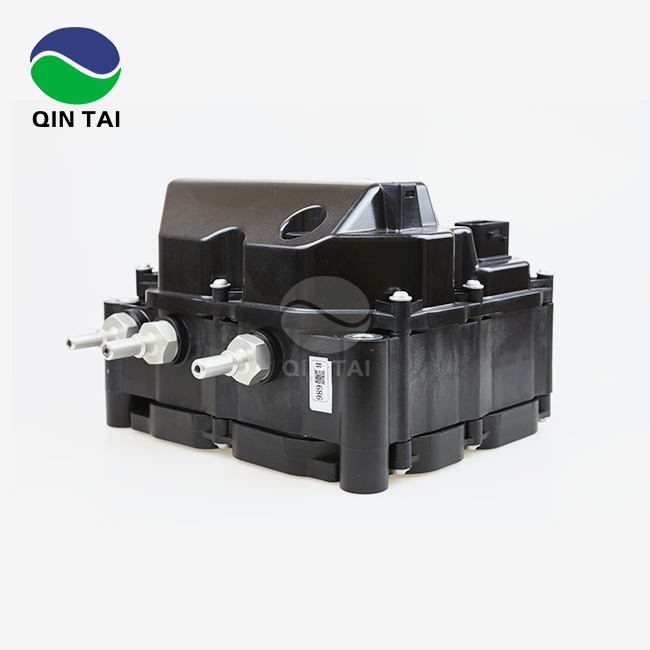
With more than 20 years of experience in car pollution technology, Qintai makes high-quality urea doser pumps and SCR aftertreatment parts. As the biggest urea doser pump maker in China's OEM market, we work with big powertrain suppliers like Weichai, Yuchai, and Quanchai. Our production-grade reliability has been tested over millions of cycles. We use IATF 16949-certified manufacturing methods and thorough testing routines to make sure that the quality is always the same and meets Euro VI and EPA compliance standards.
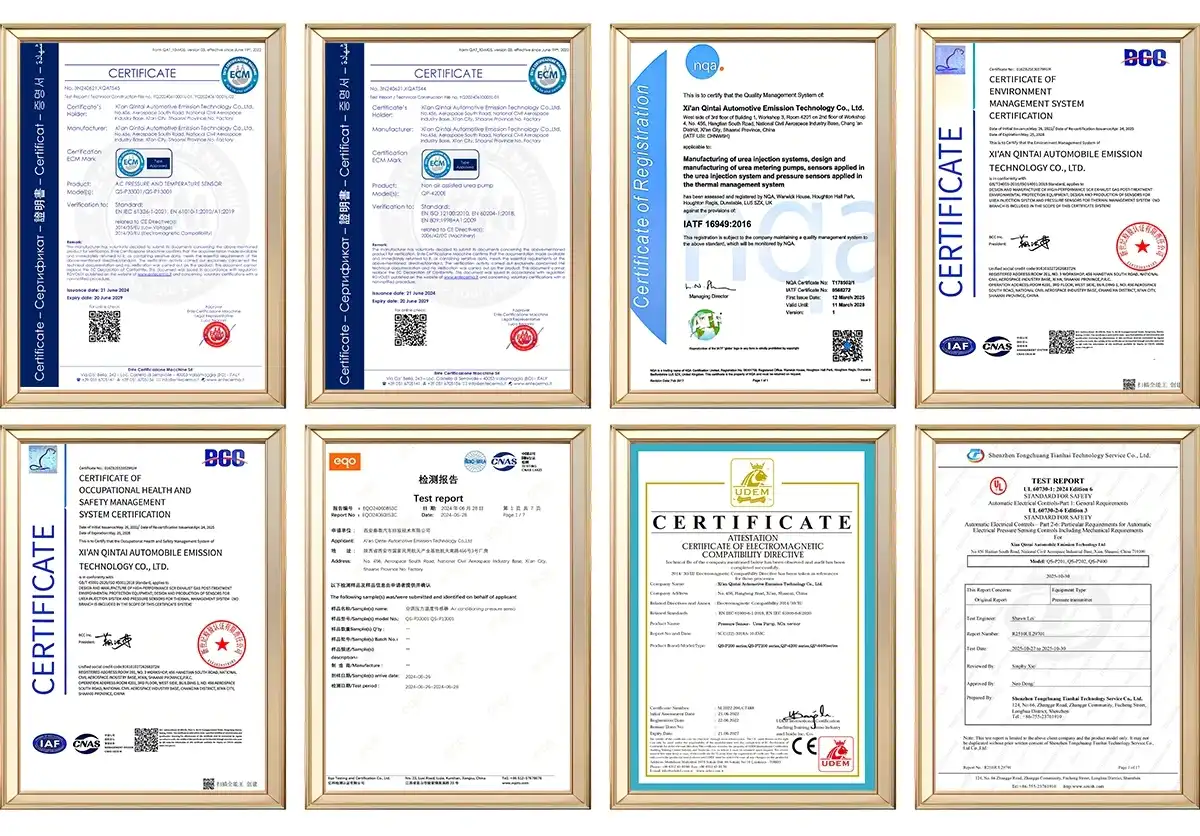
We can make a lot of changes to meet the individual needs of each application, from setting the flow rate to setting up the control interface. Technical support teams offer technical advice at all stages of the procurement process, from creating the initial specifications to integrating the products into production and providing help in the field. Our 58 invention patents show that we are committed to constant innovation, and our ISO 9001, CMC, and UL certifications show that our quality management systems and product safety standards are met.
B2B partners benefit from competitive volume pricing structures, expedited logistics supporting just-in-time delivery requirements, and comprehensive warranty coverage protecting your investment. Qintai has the technical know-how and manufacturing capacity to help you reach your emission control goals, whether you need OEM parts for making new equipment, replacement parts for selling aftermarket items, or custom solutions for unique uses.
Contact our technical sales team at info@qt-sensor.com to discuss your specific requirements. Visit qt-sensor.com to explore our complete product portfolio and access technical documentation supporting informed procurement decisions. Let us demonstrate how Qintai's emission control solutions can enhance your competitive positioning through superior quality, reliability, and technical support.
References
1. Johnson, T. V. (2020). Diesel Emission Control Technology: A Review of the State of the Art. SAE International Journal of Engines, 13(4), 521-548.
2. Majewski, W. A., & Khair, M. K. (2019). Diesel Emissions and Their Control. Warrendale: SAE International Technical Publications.
3. Cavataio, G., Girard, J. W., & Lambert, C. K. (2021). SCR System Performance Optimization Through Advanced Urea Dosing Strategies. Emission Control Science and Technology, 7(2), 112-129.
4. United States Environmental Protection Agency. (2022). Heavy-Duty Highway Compression-Ignition Engines and Urban Buses: Exhaust Emission Standards. Office of Transportation and Air Quality.
5. Koebel, M., Elsener, M., & Madia, G. (2018). Recent Advances in the Development of Urea-SCR for Automotive Applications. Topics in Catalysis, 61(7), 875-894.
6. Zhang, L., Wang, Y., & Chen, H. (2023). Reliability Analysis of Urea Dosing Systems in Commercial Vehicle Applications. International Journal of Automotive Technology, 24(3), 687-702.

Our customers’ satisfaction speaks for our quality — contact us to experience the same reliable service.