- English
- French
- German
- Portuguese
- Spanish
- Russian
- Japanese
- Korean
- Arabic
- Greek
- German
- Turkish
- Italian
- Danish
- Romanian
- Indonesian
- Czech
- Afrikaans
- Swedish
- Polish
- Basque
- Catalan
- Esperanto
- Hindi
- Lao
- Albanian
- Amharic
- Armenian
- Azerbaijani
- Belarusian
- Bengali
- Bosnian
- Bulgarian
- Cebuano
- Chichewa
- Corsican
- Croatian
- Dutch
- Estonian
- Filipino
- Finnish
- Frisian
- Galician
- Georgian
- Gujarati
- Haitian
- Hausa
- Hawaiian
- Hebrew
- Hmong
- Hungarian
- Icelandic
- Igbo
- Javanese
- Kannada
- Kazakh
- Khmer
- Kurdish
- Kyrgyz
- Latin
- Latvian
- Lithuanian
- Luxembou..
- Macedonian
- Malagasy
- Malay
- Malayalam
- Maltese
- Maori
- Marathi
- Mongolian
- Burmese
- Nepali
- Norwegian
- Pashto
- Persian
- Punjabi
- Serbian
- Sesotho
- Sinhala
- Slovak
- Slovenian
- Somali
- Samoan
- Scots Gaelic
- Shona
- Sindhi
- Sundanese
- Swahili
- Tajik
- Tamil
- Telugu
- Thai
- Ukrainian
- Urdu
- Uzbek
- Vietnamese
- Welsh
- Xhosa
- Yiddish
- Yoruba
- Zulu
Capacitive Pressure Sensor OEM Guide: Specs, Costs, and Import Tips
If you source pressure sensing components for diesel engines, SCR/DPF aftertreatment systems, or industrial generator sets, this guide is written for you. A capacitive pressure sensor converts mechanical pressure into an electrical signal by measuring changes in capacitance between a diaphragm and a fixed electrode. These devices deliver high accuracy, low temperature drift, and strong resistance to electromagnetic interference—qualities that matter when your application must meet China VI or Euro VI emission standards. Read on for technical specs, procurement cost factors, and practical import advice.

Understanding Capacitive Pressure Sensors: Principles and Applications
How the Sensing Principle Works
Formula for everything is C = ε₀εⁿA/d. The capacitance goes up when pressure moves the diaphragm toward the fixed electrode. At the same time, the gap d gets smaller. That capacitance change is turned into a stable analog or digital output by signal-conditioning circuits on board. There is less thermal noise because no piezoresistive element moves electricity through a strained bridge in the same way. This is very helpful in engine bays that go from -40 °C to 135 °C.
Key Industrial Applications
Capacitive pressure transducers are used in heavy-duty diesel platforms, HVAC refrigerant lines, systems that check the level of oil and gas tanks, and systems that clean industrial exhaust gasses. In the SCR aftertreatment process, correct differential pressure readings show how loaded the DPF is and set off regeneration processes at the right time. Generator sets in mines or power plants depend on these sensors to keep them stable over time without having to be re-calibrated all the time.
Why Capacitive Technology Stands Out
Capacitive sensors have better long-term zero stability and less distortion than systems that only use piezoresistive elements. Wear is kept to a minimum because there are no working parts. Ceramic-diaphragm capacitive sensors are constantly accurate within ±0.5% FS over multi-year service intervals, according to data published by sensor makers. This meets the consistency needs of OEM production lines.
Specifications and Design Considerations for OEMs
Reading a Datasheet Correctly
Pay attention to non-linearity, zero temperature drift, comprehensive accuracy, and safety overload rating when reading a capacitive pressure sensor's datasheet. Non-linearity is a measure of how far the output is from a straight line across the pressure range. If you know how much the standard moves per degree Celsius, you can use zero temperature drift. These two numbers have a direct effect on the cost of calibration and the number of warranty claims for mass-production OEM integration.
Material Selection for Harsh Environments
The material of the diaphragm is the most important thing for chemical protection and long-term safety. A 96% Al₂O₃ ceramic diaphragm, like the one in Qintai's QS-P105, is much more resistant to rust from acidic exhaust condensate and wear and tear from gasses full of particles than stainless steel diaphragms in the same price range. Ceramic's thermal expansion rate is also more stable, which means that zero temperature drift is less likely to happen in high-cycle diesel uses.
Packaging and Mounting Considerations
The type of connector, thread design, and housing material can all change how long it takes to put something on a production line. OEM engineers should make sure that the fitting force specs match the material of the engine block or exhaust manifold. A sensor with standard M12 or M14 threads makes it easier to place. This reduces assembly variation and the risk of diaphragm damage during torque application, which is a typical reason why early field failures happen.
Comparing Capacitive Pressure Sensors to Other Technologies
Capacitive vs. Piezoresistive Sensors
A lot of people use piezoresistive sensors because they are cheap and work well for moderate accuracy needs. But their resistance-based bridges are more likely to lose their shape when the temperature changes, which means they need extra circuitry to fix the problem. Capacitive designs are better because they are more accurate and easier to adjust for temperature changes. This makes them better in places where temperatures change a lot, like turbocharged diesel exhaust aftertreatment systems.
Capacitive vs. Piezoelectric Sensors
Piezoelectric sensors are great at picking up high-frequency, changing pressure events like combustion knock detection. Because they only make charge when the load changes, they are not good for measuring steady or slowly changing pressure. On the other hand, a capacitive pressure transducer keeps its reading stable when the pressure stays the same. This is needed for steady-state DPF differential pressure monitoring or generator lube-oil pressure monitoring.
Digital vs. Analog Output Selection
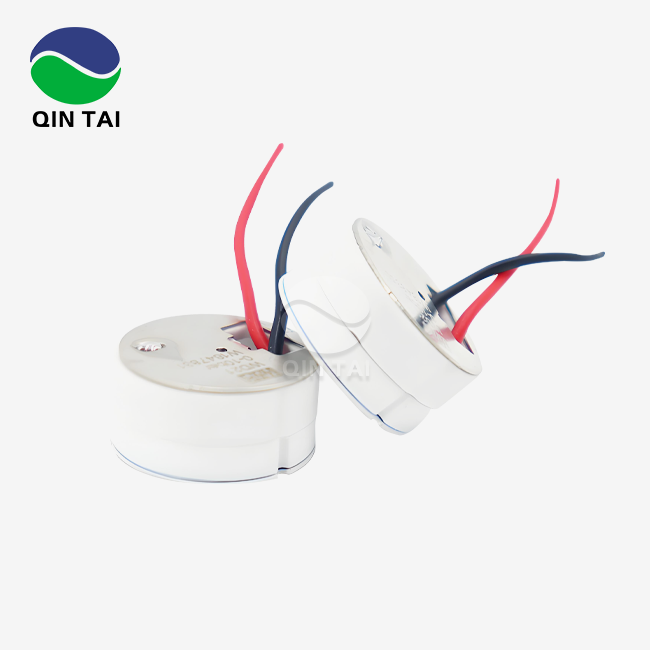
If OEMs want to add sensors to ECUs or PLCs, they need to choose between digital (CAN, I²C, SPI) and analog (ratiometric mV/V or 4–20 mA) outputs. Analog mV/V outputs, like the capacitive pressure sensor QS-P105's 2–4.0 mV/V range, are easy to wire and don't need software that is specific to the protocol. Digital outputs can make up for latency, but they make the bill of materials more complicated. Analog ratiometric outputs are still the best choice for high-volume diesel OEM builds because they are easier to validate and cost less per unit.

Procurement Guide: Costs, Suppliers, and Import Tips for OEMs
What Drives Unit Price
The diaphragm material grade, the pressure range breadth, and the order volume are the three most important factors. The cost of materials for a ceramic-diaphragm sensor that works up to 600 bar is higher than for a 10-bar silicon device, but the price per unit goes down a lot when more than 5,000 are sold each year. Customization, like non-standard fittings or calibration certificates for a particular brand, comes with a one-time NRE (non-recurring engineering) fee of around $500 to $2,000, which is quickly paid back by OEMs.
Evaluating Suppliers for OEM Programs
When choosing a pressure sensor source for a long-term OEM business, these are the most important things to look for:
- Certifications: Verify IATF 16949 and ISO 9001 at minimum; for hazardous-location generator applications, check Ex and UL listings.
- Pressure range coverage: A single supplier offering −1 bar to 600 bar across one product family reduces qualification effort.
- Lead time and buffer stock: Confirm the supplier holds safety stock or can commit to a kanban arrangement for uninterrupted line supply.
- Customization depth: OEM programs often require laser-marked part numbers, custom cable lengths, or modified output ranges.
By aligning on these points early on, you can avoid supply problems after your engineering team has finished verifying the design.
Import Regulations and Logistics Tips for the U.S. Market
The Harmonized Tariff Schedule (HTS) code 9026.20 covers liquid or gas pressure devices that are brought into the United States from China. Check the most recent Section 301 import rates before you finish figuring out the landing cost. Ask your supplier for a full REACH and RoHS compliance declaration.
These are needed to sell your products in California and other regulated states. Choosing Incoterms (FOB vs. DAP) affects where duty responsibility moves. DAP makes customs clearance easier for buyers who are new to importing directly from China. Clearance delays can be avoided by working with a qualified customs broker who deals with industrial electronics on a daily basis.
Troubleshooting, Maintenance, and Long-Term Performance Optimization
Diagnosing Sensor Drift and Signal Noise
Sensor drift, which is a slow change in zero or span output, is usually caused by the capacitive pressure sensor diaphragm wearing out from cycling pressures over and over again, which is higher than the recommended safety limit, or by thermal stress on the bonding layer. The QS-P105 lists a 200% FS safety overload rating, which is a good amount of room for error. If drift starts to show up early, check to see if the fitting torque created tiny cracks in the ceramic diaphragm. You can't see these cracks, but you can measure them through impedance tests.
Recalibration Schedules and Predictive Maintenance
A 12-month recalibration interval is usual for engine OEM uses that run 24 hours a day, seven days a week. During scheduled maintenance windows, generator sets that provide important backup power should compare the output of a live sensor to that of a reference transducer. When sensor health data is added to a telematics or condition-monitoring platform, maintenance teams can notice problems before they affect the engine protection logic.
Extending Service Life in Extreme Conditions
The operating temperature range is important. The QS-P105 can work in temperatures ranging from -40 °C to 135 °C, so it can be used in both arctic mines and tropical power plants. Sealing cord entries with IP-rated grommets will keep the connection from getting wet, which will extend its useful life. Over many years of use, the seal stays intact as long as the mounting thread is checked for fretting rust on a regular basis. This is common in farming equipment that is subject to a lot of shaking.

Conclusion
To choose the best capacitive pressure sensor technology for an OEM diesel or industrial program, you need to make sure that the sensor's specs match the environment it will be used in, check the credibility of the supplier, and set up a buying process that takes into account import taxes and lead times.
Ceramic-diaphragm sensors that work well with China VI and Euro VI engine systems have a wide pressure range, low temperature drift, and a high safety overload cushion. The QS-P105 from Qintai meets these needs because it has clear specs and can handle pressures from -1 bar to 600 bar.
FAQ
What pressure ranges does the QS-P105 support?
The QS-P105 can measure pressures from −1/0 bar to 600 bar, across thirteen common ranges. These ranges are 2, 5, 10, 20, 30, 40, 50, 80, 100, 200, 400, and 600 bar. Because of this, one qualified supplier can work with more than one engine platform without having to get separate qualifications for each platform.
What makes a ceramic diaphragm better for diesel exhaust applications?
The 96% Al₂O₃ ceramic diaphragm is better at protecting against acid condensate corrosion and particulate wear than regular metal diaphragms. It also has a lower thermal expansion rate, which makes zero drift less likely when temperatures change quickly.
How do I confirm a sensor supplier meets IATF 16949 requirements?
You can directly ask for the most up-to-date IATF 16949 certificate and check the number of the certificate in the IATF public database at iatfglobaloversight.org.
What is a typical OEM annual volume threshold for custom pricing?
Most makers start to change prices based on volume when 1,000 units are sold each year, and they start to offer big price cuts when 5,000 units or more are sold each year.
How should I handle Section 301 tariffs when importing from China?
Use the HTS code 9026.20, ask your customs broker about the current tariff rate, and include the duty in your landed cost model before signing any supply deals.
Partner with Qintai for Your Capacitive Pressure Sensor Supply
Qintai has been a supplier to diesel engine OEMs since 2001. They are certified by IATF 16949, ISO 9001, CE, UL, and Ex. In China, Qintai is the top provider of pressure sensors to Weichai Power, Yuchai Power, and Quanchai Power. They can make a lot of them, so your program is in good hands. The QS-P105 can be fully customized by the OEM. For price, datasheets, and sample requests, please email our tech team at info@qt-sensor.com or visit qt-sensor.com right now.
References
1. IEEE Sensors Journal — "Long-Term Stability of Ceramic Capacitive Pressure Transducers in High-Cycle Industrial Applications," 2021.
2. SAE International Technical Paper Series — "Pressure Sensor Requirements for China VI and Euro VI Diesel Aftertreatment Systems," 2020.
3. Sensors and Actuators A: Physical (Elsevier) — "Temperature Drift Compensation Methods for Capacitive Pressure Sensors," 2019.
4. ISA Transactions (International Society of Automation) — "Sensor Selection Criteria for SCR and DPF Aftertreatment Control Loops," 2022.
5. U.S. International Trade Commission Harmonized Tariff Schedule — Section XVI, Chapter 90, Subheading 9026.20, 2024 Edition.
6. Journal of Mechanical Science and Technology — "Ceramic Diaphragm Performance Under Cyclic Pressure Loading in Diesel Engine Environments," 2020.

Our customers’ satisfaction speaks for our quality — contact us to experience the same reliable service.