- English
- French
- German
- Portuguese
- Spanish
- Russian
- Japanese
- Korean
- Arabic
- Greek
- German
- Turkish
- Italian
- Danish
- Romanian
- Indonesian
- Czech
- Afrikaans
- Swedish
- Polish
- Basque
- Catalan
- Esperanto
- Hindi
- Lao
- Albanian
- Amharic
- Armenian
- Azerbaijani
- Belarusian
- Bengali
- Bosnian
- Bulgarian
- Cebuano
- Chichewa
- Corsican
- Croatian
- Dutch
- Estonian
- Filipino
- Finnish
- Frisian
- Galician
- Georgian
- Gujarati
- Haitian
- Hausa
- Hawaiian
- Hebrew
- Hmong
- Hungarian
- Icelandic
- Igbo
- Javanese
- Kannada
- Kazakh
- Khmer
- Kurdish
- Kyrgyz
- Latin
- Latvian
- Lithuanian
- Luxembou..
- Macedonian
- Malagasy
- Malay
- Malayalam
- Maltese
- Maori
- Marathi
- Mongolian
- Burmese
- Nepali
- Norwegian
- Pashto
- Persian
- Punjabi
- Serbian
- Sesotho
- Sinhala
- Slovak
- Slovenian
- Somali
- Samoan
- Scots Gaelic
- Shona
- Sindhi
- Sundanese
- Swahili
- Tajik
- Tamil
- Telugu
- Thai
- Ukrainian
- Urdu
- Uzbek
- Vietnamese
- Welsh
- Xhosa
- Yiddish
- Yoruba
- Zulu
OEM Thin Film Pressure Sensor Solutions for Automation Systems
When engineers and procurement managers search for dependable pressure measurement in automated equipment, the thin film pressure sensor stands out as a practical and well-proven choice. These sensors convert applied pressure into an electrical signal by detecting the resistance change across a deposited metal or polysilicon film on a stainless steel diaphragm. They work across wide temperature ranges, tolerate vibration, and deliver repeatable readings — exactly what diesel engine OEMs, SCR/DPF integrators, and generator set builders need when they cannot afford measurement drift in the field.

Understanding Thin Film Pressure Sensors and Their Role in Automation Systems
How the Technology Works
On a stainless steel base, an atom link forms between a thin film that was sputtered on top of it. The sensitive part reacts right away to changes in pressure since the film is not stuck to the base metal with glue or silicone oil. A lot of designs can turn on in less than 0.01 seconds, and response times of less than 10 ms are rare. Because it is direct-contact, it doesn't have the creep that happens over time with foil strain gages that are connected.
Temperature Compensation
There are a lot of different types of workplaces in factories. Film sensors that are well-made can work correctly from -40 °C to 85 °C because they have resistive temperature monitors built into the chip. These monitors send correction data to the signal filtering circuit. As the resistor networks are being made, the adjustment factors are locked in when they are laser-trimmed. In other words, the output doesn't change whether the sensor is in a cold mine or next to a hot exhaust manifold. This built-in temperature compensation is what makes a thin film pressure sensor reliable across such a wide range of harsh industrial environments.
Real-World Applications in Automation
Pressure data that you can trust is needed to turn on solenoids, keep hydraulic circuits safe, and make sure that filters are loaded in systems that clean diesel after big trucks, construction equipment, and generator sets. Robots in factories use the same idea of sense to decide how much force to use to hold things without breaking them. Sensors can be put in places where bigger devices just won't fit because the shape is so thin (0.3 mm to 0.45 mm).
Key Selection Criteria for OEM Thin Film Pressure Sensors in Automation
Performance Metrics That Matter
For R&D engineers, the pressure range, full-scale output, and precision should all be checked before a mass order is made. The accuracy for tube shapes made of a single material is ±5%. For units made of more than one material, it's about ±15%. Response time, burst pressure grade, and long-term zero drift are at the end of the list. The savings are lost when the sensor starts to move after the first day of use. It costs more to fix than it did to buy in the first place.
Comparing Sensor Technologies
Because they can handle more stress, thin film sensors are sometimes better than MEMS and foil strain gages. Bits of diesel exhaust can damage MEMS devices, even though they are great for making things smaller. Foil gages need glue that sticks to itself, which makes them creep at high temperatures. If you use sputtered thin film designs, you don't have to worry about either of those problems. They are made of laser-welded stainless steel that doesn't rust or break when the pressure is raised.
Customization and OEM Manufacturing Capability
Buying managers at diesel OEMs usually need output signs that work with the ECUs they already have. Some types of signals that can be used are CAN/digital, 4–20 mA, and 0.5–4.5 V ratiometric. A good company that makes thin film pressure sensors should have a variety of connectors and diaphragm widths that range from 7.6 mm to bigger industrial sizes. They should also be able to seal their products at IP67 or IP69K levels. It's not just the numbers on the sheet that matter. Also very important are the minimum order amounts, wait times, and paperwork packages (PPAP, FMEA, and DFMEA).

Advantages and Challenges of Using Thin Film Pressure Sensors in Automation
Core Advantages Worth Knowing
These sensors are unique because they are made of polished film, which makes them stand out in accurate robotic setups. These are the things that procurement and engineering teams always check to see how well something works:
- No leakage risk: Laser or plasma welding seals the sensitive core to the pressure port — no O-ring seals, no oil fill, no path for process fluid to escape even under high-vibration conditions.
- High-frequency response: Because the pressure medium contacts the stainless diaphragm directly, the sensor tracks fast pressure transients accurately, which matters in hydraulic hammer and fuel-rail monitoring applications.
- Long cycle life: Designs rated for over one million pressure cycles are available, reducing planned-maintenance intervals on production equipment.
- Compact form factor: With sensing element thicknesses starting at 0.3 mm, integration into space-constrained housings on construction machinery or generator sets becomes straightforward.
Because of these traits, replacement rates are lower, and both production lines and field tools stop more rarely for no reason.
Honest Limitations and How to Address Them
There is no such thing as a really good sensor. Harsh chemicals can damage thin film elements if the grade of stainless steel isn't right for the process fluid. If the standards used for the first output are not very strict, the calibration can change over years of heat cycle. To solve this problem, you should only buy from companies that have strict process controls in place. For example, they should test at the end of every line, keep records of calibration certificates, and make it easy to connect batches of finished goods to batches of raw materials. These process controls are what separate a dependable thin film pressure sensor supplier from an inconsistent one.
OEM Thin Film Pressure Sensor Solutions: Market Leaders and Offerings
Established Global Brands
Honeywell's TruStability and TE Connectivity's M3200 series are widely referenced in North American automation projects. Both offer SPI/I²C digital output and compensated accuracy in the 0.25% full-scale range. Bosch and STMicroelectronics supply MEMS-based alternatives that compete on price at lower pressure ranges. Sensata's Kavlico film sensors appear frequently in heavy-vehicle hydraulic systems.
What to Verify Before Committing
Beyond brand recognition, procurement teams should confirm: ISO 9001 and IATF 16949 certification status, compliance with REACH and RoHS directives, export classification for the U.S. market, and whether the supplier holds any application-specific certifications such as ATEX/Ex for hazardous-area generator sets. Suppliers serving China VI and Euro VI emission programs should also carry CMC calibration credentials.
Qintai's Position in the Market
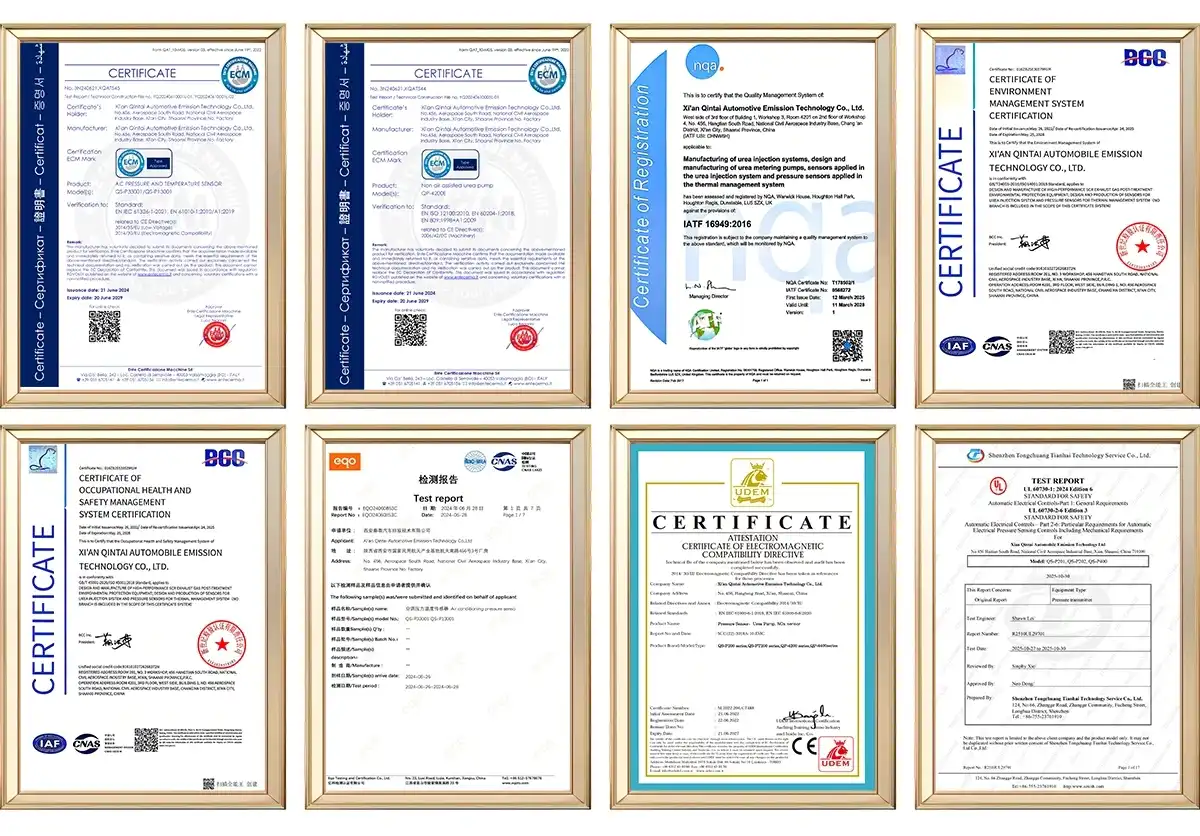
Xi'an Qintai Automotive Emission Technology Co., Ltd has supplied diesel engine aftertreatment and pressure sensing components since 2001. As a core OEM supplier to Weichai Power, Yuchai Power, and Quanchai Power — holding the top market share position in China — Qintai holds ISO 9001, IATF 16949, CE, UL, Ex, and RoHS certifications, and has filed 58 invention patents. Products reach customers in more than 60 countries, including across Europe, the Middle East, and the Americas.
Integrating Thin Film Pressure Sensors into Automation Systems: Best Practices
Installation and Initial Verification
When you mount the sensor, make sure that there are no air holes in the pressure port. This will make sure that it works right. Tighten the bolts to the level that the manufacturer says is right. If you put too much force on a stainless steel hex body, it may stop working. When you are done setting it up, use a known reference pressure and compare the reading to the certificate of calibration. If the reading goes outside the range shown for accuracy, it means that either the connection is broken or the diaphragm isn't working right.
Ongoing Calibration and Data Validation
Set up a measure that can be used to check anything in real time. Keep track of both the sensor output and the temperature data so you can tell the difference between long-term drift and real changes in the process. As a part of the emissions compliance audit trail, Euro VI cars that use SCR backpressure tracking may need to show calibration records.
Trends Shaping Future Sensor Deployments
If the OEM partner you choose spends money on research and development (R&D) instead of just repackaging common parts, you won't have to rethink the sensors for these changes. Instead, the automation platform will be ready for them.
Conclusion
Choosing the right pressure sensor element can affect how well emissions are controlled, how long the equipment works, and how much it costs in total over its lifetime. Engine OEMs, SCR system integrators, aftermarket distributors, and generator set builders can all use sputtered thin film technology because it works well, doesn't move around much, and lasts a long time. When scientific needs are matched with a qualified, high-volume maker, qualification times are cut down and supply risks are reduced. It has been 20 years since Qintai became an expert in diesel aftertreatment sensing. It is a good partner to think about early on in the sourcing process because of its global certification portfolio and OEM/ODM service model. This makes Qintai a strong candidate when selecting a thin film pressure sensor for diesel aftertreatment applications.
FAQ
How does a sputtered thin film sensor differ from a piezoresistive sensor?
A piezoresistive sensor typically bonds silicon elements with adhesive or uses oil-filled cavities. A sputtered film sensor deposits the sensing material directly onto stainless steel at the atomic level, removing the adhesive layer entirely. This eliminates creep, improves high-temperature stability, and removes leakage paths from O-ring seals.
What customization options does an OEM supplier typically offer?
Standard customization covers pressure range, output signal type (analog voltage, 4–20 mA, digital), connector format, thread size, and IP sealing level. Some suppliers also adjust the diaphragm alloy grade for compatibility with specific process media, and provide application-specific calibration offsets.
What lead times should I expect for bulk OEM orders?
Standard catalog variants typically ship within two to four weeks for moderate volumes. Custom configurations — involving new connector tooling or special calibration ranges — generally require eight to twelve weeks for the first production batch. Confirm these timelines and safety stock policies before signing a supply agreement.
Are Qintai sensors compliant with Euro VI and China VI emission standards?
Yes. Qintai holds IATF 16949 and CMC certifications, and its products are qualified as core OEM components for major China VI-certified engine manufacturers including Weichai and Yuchai.
Partner with Qintai for Your Thin Film Pressure Sensor Supply
Qintai has high-volume thin film pressure sensor systems that are approved. They have been in the diesel aftertreatment business for more than 20 years and have a marketing network that covers more than 60 countries around the world. It doesn't matter if you need standard catalog parts or a completely custom thin film pressure sensor supplier arrangement for a new engine platform. Our team is ready to talk about specs, samples, and prices. Send us an email at info@qt-sensor.com right away to get a price.
References
1. Fraden, J. Handbook of Modern Sensors: Physics, Designs, and Applications. Springer, 2016.
2. Madou, M. J. Fundamentals of Microfabrication and Nanotechnology. CRC Press, 2011.
3. Hauptmann, P. Sensors: Principles and Applications. Prentice Hall, 1993.
4. Wilson, J. S. (Ed.). Sensor Technology Handbook. Elsevier/Newnes, 2005.
5. IEEE Transactions on Industrial Electronics — Special Issue on Industrial Sensor Systems. IEEE, 2020.
6. SAE International Journal of Engines — Advances in Diesel Aftertreatment Sensing and Control. SAE International, 2022.

Our customers’ satisfaction speaks for our quality — contact us to experience the same reliable service.