- English
- French
- German
- Portuguese
- Spanish
- Russian
- Japanese
- Korean
- Arabic
- Greek
- German
- Turkish
- Italian
- Danish
- Romanian
- Indonesian
- Czech
- Afrikaans
- Swedish
- Polish
- Basque
- Catalan
- Esperanto
- Hindi
- Lao
- Albanian
- Amharic
- Armenian
- Azerbaijani
- Belarusian
- Bengali
- Bosnian
- Bulgarian
- Cebuano
- Chichewa
- Corsican
- Croatian
- Dutch
- Estonian
- Filipino
- Finnish
- Frisian
- Galician
- Georgian
- Gujarati
- Haitian
- Hausa
- Hawaiian
- Hebrew
- Hmong
- Hungarian
- Icelandic
- Igbo
- Javanese
- Kannada
- Kazakh
- Khmer
- Kurdish
- Kyrgyz
- Latin
- Latvian
- Lithuanian
- Luxembou..
- Macedonian
- Malagasy
- Malay
- Malayalam
- Maltese
- Maori
- Marathi
- Mongolian
- Burmese
- Nepali
- Norwegian
- Pashto
- Persian
- Punjabi
- Serbian
- Sesotho
- Sinhala
- Slovak
- Slovenian
- Somali
- Samoan
- Scots Gaelic
- Shona
- Sindhi
- Sundanese
- Swahili
- Tajik
- Tamil
- Telugu
- Thai
- Ukrainian
- Urdu
- Uzbek
- Vietnamese
- Welsh
- Xhosa
- Yiddish
- Yoruba
- Zulu
Pressure Transmitter vs Pressure Switch: Which Is Best for HVAC?
A pressure transmitter is better for most HVAC systems that need to measure continuously, connect to a building management system, control speeds in a range, or collect trend data. For simple ON/OFF protection, like cutting off the compressor when the pressure gets too high or too low, a pressure switch is better. There is no clear winner among the two. A pressure transmitter sends out the whole pressure curve, while a switch only works at a certain set point. I suggest using both on important pieces of equipment like chillers and refrigeration plants. After that, the controller sees real-time data, and a separate safety circuit stays in place. This book tells you how to make a choice.
How Pressure Transmitters and Pressure Switches Work
What a Pressure Transmitter Does
A pressure transmitter has a sensor and electronics that turn pressure into a signal that is proportional to the pressure. Some of the most common outputs are 0–10 V, 4–20 mA, HART, and Modbus. Piezoresistive, capacitive, and thin-film strain gage designs are common ways to sense things. When the temperature of the coil, suction, or water changes, temperature compensation keeps the readings the same.
There is a use for the 4–20 mA signal. A reading close to 0 mA means that a wire is broken or the power went out, not that the pressure is low. On top of this idea, NAMUR NE 43 sets up signal ranges that show when something isn't working. The value is then read by a controller or building management system (BMS), which will then do something with it.
What a Pressure Switch Does
A pressure switch does not have to do as much. If the pressure gets to a certain level, a diaphragm, piston, or electronic sensor will move a contact. Different control circuits can use versions that are normally open or normally closed. The reset differential, also known as hysteresis, is the distance between the trip point and the reset point. It keeps the machine from cycling quickly around the set point.
A normal switch in HVAC opens the compressor contactor circuit when the discharge pressure goes up too high or the suction pressure goes down too low. Since there are only two states for the output, it doesn't show how close the system was to the limit. It only does one thing and doesn't need any software to do it.
Continuous Data Versus Binary Action
The type of data that each device sends is what makes them different in real life. There is a stream of values from a pressure transmitter. As the temperature rises in the afternoon, an engineer can see the head pressure go up. If the suction pressure drops, they can see a slow refrigerant leak and tune the pump.
A pressure switch only has two options: it either trips or it doesn't. A transmitter is like a gage that can talk to the controller, and a switch is like a wire that can trip. Both have a place in HVAC design. If the job is to understand the system or stop it quickly, the right choice will depend on that.
Pressure Transmitter vs Pressure Switch for HVAC Applications
Where a Pressure Transmitter Fits
Senders are useful for any job that needs a number. Common examples include checking the pressure of chilled water, controlling the differential pressure for variable-speed pumps, checking the static pressure in ducts for variable air volume systems, diagnosing refrigeration problems, and analyzing compressors. They are also used in predictive maintenance programs because a slow drop in pressure is often a sign that a problem is starting to form.
ASHRAE Guideline 36 talks about steps like duct static pressure reset and differential pressure reset. The pressure transmitter provides the continuous measurement signal here. The controller needs to see small changes in order to change the speed of the fan or pump, so these sequences only work with continuous measurement. That signal can't come from a switch.
Where a Pressure Switch Fits
Switches are still the most common way to protect things. High- and low-pressure compressor shut-off, refrigeration safety shutdown, fan or pump staging, dirty-filter alarms, and basic overpressure protection are all common uses. It is easier to set them up, costs less, and the wires go straight into a control circuit.
Pressure-limiting and relief protection in refrigeration systems are talked about in ASHRAE Standard 15. Because of this, designers often write down a separate safety device that doesn't need a controller program. In that case, a pressure switch works well because it doesn't depend on firmware, network links, or scaling settings to do its job.
When Both Devices Belong Together
Most of the time, both devices are used on the same circuit in critical installations. The transmitter sends operational data all the time for alarms and control. The separate switch gives you an extra safety path.
This layout works well in data centers, commercial chillers, industrial refrigeration, and other large buildings where downtime costs a lot. The switch will still trip and protect the compressor even if a transmitter fails, a cable breaks, or a controller gets stuck. If the switch trips, the history of the transmitter data helps the technician figure out what went wrong more quickly. The second device doesn't cost much more than the first one, but a broken compressor does.

Technical Comparison and Trade-Offs
Accuracy, Output, and Response
Transmitters are graded on how accurate they are, which is usually given as a percentage of span. They send a proportional signal that can be read by PLCs, BMS platforms, variable-frequency drives, and monitoring systems that are far away. For fast-moving loops like pump control, response time is important, so look it up on the datasheet.
People judge switches in different ways. Setpoint repeatability, hysteresis, reset differential, and contact reliability are the most important specs. A switch that always trips at the same level of pressure is better than one that has a fancy name on it. This is the rule I follow when I compare the two: I compare transmitters based on how well they measure, and I compare switches based on how well they switch.
Range, Ratings, and Environment
Range selection has an effect on both devices. For the pressure transmitter, pick a range that includes normal, maximum, and short-term pressures without going too far. If the range is too small, it could lead to overload. When the range is too big, the resolution is not as good. As an example, a system that normally reads 2 bar on a 0–10 bar transmitter only uses 20% of the span. This makes the percent-of-span error band look bigger.
Compare the proof and burst pressure, the ability to work with vacuum, the ability to cycle pressure, the compatibility of the media, the temperature limits, the resistance to vibration, the protection against ingress, and the connection standard. Different types, like gage, absolute, and differential, are used for different kinds of measurements.
Strengths and Limits of Each Device
There are clear pros and cons for each device. Transmitters send data all the time, support proportional control, let you look at trends, and connect to modern automation. Their limits are that they cost more at first, need more work to be done to commission them, and need to be wired, grounded, scaled, and compatible with controllers correctly.
Switches are easy to set up, don't cost much, can be controlled directly, and provide useful independent protection. Their flaws are that you can't see the process very well, do diagnostics from afar, or log data. Contacts made of metal can also wear out over time. Which choice is best for your system depends on whether it needs basic security, advanced control, or both.
How to Choose the Best Pressure Device for HVAC
Define the Job and the Medium
Start with what it does. Do you need to measure, control, set alarms, protect the compressor, manage the pump or fan, shut down in an emergency, or collect BMS data? Next, choose the type of pressure (gauge, absolute, or differential) and the medium, which could be water, glycol, air, steam, or refrigerant.
Then make sure you know the required certifications, range, accuracy, output protocol, power supply, wiring, process connection, enclosure rating, temperature limits, and power supply. Each of these things cuts down the model list, so writing them down before you call a supplier saves time. Lastly, think about the unit price along with the cost over its whole life, calibration, warranty, documentation, lead time, and spare parts.
Match the Device to the Scenario
A pressure switch is usually the best way to go for a small commercial system that only needs to turn off the compressor when the pressure gets too high or too low. It's easy and cheap to do. For monitoring, BMS integration, pump control, and alarms, transmitters are usually helpful for large chillers and central plants. Switches can be added for extra protection.
Differential pressure transmitters are often needed for variable-speed hydronic systems to keep the flow steady. Media that is corrosive or contaminated may need resistant materials that are wet or flush diaphragms. For uses with steam and high temperatures, you might need remote seals or cooling systems. Standard connections, labeling, packaging, and customization should all be planned for from the start in OEM projects.
Plan Installation and Calibration
The accuracy of measurements is kept safe by good installation. Put a transmitter in a place where the pressure shows what the system is really like. Protect it from water hammer, vibration, unsupported tubing, and heat stress. Check the power supply, signal scaling, wiring polarity, and grounding. Check the setpoints, reset differentials, and contact ratings for switches.
For transmitters that work with 4–20 mA, you should calibrate zero, span, and a few points across the operating range. Then, write down the results. Impulse lines that are blocked, signals that aren't stable, zero drift, wrong scaling, electrical interference, contact failure, setpoint drift, and connection leaks are all common faults. Most of them are stopped by a short checklist at commissioning.
Procurement Checklist and Qintai Pressure Transmitter Options
Write a Complete Specification
Clear specifications for the pressure transmitter cut down on mistakes and speed up the quote process. Write down the type of pressure, its range, its ability to handle overload, its accuracy or repeatability, the process medium, the temperature range, the output signal or contact arrangement, the process connection, the rating of the enclosure, the need for calibration, and any certifications that are needed.
Include the use, amount, location, controller interface, wet materials, connector type, and display requirements. Labeling and packaging needs should be included for OEM orders. IEC 60770 lists ways to test the performance of transmitters, so you can ask suppliers what test methods they use. The more information you give, the less changes you will have to make later.
Evaluate the Supplier
A good supplier should have experience in the field, a documented quality system, clear test procedures, and technical support. What should you ask about the production capacity, lead time, warranty, spare parts, and packaging for export?
Before you give your approval, you should ask for datasheets, drawings, test reports, calibration certificates, sample prices, bulk prices, and a confirmed production schedule. Your technical team can use these to decide if something fits, and your purchasing team can use them to compare prices. Then, management can approve the supplier based on facts instead of promises. For repeat orders, long-term stability and quick help are just as important as unit price.
What Qintai Brings to Your Project
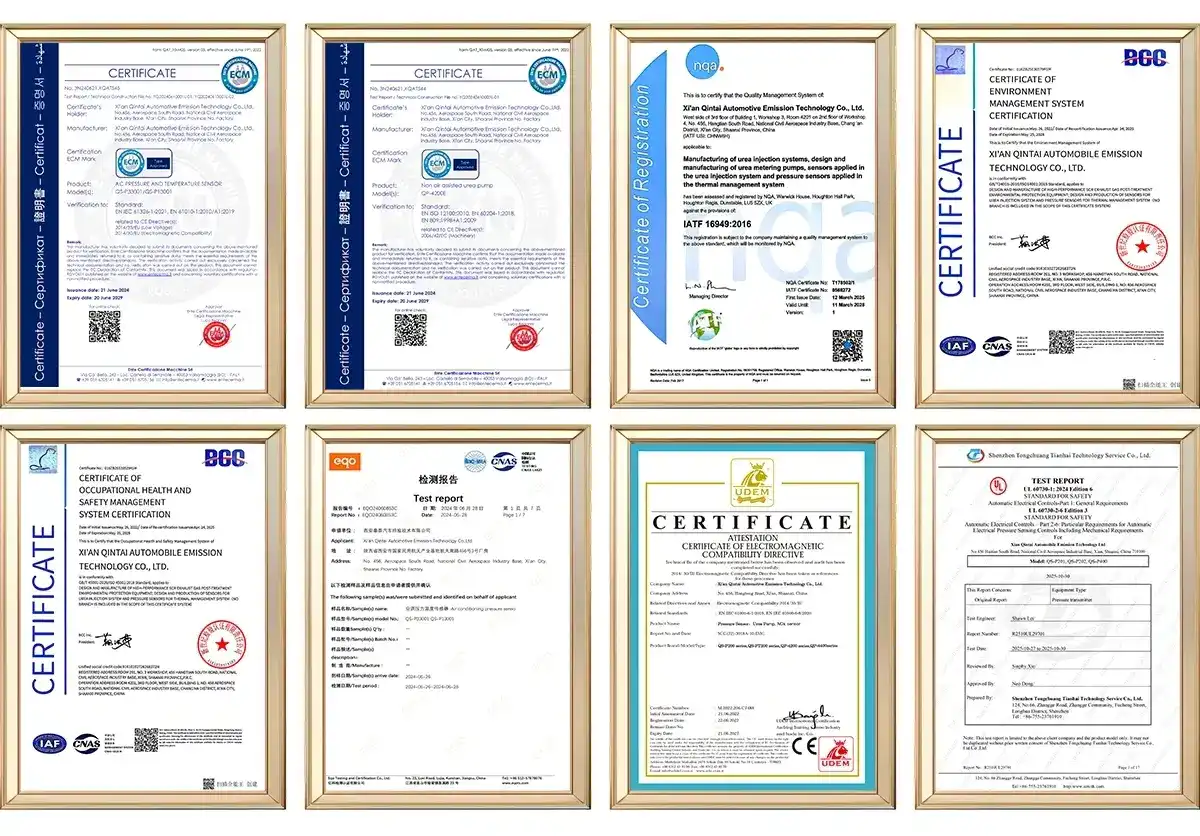
Qintai Automotive Emission Technology Co., Ltd. Ltd. is a national high-tech company that was started in 2001. Mostly pressure sensors, it designs and makes diesel engine SCR aftertreatment systems and other types of sensors. It has ISO9001, IATF16949, CMC, Ex, UL, CE, REACH, and RoHS certifications, and it has also put in for 58 invention patents.
Weichai Power, Yuchai Power, and Quanchai Power all get most of their power from Qintai. The company also sells power in more than 60 countries and areas. It provides OEM and ODM services and lets you make changes based on the application. Let us know the range, medium, output signal, and connection for the pressure transmitter that you need for your HVAC project. They will look at the fit with you.
Conclusion
In an HVAC system, a pressure transmitter and a pressure switch do different things. For monitoring, BMS integration, variable-speed control, and trend analysis, the transmitter sends out continuous, proportional data. The switch only costs a little more and works in a simple, direct way to protect you. It was found that transmitters are judged on their accuracy, output, and range selection, while switches are judged on their repeatability, hysteresis, and the reliability of their contacts.
A switch can often be used for small systems that only need to be turned off. Large chillers, central plants, and hydronic loops with variable speeds usually need transmitters. Switches are kept as a separate safety path. As important as the type of device is the correct range, media compatibility, installation, and calibration. A full specification helps you make a good supplier decision.
FAQ
Is a pressure transmitter better than a pressure switch for HVAC?
In some situations, neither is better than the other. For continuous monitoring and control, a transmitter works best, while for threshold protection, a switch works best. Both are often used in critical systems.
Can a pressure transmitter replace a safety switch?
Not all the time. A controller and its program are what make a transmitter alarm work. Before you use an independent switch, make sure you know what the system needs and what the local rules are.
Which output signal should I choose?
The 4–20 mA signal is good for finding faults and running long cable runs because it has a live zero. A signal of 0 to 10 V works well for short runs inside panels. Certain types of control architectures work with HART and Modbus. Connect the signal to the input on your controller.
How often should I calibrate?
The interval should be set based on how important the system is, how it is being used, manufacturer instructions, and past drift. Keep track of each result so you can see patterns.
Request a Pressure Transmitter Quote from Qintai
Customization, independent research and development, and certifications like ISO9001, IATF16949, CE, and RoHS are some of the things that Qintai offers to help OEM and ODM projects. Send your needs to info@qt-sensor.com if you need a pressure transmitter supplier who can talk about your range, medium, output signal, and quantity. You can find out more about the product at qt-sensor.com. Our team will get back to you with technical information so you can feel good about comparing your options.
References
1. ASHRAE Standard 15, Safety Standard for Refrigeration Systems, 2022
2. ASHRAE Guideline 36, High-Performance Sequences of Operation for HVAC Systems, 2021
3. ASHRAE Handbook: HVAC Systems and Equipment, 2024
4. NAMUR NE 43, Standardization of the Signal Level for the Failure Information of Digital Transmitters, 2003
5. IEC 60770-1, Transmitters for Use in Industrial-Process Control Systems, Part 1: Methods for Performance Evaluation, 2010
6. Instrument Engineers' Handbook, Volume 1: Process Measurement and Analysis, 2003



Our customers’ satisfaction speaks for our quality — contact us to experience the same reliable service.