- English
- French
- German
- Portuguese
- Spanish
- Russian
- Japanese
- Korean
- Arabic
- Greek
- German
- Turkish
- Italian
- Danish
- Romanian
- Indonesian
- Czech
- Afrikaans
- Swedish
- Polish
- Basque
- Catalan
- Esperanto
- Hindi
- Lao
- Albanian
- Amharic
- Armenian
- Azerbaijani
- Belarusian
- Bengali
- Bosnian
- Bulgarian
- Cebuano
- Chichewa
- Corsican
- Croatian
- Dutch
- Estonian
- Filipino
- Finnish
- Frisian
- Galician
- Georgian
- Gujarati
- Haitian
- Hausa
- Hawaiian
- Hebrew
- Hmong
- Hungarian
- Icelandic
- Igbo
- Javanese
- Kannada
- Kazakh
- Khmer
- Kurdish
- Kyrgyz
- Latin
- Latvian
- Lithuanian
- Luxembou..
- Macedonian
- Malagasy
- Malay
- Malayalam
- Maltese
- Maori
- Marathi
- Mongolian
- Burmese
- Nepali
- Norwegian
- Pashto
- Persian
- Punjabi
- Serbian
- Sesotho
- Sinhala
- Slovak
- Slovenian
- Somali
- Samoan
- Scots Gaelic
- Shona
- Sindhi
- Sundanese
- Swahili
- Tajik
- Tamil
- Telugu
- Thai
- Ukrainian
- Urdu
- Uzbek
- Vietnamese
- Welsh
- Xhosa
- Yiddish
- Yoruba
- Zulu
Top Nox Sensor Benefits for Fleet Emissions Compliance and Uptime
The amount of nitrogen oxide in diesel exhaust is sent to the engine control unit by a Nox sensor. This helps the fleet stay on the road and follow the rules. The SCR system adds the right amount of diesel exhaust fluid (DEF) when readings are correct. This helps find problems faster so trucks don't have to stop for repairs that would cause deliveries to be late. The main benefits are clean air, more uptime, faster diagnosis, less DEF waste, better preventive maintenance, easier fleet standardization, and more stable procurement. In this guide, I explain how each benefit works, what you should check before you buy, and how Qintai helps buyers in OEM, integrator, and aftermarket.
Why NOx Sensors Matter to Modern Fleets
What a NOx Sensor Measures
A NOx sensor, a high-temperature exhaust sensor, is used to measure the amount of nitrogen oxide in diesel exhaust. There is an oxygen-ion conductor inside the zirconia ceramic cell that makes it work. An oxygen pump cell is the first thing that sets the amount of oxygen in a measuring chamber. The sensing cell then breaks up the NOx and pushes the oxygen ions out of the cell.
This makes a current that is linked to the amount of NOx. Something warm keeps the element at the right temperature, and a computer sends the message to the engine control unit. Because of how it's made, the sensor can report NOx in parts per million. This tells the SCR system a lot more than just whether the signal is pass or fail.
Upstream and Downstream Roles
SCR trucks often feature two sensors. This sensor before the SCR catalyst transmits engine NOx data. The controller uses this to determine DEF use. The sensor down the line measures NOx exiting the tailpipe after the catalyst. Similar to a report card. Techs should check the service information or VIN before ordering since every engine and automobile is different. Too much DEF may create a false high since the sensor can also detect ammonia. This is one reason to diagnose the overall system.
Why Regulations Raise the Stakes
In 2010, the US EPA banned heavy-duty NOx over 0.2 g/hp-hr. For engines built after 2027, the agency's 2023 final regulation reduces the restriction to 0.035 g/hp-hr. More than 80% down. The regulation also extends warranty and useful-life requirements. 2021 saw California enact the Heavy-Duty Inspection and Maintenance regulation. This regulation checks truck emissions control data in the state. Due to tougher requirements and audits, fleets need reliable NOx data. China VI and Euro VI are stressing OEMs and integrators worldwide. Because heavy-duty engine SCR systems require precise NOx feedback.
Seven NOx Sensor Benefits for Compliance and Uptime
1. Emissions Compliance Support
Follow-through is its first benefit. The controller checks NOx to ensure the SCR system cuts emissions properly. Fault codes, DEF injection, stops, and failed inspections may result from faulty sensors. The chain also includes the SCR catalyst, DEF system, temperature sensors, wiring, and ECU. Check the model-year fit, connection design, communication protocol, and manufacturing history before buying. Buyers who intend to sell in many markets should know whether the engine program meets EPA, China VI, or Euro VI standards.
2. Higher Fleet Uptime
If a NOx sensor fails, a check engine light, DEF warning, torque restriction, or speed limit may appear. If these things happen, the vehicle may not drive. Signs include illogical readings, communication issues, reduced power, and greater DEF consumption. Knowing how to diagnose a sensor makes it cheaper to replace it than to repair it on the road and miss delivery. Make a list of the most common failures and get the part numbers. Select vendors with clear lead times, documentation, and warranty support. By maintaining a consistent signal, customers may avoid frequent store visits.
3. Faster, More Accurate Diagnostics
A good NOx measurement helps limit a warning search. Techs may compare upstream and downstream measurements to system expectations. This allows fault codes, live data, harness and connection inspections, and power/communication testing. Before they claim the sensor is faulty, there may be additional issues. It might be exhaust leaks, poor DEF, damaged wiring, or ECU difficulties. This sequence prevents several switches, saving time. A reliable sensor signal helps also. It's easy to compare readings to expectations. When a trouble code is unusual, their technical staff can speed things up.
4. Lower DEF Waste and Operating Cost
The amount of DEF given is based on the NOx readings. ISO 22241 says that DEF is a urea solution that has about 32.5% urea in it. Either too much DEF is added, which wastes fluid and can push ammonia into the exhaust, or not enough is added, which lets NOx pass. It costs a lot of money to have extra fluid, diagnostic work, SCR parts that aren't needed, emergency freight, and downtime. Don't just look at the price per unit when you compare sensors. You should also check the delivery, service life, failure rate, and time it takes to set up. A cheap part that breaks twice costs more than one that lasts.
5. Stronger Preventive Maintenance
What makes a sensor last longer? The temperature of the exhaust, dirt, vibration, moisture, the duty cycle, the condition of the wiring, and how well it was installed are all factors. Remember that not every engine needs to be replaced at the same time, so look at both the diagnostic results and what the manufacturer says. Things can lose their usefulness over time if they get too hot, have exhaust leaks, DEF crystallize, get contaminated with oil or coolant, rust, or have bad cable routing.
You can find patterns by keeping a simple log of the miles driven, hours worked, fault codes, replacement dates, and supplier batches. People who work for Qintai say that the service life is up to 6000 hours. This helps them figure out when to replace things. There are two checks: one before the replacement and one after. These checks find problems before they happen again.
6. Easier Standardization Across Platforms
Trucks, busses, and other vehicles in mixed fleets may have engines from different families, so each one needs its own set of part numbers. The standard application sheet should have space for the car's make and model, as well as the engine family, model year, emissions standard, sensor position, original part number, connector, cable configuration, and sensor position. Different types of parts can work, such as OEM parts, OE-equivalent parts, and qualified aftermarket sensors.
However, a part that seems like it will fit all vehicles may not. You shouldn't just compare brands by name; you should also look at the verified part number, the calibration, the communication, the design of the connector, and the list of approved uses. You can pick the connectors and cable lengths that work with your products with Qintai. Its customers can also use it with popular OEM products because it looks and works the same.
7. More Dependable Procurement
A good supplier for the NOx sensor gives you more than just stock. Questions should be asked about how accurate the application is, how the goods will be packaged, how they will be shipped overseas, and how quality control is handled during production. Before you place a large order, make sure you have catalogs, cross-reference data, samples, test reports, minimum order quantities, lead times, and private-label options. When you judge a low-cost offer, you should think about the total cost of ownership, which includes returns, labor, and downtime.
For aftermarket buyers, having stock on hand and how easy it is to install are important. For OEMs, on the other hand, certifications and being able to make a lot of units are important. For programs that work with more than one generation of cars, the most important things are a sure fit and a steady supply. Ask each supplier to write these things down before the first order.

How to Choose, Install, and Maintain a NOx Sensor
Selection Checklist
To start, you need to find out what kind of car it is by its make, model, engine, model year, VIN, emissions standard, original part number, and where it is located (upstream or downstream). Next, check the size of the cable, the mounting thread, the temperature range, the communication protocol, whether it works with the ECU, and whether it needs to be calibrated. To find out how good the supplier is, look at how they inspect, what certifications they have, how long their warranties are, how they help with technical issues, how they package their products, and how they deliver them.
Last but not least, check out the price, freight, labor, downtime, returns, and expected service life. These are all parts of the total cost of ownership. I also think you should test it on the target platform before the full release. This step helps integrators and OEM engineers the most because it finds interface issues early on.
Installation and Verification
Give the exhaust some time to cool down after work. Check the mounting area, put the new sensor next to the old one, and tighten until the right amount of torque is reached. Keep the cable away from things that are hot, moving parts, and edges that are sharp. Next, look at the wiring to see if there is chafing, corrosion, insulation that has melted, loose terminals, or water getting in. After being replaced, some cars need to have their learned values reset or changed.
Make sure the live data and codes are correct before clearing faults. This is also the time to finish the required road test. The sensor is better protected from water because it is sealed and waterproof, but it is still important to have the right routing. Follow the steps in the service manual that came with the car.
Common Mistakes to Avoid
Many times, people buy something based only on price, match only the connector, believe that upstream and downstream sensors are the same, or replace the sensor without checking to see why it broke. The same kinds of problems can be caused by exhaust leaks, DEF contamination, wiring damage, temperature sensor faults, and SCR issues. You also need to use the wrong torque, route the cables badly, and fail to protect them from heat well if you want it to fail early.
You should keep track of the part number, details about the car, fault codes, test results, installation date, and supplier batch for the NOx sensor. They help you figure out what went wrong, get your money back from the warranty, and buy things this time next year. You can also show a supplier what really happened with them. A shared spreadsheet is all you need to get started.
Qintai NOx Sensor Features and Specifications
Core Performance Features
The Qintai NOx sensor for diesel applications offers the following main advantages:.
- Fast response and startup: Response time is under 1400 ms, measured from 33% to 66% of final value, so the SCR system reacts quickly to changing exhaust conditions. Light-off time is listed at under 165 seconds, and Qintai positions its startup as much shorter than the industry's 165 seconds, which helps cut cold-start emissions.
- Long life and poisoning resistance: Service life reaches up to 6000 hours, higher than the industry standard, which means fewer replacements and lower maintenance cost for your fleet. The sensor also resists lead and sulfide poisoning better than ordinary options, so it keeps its accuracy longer in diesel exhaust that carries contaminants.
- Sealed design and flexible integration: A sealed waterproof design supports stable signal output. Connectors and cable lengths can be customized, various software and 300+ communication protocols are available, and the appearance and customer interface can be compatible with mainstream OEM products. This reduces redesign work for integrators and simplifies stocking for aftermarket buyers.
Things that often go wrong with fleets and suppliers are slow response, short life, and bad fit. These benefits take care of these problems.
Technical Specifications
Most of the time, engineers ask for numbers first. The table shows the information that has been made public about the Qintai sensor.
| Parameter | Specification |
|---|---|
| NOx measuring range | 0–2500 ppm |
| O2 measuring range | 0%–21% |
| NOx accuracy | ±10 ppm (0–100 ppm); ±10% (100–500 ppm); ±15% (500–1500 ppm); ±30% (1500–2500 ppm) |
| O2 accuracy | ±0.2% (0%–5%); ±4% (5%–21%) |
| Response time | <1400 ms (33% to 66% of final value) |
| Supply voltage | 9–32 V |
| Light-off time | <165 s |
| Operating temperature (NOx) | 100°C to 800°C |
| Emission gas temperature | -40°C to 800°C |
| Cable temperature range | -40°C to 200°C |
| Sensor mounting thread | M20×1.5 |
You can connect both 12 V and 24 V systems, which are used in many commercial vehicles, between 9 V and 32 V. Please make sure that our team knows the exact part number and interface for your platform before you place your order.
Company Background and OEM Experience
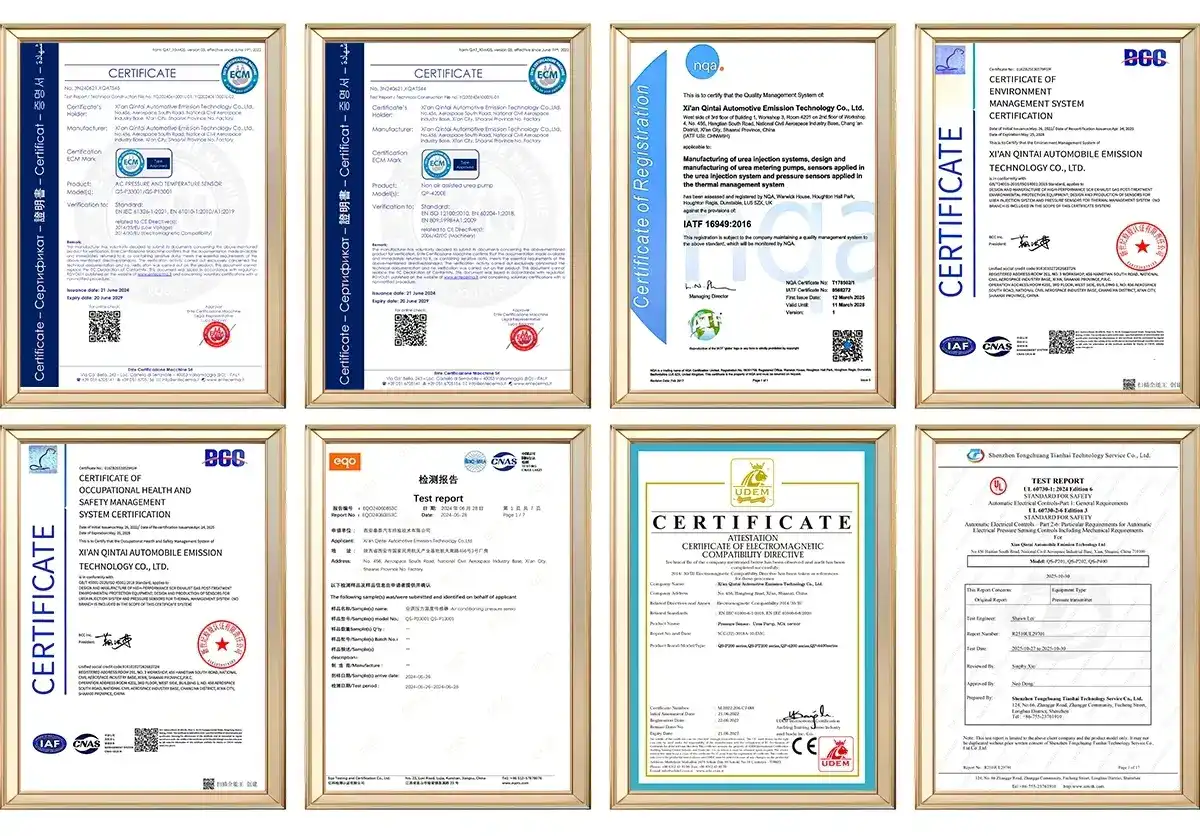
It is called Qintai Automotive Emission Technology Co., Ltd. Ltd is a national tech company that has been around since 2001. We design, make, sell, and provide service for sensors and other items used in diesel engines with SCR aftertreatment. Pressure sensors are a big part of what we do. We are certified by ISO9001, IATF16949, CMC, Ex, UL, CE, REACH, and RoHS, and we have applied for 58 invention patents.
There is a separate R&D team that works on improving things all the time. Weukai Power, Yuchai Power, and Quanchai Power all buy from us, so we have the biggest share of the China market. And we sell in more than 60 countries and regions. As part of our OEM and ODM services, we design products and make a lot of them. You can also change them in any way you like.
Conclusion
Because it gives the engine control unit the information it needs to control SCR and DEF dosing, the accuracy of a NOx sensor affects compliance, uptime, diagnostics, and operating costs. For these seven benefits to work, you need to have correct application data, careful installation, and records that show how things fail most of the time. It is more important for fleets and engine programs to have correct NOx data in the U.S. because of stricter rules, such as the 2027 heavy-duty standard, and inspection programs, such as California's.
Price isn't the only thing buyers should think about. For the NOx sensor, they should also think about how well the sensors fit, how fast they respond, how long they last, how well they keep pets from getting poisoned, how well they are covered, and how much the whole system costs. If you think you have a bad sensor, you should get it checked out first to make sure it's not something else.
FAQ
What does a NOx sensor do in a diesel truck?
N2O is checked in the exhaust, and a report is sent to the ECU. Sensors further down the line check how well the SCR is working and control how much DEF is added. With out this feedback, the system can't change DEF to match the output of the engine.
Can upstream and downstream sensors be swapped?
No, most of the time. It's possible for the calibration or connectors to be off, and the ECU needs a signal from a certain spot. If you use the wrong position, fault codes can be set off. First, make sure you have the part number and application data that came with the item.
How long does a NOx sensor last?
Every engine can't use the same time between checks. The product can last up to 6000 hours, but in practice, it depends on the temperature, the amount of dust and dirt on it, and how well it was put in place. Figure out when to replace the car by looking at the mileage and fault codes.
Is calibration needed after replacement?
Some vehicles need to change how they work or reset the values they have learned. Follow the service manual to fix your car. First, make sure there aren't problems with the DEF, wiring, exhaust, SCR, or ECU, as their symptoms can be the same.
Request a Nox Sensor Quote from Qintai
Qintai makes Nox sensors and is ready to work with OEM, integrator, distributor, and fleet programs. Send info@qt-sensor.com about your car or engine, the connectors you need, the length of the cable you want, and how much data you send each year, and our team will get back to you about whether or not it will work. At qt-sensor.com, you can also see all of our products. We'll help you find a sensor that works for what you want to do.
References
1. U.S. Environmental Protection Agency, Control of Air Pollution From New Motor Vehicles: Heavy-Duty Engine and Vehicle Standards, Federal Register, 2023.
2. California Air Resources Board, Heavy-Duty Inspection and Maintenance Regulation, 2021.
3. Johnson, T. V., Review of Diesel Emissions and Control, International Journal of Engine Research, 2009.
4. Moos, R., A Brief Overview on Automotive Exhaust Gas Sensors Based on Electroceramics, International Journal of Applied Ceramic Technology, 2005.
5. Kato, N. et al., Performance of Thick Film NOx Sensor on Diesel and Gasoline Engines, SAE International, 1997.
6. International Organization for Standardization, ISO 22241-1: Diesel Engines — NOx Reduction Agent AUS 32 — Part 1: Quality Requirements, 2019.

Our customers’ satisfaction speaks for our quality — contact us to experience the same reliable service.