- English
- French
- German
- Portuguese
- Spanish
- Russian
- Japanese
- Korean
- Arabic
- Greek
- German
- Turkish
- Italian
- Danish
- Romanian
- Indonesian
- Czech
- Afrikaans
- Swedish
- Polish
- Basque
- Catalan
- Esperanto
- Hindi
- Lao
- Albanian
- Amharic
- Armenian
- Azerbaijani
- Belarusian
- Bengali
- Bosnian
- Bulgarian
- Cebuano
- Chichewa
- Corsican
- Croatian
- Dutch
- Estonian
- Filipino
- Finnish
- Frisian
- Galician
- Georgian
- Gujarati
- Haitian
- Hausa
- Hawaiian
- Hebrew
- Hmong
- Hungarian
- Icelandic
- Igbo
- Javanese
- Kannada
- Kazakh
- Khmer
- Kurdish
- Kyrgyz
- Latin
- Latvian
- Lithuanian
- Luxembou..
- Macedonian
- Malagasy
- Malay
- Malayalam
- Maltese
- Maori
- Marathi
- Mongolian
- Burmese
- Nepali
- Norwegian
- Pashto
- Persian
- Punjabi
- Serbian
- Sesotho
- Sinhala
- Slovak
- Slovenian
- Somali
- Samoan
- Scots Gaelic
- Shona
- Sindhi
- Sundanese
- Swahili
- Tajik
- Tamil
- Telugu
- Thai
- Ukrainian
- Urdu
- Uzbek
- Vietnamese
- Welsh
- Xhosa
- Yiddish
- Yoruba
- Zulu
Smart Pressure Monitoring Device vs Traditional Gauges: A Guide
When evaluating pressure measurement solutions for diesel engines, SCR aftertreatment systems, or industrial generator sets, the choice between a smart pressure monitoring device and a traditional analog gauge carries real operational consequences. A smart pressure monitoring device integrates digital sensors, IoT connectivity, and real-time data transmission to deliver continuous, accurate readings — outperforming conventional mechanical gauges in precision, safety, and system compatibility. This guide breaks down both technologies to help procurement engineers and technical managers make well-informed decisions.
Understanding Pressure Monitoring Technologies
How Traditional Gauges Work
Traditional pressure gages use a Bourdon tube or diaphragm element, which physically changes shape when pressure is applied and moves a needle across an analog scale. They don't need a power source, which makes them useful in remote areas. But they don't log data, let you access them from afar, and aren't very accurate, especially when the temperature or vibration changes. These problems can cause measurements to drift and fault signals to be missed in heavy-duty diesel applications or exhaust aftertreatment systems.
How Smart Pressure Sensors Work
There are piezoresistive or capacitive sensing elements, signal-conditioning circuits, and digital output ports like CAN, RS485, 4–20mA, or PWM that are used in a smart pressure monitoring device. These gadgets send pressure readings in real time to an ECU, SCADA system, or fleet control platform. Differential pressure sensors constantly check the loading of particulate filters in diesel engine SCR/DPF aftertreatment systems, which is something that a mechanical gage can't do reliably. A study from 2022 by MarketsandMarkets says that the global market for pressure sensors will hit $14.8 billion by 2027. This will mostly be due to the growth of industrial IoT.
Comparison of Smart Pressure Monitoring Devices and Traditional Gauges
There are many more changes between these two systems than just the type of display. They change when to do repair, how well systems can work together, and how much things will cost in the long run.
Here is a straight comparison of the most important factors in the buying process:
- Accuracy and Repeatability: Smart sensors typically achieve ±0.5% full-scale accuracy or better, with built-in temperature compensation. Traditional gauges commonly carry ±1.5–2% accuracy and are susceptible to mechanical wear over time, causing calibration drift in high-vibration environments such as construction machinery or agricultural tractors.
- Data Integration: Smart devices output structured digital signals compatible with CAN bus, OBD-II, or Modbus protocols. This enables seamless integration with ECU dashboards, emission compliance systems, and cloud-based analytics platforms. Analog gauges provide no connectivity and require manual recording.
- Maintenance Burden: Traditional gauges require frequent physical inspection and periodic recalibration. Smart pressure sensors support remote diagnostics, reducing manual check intervals significantly and lowering total maintenance labor costs.
- Environmental Resilience: Industrial-grade smart sensors are rated to IP67 or IP69K, with operating temperature ranges from -40°C to +125°C — essential for mine-site generator sets or under-hood diesel engine applications.
These gaps in ability are not small. When OEM manufacturers have to follow China VI or Euro VI emission rules, choosing measurement tools that aren't accurate enough can directly lead to events that aren't compliant. Data from smart sensors gives regulators and quality auditors the paper trail they need.

Benefits and Use Cases of Smart Pressure Monitoring Devices
Manufacturers of heavy trucks, SCR integrators, and generator sets all find that smart pressure monitoring devices improve their operations in measurable ways. Business-to-business (B2B) buying and tech teams care most about these pros:
- Early Fault Detection: Continuous monitoring enables real-time alerts when pressure deviates from threshold ranges, allowing maintenance teams to intervene before a minor anomaly becomes a costly breakdown. In DPF systems, catching a differential pressure anomaly early can prevent full filter replacement.
- Remote Monitoring and Fleet-Level Visibility: Wireless-capable sensors feed data into fleet telematics platforms, giving fleet managers and service engineers a live view of pressure status across all assets without physical inspection.
- Scalability for Mass Production: For OEM purchasing managers sourcing components at volume, smart sensors with standardized digital outputs simplify integration across multiple engine platforms, reducing BOM complexity.
- Regulatory Compliance Support: Emission control systems on China VI and Euro VI engines require verified sensor data for onboard diagnostics (OBD). Smart pressure sensors provide the certified, traceable output that compliance documentation requires.
These skills add up to a meaningful return on investment (ROI). A study released in 2021 in the Journal of Manufacturing Science and Engineering found that intelligent sensor systems could help with predictive maintenance, which cut unexpected downtime in heavy industrial situations by up to 30%. This number is hard for purchasing departments to ignore when they are looking at the total cost of ownership.
Procurement Factors: How to Choose the Right Pressure Monitoring Device?
Key Selection Criteria
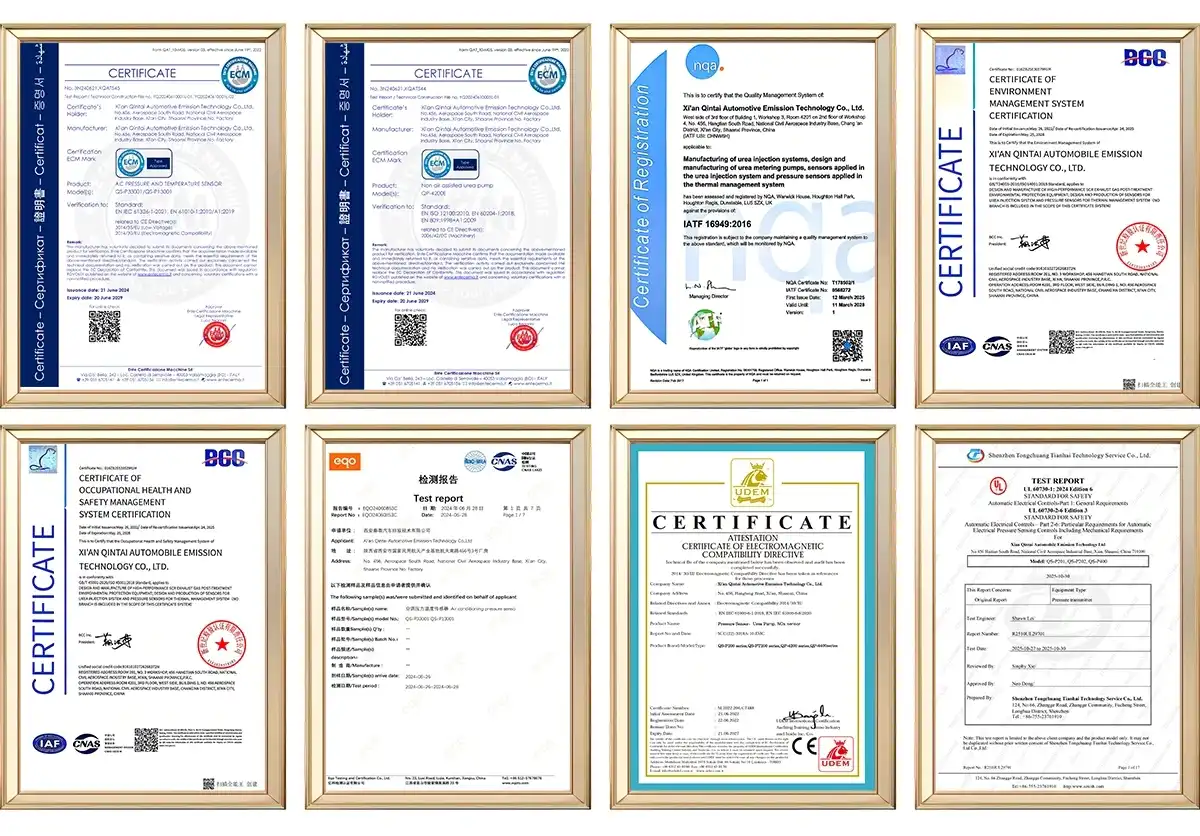
It's not enough to just compare prices per unit to find the right pressure monitor. Technical managers and people who work in the supply chain should check that the output signal works with the target ECU or control system, that the ingress protection rating is right for the working environment, and that the seller has a lot of different certifications, such as ISO 9001, IATF 16949, and CE marks.
Supplier Qualifications and After-Sales Support
When buying a smart pressure monitoring device in bulk from an OEM, the security of the seller is just as important as the product specifications. Check to see if your provider has any well-known quality certifications, provides OEM/ODM customization services, and has clear written guidelines for how to respond to customers after the sale. Check the minimum order quantity, lead times, and availability of in-stock items for quick replacements. This is a very important factor for aftermarket dealers and repair shops that have to deal with equipment breakdowns.
Total Cost of Ownership
A smart sensor costs more up front than a mechanical gage, but over time, the math usually works out better for digital solutions. Over a 5–10 year working period, the total cost of ownership goes down because of less manual inspection work, fewer unexpected shutdowns, and longer component lifespans.
Future Trends and Innovations in Pressure Monitoring
Because of Industry 4.0, things are changing quickly in the world of pressure tracking. AI-driven predictive analytics are being built right into the firmware of sensors, which lets them find problems at the edge without having to use a central server. The size of wireless MEMS (Micro-Electro-Mechanical Systems) devices is getting smaller while their sensitivity is getting higher. This is a trend that is good for small diesel engines and off-road equipment that needs to save room.
For procurement professionals, these changes mean that investments made today in smart infrastructure for monitoring pressure will still work with digital ecosystems of the future. If you choose suppliers who put money into research and development and have active patent portfolios, you can use new technology without having to replace the whole system.
Conclusion
The difference between smart pressure monitoring device and old-fashioned manual gages is not a matter of taste, but of how well they work. For OEM engineers working with diesel engines that have to follow emission rules, SCR/DPF installers needing accurate differential pressure data, or generator set workers working in remote industrial settings, smart sensors offer accuracy, connectivity, and durability that mechanical gages can't match. Picking the right tool and provider is the first step to running a stable, legal, and cost-effective business.
FAQ
Q1: What output signals do smart pressure sensors typically support?
A: A lot of industrial-grade smart pressure monitors can generate voltage, RS485, 4–20mA, or the CAN bus. Your ECU or control system protocol will tell you what the right output is. CAN bus output is most often used for diesel engine OEM applications that follow China VI or Euro VI standards because it can handle noise and work with multiple nodes.
Q2: How long do smart pressure sensors last in heavy-duty environments?
A: In harsh settings like building machinery, generator sets, and farm equipment, high-quality sensors rated to IP67 or higher, with wide temperature ranges and housings that don't vibrate easily usually last 5 to 10 years. Regular diagnostic checks through the digital interface help make sure that the sensors are still healthy without having to take them apart.
Q3: Are smart pressure monitoring devices compatible with existing industrial IoT platforms?
A: Most devices that use standard protocols, such as Modbus, CAN, or 4–20mA, can connect to common platforms for SCADA, telematics, and fleet management. Confirming compatibility should be a part of the technical proof you do with your supplier's engineering team before you buy something.
Q4: Can smart pressure sensors be customized for specific OEM applications?
A: Reliable suppliers offer OEM/ODM services that let you change the housing dimensions, output signals, connector types, and pressure ranges to fit the needs of a specific engine or system integration.
Partner with Qintai for Reliable Smart Pressure Monitoring Device Solutions
Qintai is a reliable company that has been in business since 2001 and has IATF 16949, ISO 9001, CE, and UL certifications. They sell smart pressure monitoring devices to OEMs in more than 60 countries. Qintai is China's top original equipment manufacturer (OEM) supplier for pressure sensors to Weichai Power and Yuchai Power. It offers flexible solutions, the ability to produce large quantities, and quick customer service after the sale. To talk about your buying needs, please contact our tech team at info@qt-sensor.com.
References
1. MarketsandMarkets. (2022). Pressure Sensor Market — Global Forecast to 2027. MarketsandMarkets Research.
2. Journal of Manufacturing Science and Engineering. (2021). Predictive Maintenance Strategies in Heavy Industrial Equipment. ASME Publications.
3. SAE International. (2020). Onboard Diagnostics Requirements for Heavy-Duty Diesel Engines Under Euro VI Regulation. SAE Technical Paper Series.
4. IEEE Sensors Journal. (2023). Advances in MEMS-Based Pressure Sensing for Automotive Applications. IEEE.
5. McKinsey & Company. (2022). Industry 4.0: How Smart Manufacturing Is Reshaping Industrial Operations. McKinsey Global Institute.
6. International Organization for Standardization. (2016). ISO 9001:2015 Quality Management Systems — Requirements. ISO Publications.


Our customers’ satisfaction speaks for our quality — contact us to experience the same reliable service.