- English
- French
- German
- Portuguese
- Spanish
- Russian
- Japanese
- Korean
- Arabic
- Greek
- German
- Turkish
- Italian
- Danish
- Romanian
- Indonesian
- Czech
- Afrikaans
- Swedish
- Polish
- Basque
- Catalan
- Esperanto
- Hindi
- Lao
- Albanian
- Amharic
- Armenian
- Azerbaijani
- Belarusian
- Bengali
- Bosnian
- Bulgarian
- Cebuano
- Chichewa
- Corsican
- Croatian
- Dutch
- Estonian
- Filipino
- Finnish
- Frisian
- Galician
- Georgian
- Gujarati
- Haitian
- Hausa
- Hawaiian
- Hebrew
- Hmong
- Hungarian
- Icelandic
- Igbo
- Javanese
- Kannada
- Kazakh
- Khmer
- Kurdish
- Kyrgyz
- Latin
- Latvian
- Lithuanian
- Luxembou..
- Macedonian
- Malagasy
- Malay
- Malayalam
- Maltese
- Maori
- Marathi
- Mongolian
- Burmese
- Nepali
- Norwegian
- Pashto
- Persian
- Punjabi
- Serbian
- Sesotho
- Sinhala
- Slovak
- Slovenian
- Somali
- Samoan
- Scots Gaelic
- Shona
- Sindhi
- Sundanese
- Swahili
- Tajik
- Tamil
- Telugu
- Thai
- Ukrainian
- Urdu
- Uzbek
- Vietnamese
- Welsh
- Xhosa
- Yiddish
- Yoruba
- Zulu
Thin Film Pressure Sensor Applications in Automotive Systems
Thin film pressure sensors have become a go-to measurement solution across modern automotive platforms. By depositing ultra-thin resistive layers directly onto a stainless steel diaphragm through sputtering, these sensors achieve pressure readings with accuracy as tight as ±0.5% full scale and response times under 10 milliseconds.
Because no adhesive or silicone oil fill is involved, the sensing element bonds at the atomic level, eliminating creep and leak risk. For diesel engine OEMs, SCR/DPF integrators, and aftermarket suppliers working under China VI or Euro VI emission rules, that combination of speed, accuracy, and chemical resistance makes these sensors a strong fit for demanding vehicle environments.
Understanding Thin Film Pressure Sensor Technology in Automotive Systems
How Sputtered Thin Films Work
In a sputtered thin film sensor, target atoms are physically ejected onto a stainless steel substrate inside a high-vacuum chamber. The resulting film bonds through atomic force rather than adhesive, so there is no organic layer to degrade over time. Typical film thickness sits between 0.3 mm and 0.45 mm. This construction lets the diaphragm deflect precisely under load while the resistive bridge converts that deflection into a stable electrical output.
Performance Advantages Over Conventional Sensors
Piezoresistive ceramic sensors rely on bonded chips and O-ring seals that can leak under vibration. Strain gauge sensors carry nonlinearity errors that grow at temperature extremes. Thin film technology eliminates both weaknesses. Laser resistance trimming after deposition brings zero-offset and span errors down, and on-chip temperature compensation keeps accuracy stable from −40 °C to 125 °C, a range that covers underhood conditions in heavy trucks and agricultural machinery.
Why Automotive Engineers Prefer This Approach
Engineers value repeatability as much as absolute accuracy. Because the film is deposited in one controlled vacuum step, batch-to-batch variation stays low. Independent tests from sensor manufacturers report repeatability within ±0.1% of full-scale output. For R&D teams qualifying a part for a new diesel platform, that consistency shortens calibration cycles and reduces warranty exposure, which directly supports cost-control targets during mass production ramp-up.
Key Applications of Thin Film Pressure Sensors in Automotive Systems
Engine and Fuel System Monitoring
The fuel rail pressure is used to control modern common-rail injection in real time. On the high-pressure line, there is a thin film pressure monitor that sends up to 2,000 bar of pressure to the ECU. That range has very high accuracy, which helps the injection system get the exact fuel-to-air ratio that China VI and Euro VI emission standards call for. This cuts down on smog and makes cars use less gas at the same time.
Tire Pressure Monitoring Systems (TPMS)
TPMS regulations mandate pressure monitoring for passenger and commercial vehicles in the US (FMVSS No.138) and EU, utilising the thin film pressure sensor. With a width of merely 7.6 mm, thin film sensors can be integrated inside wheel valve stems. Showing no obvious degradation after more than one million pressure cycles, they are ideal for fleets whose wheels are rarely removed for servicing.
Braking, Transmission, and HVAC Systems
Hydraulic brake systems need pressure between 100 bar and 250 bar in order to work. When thin film sensors are put into ABS modulators, they send the control unit a direct, high-frequency signal of pressure. This makes the reaction to anti-lock work better. Automatic transmissions last longer when line pressure sensing is used with an accuracy of ±1%. This keeps the clutch from slipping. When the sensor is exposed to R-134a or R-1234yf refrigerants, it doesn't corrode. This means that the sensor stays in good shape and the air quality inside the cabin stays high.

Comparing Thin Film Pressure Sensors with Other Sensor Technologies in Automotive Use
Thin Film vs. Piezoresistive and Strain Gauge Sensors
Silicon piezoresistive sensors work well in clean areas, but they are fragile and can be broken by shock. When it gets hot, strain gage sensors that are joined with epoxy begin to move apart. This leads to less exact readings over the course of a car's life. Standards for measuring vibration in cars, like ISO 16750-3, show that thin film forms can handle high-intensity contact and vibration without damaging the structure. When OEM purchasing teams look at the total cost of ownership, the fact that thin film parts need to be fixed less often makes up for their slightly higher price per unit.
Thin Film vs. Capacitive and MEMS Sensors
If the pressure is low, capacitive sensors work great. But, moisture and electromagnetic interference (EMI), which are both common in engine compartments, can mess them up. MEMS devices are small and don't need a lot of power, but the silicon layers that make them up can't handle as much pressure at once.
When placed on stainless steel, thin film sensors can handle forces many times higher than their normal range before they break. This is important for systems like fuel and brakes that experience short-lived pressure spikes. This burst limit is something that procurement managers should think about when they pick out parts for circuits that are very important for safety.
Cost vs. Longevity Trade-Off
A thin film pressure sensor that is sprayed costs a little more per unit than regular piezoresistive parts. But since there are fewer warranty claims, longer service intervals, and less system downtime, the costs change in a way that is better over the life of a car. If you own a fleet of generators or buy sets for mine sites or power plants, where unplanned downtime costs a lot of money, you'll get your money back in the first year.
Procurement Guide: Sourcing Thin Film Pressure Sensors for Automotive Projects
Defining Specifications Before Ordering
Five things that purchasing managers should be sure of before asking for quotes are the pressure range, the operating temperature range, the type of output signal (analog 0.5–4.5 V, ratiometric, or digital I²C/SPI), the range of pressures that can be used, and the standard of the connector. Due dates for projects can be pushed back by weeks if just one thing isn't lined up right. Giving the provider a full application data sheet at the first contact makes the process of getting qualified go much faster.
Evaluating Suppliers for Mass Production
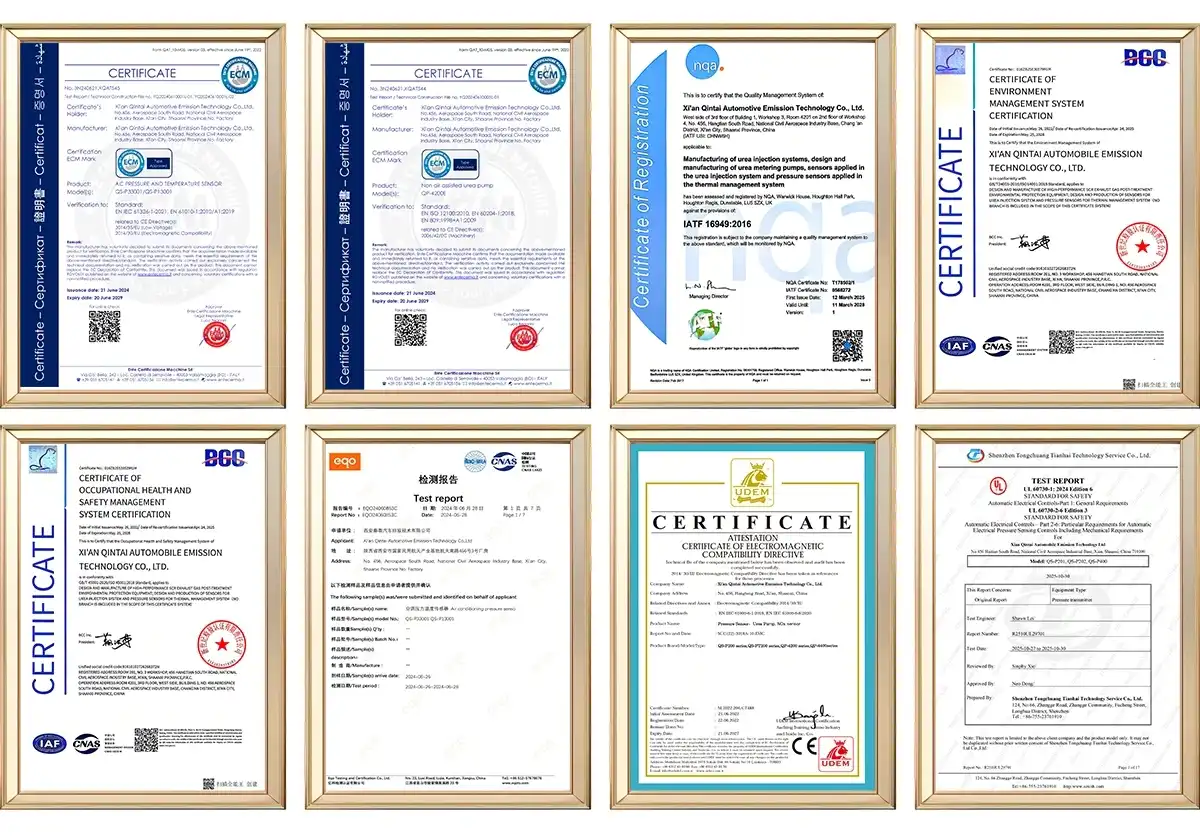
You need more than a sample that can be checked on a bench to be sure that OEM stock is good. If you want to make sure a supplier is qualified, look for certifications like IATF 16949 for quality management in the auto industry, ISO 9001 for general quality systems, and product-level certifications like CE and RoHS. Suppliers should also show proof that they can actually make what they say they can. If you want to give someone a big deal, make sure you have written proof of their monthly output numbers and wait times.
Inventory and Delivery Planning
Just-in-time production schedules cannot tolerate frequent delivery delays when sourcing thin film pressure sensor components for high-volume diesel projects. Two commercial arrangements for pressure sensors are available: standard lead-time contracts and safety stock agreements. Confirm the minimum order quantity (MOQ) at the earliest stage.
There are some suppliers that offer tiered MOQ structures that can handle both small batches of prototypes and large amounts of production. Repair shops and people who sell parts in the aftermarket should check to see if the part is in stock and if the supplier has a warehouse in the area that can handle quick orders.
Future Trends and Innovations in Thin Film Pressure Sensors for Automotive Systems
Miniaturization and Flexible Integration
In cars of the future, sensors will be put closer to the points where they are used. This means that the housings for these sensors have to be smaller without losing their accuracy. Things have come a long way with thin film casting. Now, sensors can be put on surfaces that are smaller than 10 mm across. So, they can be used in compressor boost circuits and exhaust aftertreatment lines that don't have a lot of room.
IoT Connectivity and Autonomous Vehicle Requirements
Cars that drive themselves need instrument data feeds that have a delay of less than 5 milliseconds. Thin film sensors that have digital output standards can link straight to the CAN or LIN busses in a car. They send information about high-frequency pressure to the devices that sense and control the car. More and more commercial cars are using electric and hybrid vehicles. These sensors are also being used in battery thermal control circuits to keep an eye on the fuel pressure.
Sustainability and Material Innovation
The rules set by REACH and RoHS are making companies switch to lead-free solder, housings without halogens, and bodies made of stainless steel that can be recycled. Now, teams that buy things and care about the environment can pick devices that meet performance and environmental standards without dropping production.
Conclusion
Low-cost thin film pressure sensor monitors provide a technical solution for pressure measurement on modern diesel and commercial vehicle platforms. Their sputtered thin-film construction delivers precision, high-temperature stability and vibration resistance, performance advantages difficult for legacy sensor technologies to match. This technology can be deployed across multiple vehicle assemblies.
For example, the fuel rail can be watched to make sure that pollution rules are followed, and TPMS apps can be used to make sure that government safety rules are followed. When OEM engineers and buying managers set up long-term supply chains, they should work with a qualified manufacturer that has IATF 16949 and can make a lot of items. This is the simplest way to make sure that all sensors work the same way and are ready to be regulated.
FAQ
How does a thin film pressure sensor improve fuel emission compliance?
These sensors send fuel rail pressure data that is accurate to within 0.5% of the full scale and has reaction times of less than 10 milliseconds. This gives the ECU the real-time information it needs to exactly control when the injections happen. Diesel engines can meet the requirements set by China VI and Euro VI if they have tight injection control. This cuts down on the NOx and particulate matter they release.
What operating temperature range do automotive thin film sensors cover?
The temperature range for most sputtered thin film sensors used in cars is -40 °C to 125 °C. Units made for use under the hood or next to the exhaust can go to higher ranges, depending on the base and film material chosen.
Can thin film sensors be customized for specific vehicle platforms?
Yes, OEM/ODM suppliers can change the housing's shape, the output signal, the connector type, and the pressure range to fit each platform. Make sure you have accurate information about the wait time and tooling costs before you send in your application data sheet.
What certifications should I require from a sensor supplier?
Just make sure they can show proof that they follow IATF 16949, ISO 9001, CE, RoHS, and REACH. Generator sets that will be used in dangerous places also need to be certified as "Ex" (explosion-proof).
What is a typical lead time for a custom thin film pressure sensor order?
In two to four weeks, most stock parts are sent out. It can take anywhere from eight to twelve weeks for the first production run of custom-designed parts that need new tools, depending on how complicated they are.
Partner with Qintai for Your Thin Film Pressure Sensor Supply
Since 2001, Qintai has sold diesel engine aftertreatment sensors to Weichai Power, Yuchai Power, and Quanchai Power. The business has been approved by IATF 16949, ISO 9001, CE, RoHS, and Ex. As a leading manufacturer of thin film pressure sensors, we can take on OEM/ODM orders from the pilot stage all the way through mass production. Please go to qt-sensor.com or email our team at info@qt-sensor.com right now to get the sizes, samples, or bulk quote that you need.
References
1. Fraden, J. Handbook of Modern Sensors: Physics, Designs, and Applications. Springer, 2016.
2. Bao, M. Analysis and Design Principles of MEMS Devices. Elsevier, 2005.
3. SAE International. SAE J3061: Cybersecurity Guidebook for Cyber-Physical Vehicle Systems. SAE International, 2016.
4. ISO 16750-3. Road Vehicles — Environmental Conditions and Testing for Electrical and Electronic Equipment — Part 3: Mechanical Loads. ISO, 2023.
5. Tran, A. V. et al. "Sputtered Thin Film Resistive Pressure Sensors for Automotive Applications." Sensors and Actuators A: Physical, Elsevier, 2018.
6. National Highway Traffic Safety Administration (NHTSA). Federal Motor Vehicle Safety Standard No. 138: Tire Pressure Monitoring Systems. U.S. Department of Transportation, 2005.

Our customers’ satisfaction speaks for our quality — contact us to experience the same reliable service.