- English
- French
- German
- Portuguese
- Spanish
- Russian
- Japanese
- Korean
- Arabic
- Greek
- German
- Turkish
- Italian
- Danish
- Romanian
- Indonesian
- Czech
- Afrikaans
- Swedish
- Polish
- Basque
- Catalan
- Esperanto
- Hindi
- Lao
- Albanian
- Amharic
- Armenian
- Azerbaijani
- Belarusian
- Bengali
- Bosnian
- Bulgarian
- Cebuano
- Chichewa
- Corsican
- Croatian
- Dutch
- Estonian
- Filipino
- Finnish
- Frisian
- Galician
- Georgian
- Gujarati
- Haitian
- Hausa
- Hawaiian
- Hebrew
- Hmong
- Hungarian
- Icelandic
- Igbo
- Javanese
- Kannada
- Kazakh
- Khmer
- Kurdish
- Kyrgyz
- Latin
- Latvian
- Lithuanian
- Luxembou..
- Macedonian
- Malagasy
- Malay
- Malayalam
- Maltese
- Maori
- Marathi
- Mongolian
- Burmese
- Nepali
- Norwegian
- Pashto
- Persian
- Punjabi
- Serbian
- Sesotho
- Sinhala
- Slovak
- Slovenian
- Somali
- Samoan
- Scots Gaelic
- Shona
- Sindhi
- Sundanese
- Swahili
- Tajik
- Tamil
- Telugu
- Thai
- Ukrainian
- Urdu
- Uzbek
- Vietnamese
- Welsh
- Xhosa
- Yiddish
- Yoruba
- Zulu
How to Import AdBlue Dosing System from China Suppliers
Importing an AdBlue dosing system from China is a practical procurement path for OEMs, SCR integrators, and aftermarket distributors in the United States. The process involves verifying supplier certifications, confirming product compatibility with EPA or Euro VI emission standards, requesting samples, negotiating contract terms, and arranging freight and customs clearance. When done correctly, buyers access factory-direct pricing on DEF injection systems—including dosing pumps, urea filters, and control modules—without sacrificing the technical precision that diesel aftertreatment demands.
Understanding AdBlue Dosing Systems and Their Market Relevance
What Is an AdBlue Dosing System?
A gadget that measures the amount of Diesel Exhaust Fluid that needs to be added puts it right before the SCR catalyst. The main parts of the machine are a dose pump, a urea filter, an injection needle, and a computer control unit. It changes nitrogen fumes, which are dangerous, into nitrogen and water gas, which are safe. According to the EPA, SCR technology is the most popular way to treat heavy-duty diesel engines in North America and Europe. This is because it can cut NOx emissions by up to 90%.
Core SCR Components Every Buyer Should Know
The urea filter needs extra care. Small pieces and solid urea are taken out of the fluid before it goes to the dose injector. It is important to have urea filter parts that are made of synthetic fiber media that is 5 to 10 microns in size, meets ISO 22241 standards, can work in temperatures ranging from -40°C to +85°C, and keeps the pressure drop low to protect the dose accuracy. Parts can get stuck in the injector if the filter doesn't meet this standard. This can lead to limp mode, NOx sensor problems, and costly engine derating events.
Market Drivers in the United States
The EPA Tier 4 and GHG Phase 2 rules are getting stricter for people who own fleets and make equipment. A lot of big trucks in the U.S. have SCR systems, and every once in a while, the DEF system parts need to be changed. People want to buy things directly from approved Chinese makers so they don't have to pay the extra fees that come with going through multiple levels of marketing.
Key Considerations When Importing AdBlue Dosing Systems from China
Verifying Supplier Certifications
Check to see if the seller is IATF 16949 certified before purchasing adblue dosing system. This is the automotive quality management standard that ensures precision components such as dosing pumps and urea filters maintain batch-to-batch consistency. Compliance with ISO 9001 requirements is also critical. Also, suppliers serving OEMs should hold documentation complying with China VI or Euro VI homologation. Per ISO 22241, you should request test reports covering chemical safety, burst pressure and leakage tests.
Evaluating Product Specifications
Electric dosing pumps are used in new SCR platforms so that the exact amount of fluid used can be controlled. Older or off-road vehicles can use the mechanical versions just fine. Check the flow rate, voltage (12V or 24V), type of connector, and whether the pump works with your engine's ECU or DCU. Check the OEM part number to make sure the aftermarket part fits right before you buy it. When installing an SCR system for a brand, the most important things for installers are changing the interfaces and the dosing rules.
Pricing, MOQ, and Customization Terms
There is usually a minimum order quantity of 50 to 500 units at Chinese plants, but this varies by part. The price per unit goes down a lot when you buy 500 or more. Early on, the buyer should talk about ODM terms if they want OEM labels or fixing parts that are made just for them. When the quote is being made, the cost of design is much lower than when the tools are set. Get a quote that breaks down the costs of the packing, the parts, and the tools.
Step-by-Step Guide to Importing AdBlue Dosing Systems from China
Step 1 — Define Requirements and Issue an RFQ
First, make a clear technical specification sheet that lists the type of application (truck, generator, farm equipment, etc.), engine size, emission standard, working environment, and estimated yearly volume. Request full quotes from at least three of the service providers you've picked. There is less back and forth when the RFQ is well-organized. It also gives sellers all the information they need to give correct prices. In the end, this helps both sides when the contract is being worked out.
Step 2 — Sample Evaluation and Third-Party Inspection
Try out components of the adblue dosing system before bulk purchasing. Test samples on a bench tester or real engine test stand to verify accurate readings, chemical resistance of seals and filter media, and overall performance. When placing large orders, engage a third-party inspection agency such as SGS, Bureau Veritas, or TÜV to conduct factory audits before shipment. To guarantee quality, urea filter components are commonly subjected to ISO 19438 multipass testing and bubble point testing.
Here are the main steps to take to protect quality at this point:
- Dimensional inspection: Verify thread pitch, port sizing, and bracket mounting points against your drawing.
- Chemical compatibility check: Confirm that no adhesives or elastomers leach extractables into the 32.5% urea solution.
- Functional test: Run the dosing pump through pressure and flow cycles at rated voltage to confirm performance under load.
You won't get a batch that doesn't meet standards and has to be thrown away or fixed up in the US, which would cost a lot more. These checks are done before sending.
Step 3 — Logistics, Customs, and Documentation
Sea freight is the most cost-effective way to ship more than 500 items. Air freight is the best way to send samples or small restocking orders quickly. You need to show proof of your business, a packing list, a bill of lading, a certificate of origin, and any test results that are needed. Most of the time, HTS codes for DEF system parts are in the 8413 (pumps) or 8421 (filters) families. Always talk to a licensed customs broker to make sure you have the right classification. If you don't, you could face delays or fines at U.S. ports of entry for the wrong classification.
Comparing Chinese AdBlue Dosing Systems with Global Alternatives
Performance and Reliability
There is a lot of information about how well SCR parts fit OEM parts, and well-known Western suppliers like Bosch and Continental make them with very tight tolerances. Process control is the same at IATF 16949-certified Chinese businesses that work with top Chinese OEMs like Weichai Power and Yuchai Power. Some ten years ago, there was a big change in how well they did. These days, the difference is not as big, especially when it comes to dosing pumps and urea filters that are used as replacements.
Total Cost of Ownership
The price is not the only variable to consider when selecting the adblue dosing system. Think about warranty duration, spare part lead time, and the availability of replacement filter media or pump heads. A Chinese supplier may deliver a lower total cost of ownership compared with premium Western brands that feature longer lead times and higher spare part costs. The Chinese supplier can offer an 18-month warranty, 30-day refund policy, and direct technical support. Evaluate the three-year total cost before finalizing your supplier selection.
Real-World Procurement Outcomes
In North America, some repair networks and fleet owners have moved from using aftermarket SCR parts from other countries to ones from China. If you want to be successful, you need a written seller quality agreement and regular checks before shipping. People who don't do this step will not always get the same parts. These parts fail about as often as OEM-grade parts, though, if they go through an organized qualifying process.
Post-Import Considerations: Installation, Maintenance & Support
Installation Best Practices
If dirty air gets into the DEF dose pumps, they can't work right. First, flush the DEF lines and make sure the fittings are torqued to the right level. Then, prime the pump and run it for the first time. Installers who work for the business should follow the OEM repair instructions for the engine model they want to work on. For shop networks that work with a lot of different types of cars, a short technical bulletin from the seller greatly reduces the number of mistakes that happen during installation.
Maintenance Intervals and Troubleshooting
The urea filter adblue part should be changed every 120,000 to 200,000 km if everything is okay. In places where there is a lot of dust, like farming or building, it should be changed more often. The filter is failing if the amount of DEF used goes up, the NOx sensor gives trouble codes, or the engine slows down. You shouldn't clean and use the same filter media twice. Particles get stuck inside synthetic fibers because of how they are built, and cleaning them hurts the fibers, leaving the injector open to damage.
Spare Parts and After-Sales Channels
On a local level, make sure you have enough filters, injector seals, and pump diaphragms. For everyday things, make sure your provider can send replacement parts within 15 business days. If technical questions are sent straight to the supplier instead of going through a dealer, they can be fixed faster in the field.
Conclusion
It is smart to purchase adblue dosing system from China as long as buyers follow a well-organized supplier qualification and inspection process. Make sure the certifications are authentic, test samples rigorously, clarify all contract terms, and maintain local spare part inventory.
When it comes to cost, Chinese companies that sell to Tier 1 domestic OEMs have a lot of control over their processes and can offer real savings compared to Western channels of distribution. For U.S. buyers, the best supplier partner is one that provides direct engineering support and clear documentation. This way, buyers can make sure that all of their products meet emission standards while keeping the prices of the parts low.
FAQ
Q1: How do I verify a Chinese supplier's quality before placing a bulk order?
Check that they are approved by IATF 16949 and get test records from a third party that are not too old. You should get some samples and have them checked by a different lab to make sure they work well with chemicals, don't leak under pressure (ISO 19438), and filter well. You can trust the workplace even more if SGS or Bureau Veritas check it out.
Q2: What are typical shipping lead times?
When samples are sent by air freight, it takes five to ten business days. Sea freight from big Chinese ports takes about 18 to 30 days to get to ports on the West Coast of the United States. This relies on the place where the orders are brought in. Allow more time to go through customs.
Q3: Can Chinese suppliers provide custom interfaces or labeling?
Yes. As an IATF 16949-certified company, most of them offer OEM and ODM services, such as private-label packing, custom connector types, and mounting designs. During the RFQ stage, talk about the customization needs so that tooling doesn't get held up.
Q4: What certifications should a DEF system component carry?
In the very least, the product must have ISO 9001, IATF 16949, and test results that show it meets ISO 22241 requirements for AdBlue fluid compatibility. Parts that will be used in places where the EPA has rules should also show proof that they meet Tier 4 or GHG Phase 2 emission standards.
Q5: Are Chinese AdBlue dosing components compatible with U.S. engine platforms?
Yes, there are many of them. During the sample step, make sure you check the connectors' pinouts, voltage and flow rates. For North American Cummins, Detroit, and PACCAR engine types, you can get cross-reference statistics from valid sources.
Partner With Qintai for Your AdBlue Dosing System Supply
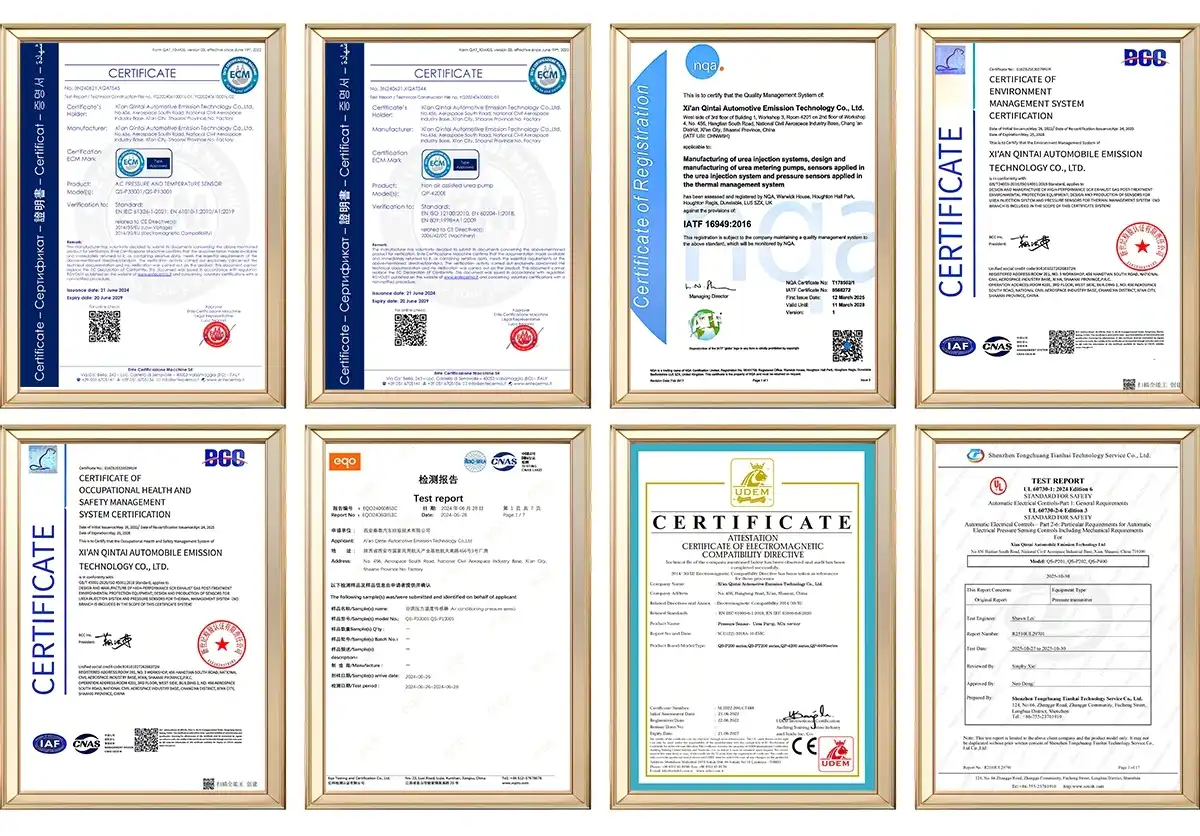
Some parts for SCR aftertreatment systems have been offered by Xi'an Qintai Automotive Emission Technology Co., Ltd. since 2001. IATF 16949, ISO 9001, CE, UL, and REACH have all given the company their seal of approval. Qintai is where Weichai Power, Yuchai Power, and Quanchai Power get most of their aqua blue dose systems. They offer accuracy at the OEM level at fair B2B prices. Please get in touch with us if you need sample reviews, custom specs, or quotes for large orders. You can email info@qt-sensor.com or go to qt-sensor.com.
References
1. U.S. Environmental Protection Agency. Diesel Exhaust Emission Standards for Heavy-Duty Engines. EPA, 2023.
2. International Organization for Standardization. ISO 22241: Diesel Engines — NOx Reduction Agent AUS 32. ISO, 2019.
3. International Organization for Standardization. ISO 19438: Diesel Fuel and Petrol Filters — Multi-Pass Testing. ISO, 2003.
4. IATF. IATF 16949:2016 — Quality Management System Requirements for Automotive Production. International Automotive Task Force, 2016.
5. Transport & Environment. Heavy-Duty Vehicles and the Role of SCR Technology in NOx Reduction. Transport & Environment, 2022.
6. U.S. International Trade Commission. HTS Classification Guide: Pumps, Filters, and Automotive Components. USITC, 2023.

Our customers’ satisfaction speaks for our quality — contact us to experience the same reliable service.