- English
- French
- German
- Portuguese
- Spanish
- Russian
- Japanese
- Korean
- Arabic
- Greek
- German
- Turkish
- Italian
- Danish
- Romanian
- Indonesian
- Czech
- Afrikaans
- Swedish
- Polish
- Basque
- Catalan
- Esperanto
- Hindi
- Lao
- Albanian
- Amharic
- Armenian
- Azerbaijani
- Belarusian
- Bengali
- Bosnian
- Bulgarian
- Cebuano
- Chichewa
- Corsican
- Croatian
- Dutch
- Estonian
- Filipino
- Finnish
- Frisian
- Galician
- Georgian
- Gujarati
- Haitian
- Hausa
- Hawaiian
- Hebrew
- Hmong
- Hungarian
- Icelandic
- Igbo
- Javanese
- Kannada
- Kazakh
- Khmer
- Kurdish
- Kyrgyz
- Latin
- Latvian
- Lithuanian
- Luxembou..
- Macedonian
- Malagasy
- Malay
- Malayalam
- Maltese
- Maori
- Marathi
- Mongolian
- Burmese
- Nepali
- Norwegian
- Pashto
- Persian
- Punjabi
- Serbian
- Sesotho
- Sinhala
- Slovak
- Slovenian
- Somali
- Samoan
- Scots Gaelic
- Shona
- Sindhi
- Sundanese
- Swahili
- Tajik
- Tamil
- Telugu
- Thai
- Ukrainian
- Urdu
- Uzbek
- Vietnamese
- Welsh
- Xhosa
- Yiddish
- Yoruba
- Zulu
Top Uses and Benefits of Capacitive Pressure Sensors in Industry
Capacitive pressure sensors have become essential instruments across heavy industrial environments. By detecting changes in electrical capacitance caused by diaphragm deflection under pressure, these devices deliver precise, stable readings that resistive and piezoelectric alternatives often cannot match in demanding conditions. Whether you manage procurement for a diesel engine OEM, oversee SCR/DPF system integration, or source replacement parts for commercial vehicles, understanding how a capacitive pressure sensor performs—and where it excels—helps you make confident, cost-effective sourcing decisions.

Understanding Capacitive Pressure Sensors: Principles and Advantages
The formula for how a capacitive pressure sensor works is C = ε₀εᵣA/d. The gap (d) between the electrodes gets smaller when pressure pushes on the diaphragm. This makes the capacitance higher. Built-in electronics then turns that capacitance shift into a clean digital or analog output signal.
Why Capacitive Technology Outperforms Alternatives
Capacitive designs have much less thermal drift than piezoresistive ones, which is very important when operating temperatures change from -40°C to 135°C. They don't need charge amplifiers like piezoelectric sensors do, and they give stable DC-level readings. Their alumina ceramic diaphragms are much more resistant to chemical attack than their metallic strain-gauge counterparts. This makes them the best choice for exhaust aftertreatment environments that are prone to corrosion.
Addressing Common Signal Challenges
EMI, or electromagnetic interference, is still a problem in real life. Noise can be successfully reduced with the right shielding, low-impedance grounding, and differential bridge setups, such as the Wheatstone bridge topology used in the Qintai QS-P105. A bridge resistance of 11 ± 30% kΩ keeps the output steady, even in engine bays or generator spaces that have a lot of electrical noise.
Top Industrial Applications of Capacitive Pressure Sensors
These devices can be used in a wide range of businesses to measure things, including through the use of a capacitive pressure sensor. The mix of accuracy, longevity, and signal linearity that each area values is a little different.
Diesel Engine Aftertreatment and Emission Control
Intake manifold pressure, DPF difference pressure, and SCR dose pressure must all be tightly controlled by China VI and Euro VI rules. Capacitive pressure sensors put across the entrance and exit ports of the DPF constantly check the amount of soot present, starting regeneration cycles before back-pressure levels become harmful. Getting accurate readings at these places directly protects the life of the engine and keeps cars legal during roadside checks.
Generator Sets, Mining, and Backup Power
Generator sets that stay in one place in mines and power plants run nonstop for thousands of hours. Pressure sensors at the fuel rails, lube circuits, and turbine boost lines must work reliably even when the temperature outside is very high or very low. Industrial-grade monitors that can work in a wide range of temperatures and are rated to 600 bar give project engineers the peace of mind they need for long-term usage without human supervision.
Process Automation and HVAC
It is used in chemical processing to make sure that product batches stay within the parameters set by sensors that check the pressure in the reactor tank with a nonlinearity of 0.3% FS. Low hysteresis helps HVAC systems keep exact refrigerant levels, which saves energy and makes compressors last longer.

Capacitive Pressure Sensor Selection: Making the Right Choice for Your Industry
To choose the right pressure measuring device, you have to weigh technical factors against the realities of buying something. The following table shows how key sensor technologies compare:
| Technology | Accuracy | Temp. Stability | Typical Range | Best Fit |
|---|---|---|---|---|
| Capacitive | ≤±0.5% FS | Excellent | Vacuum to 600 bar | Industrial OEM, SCR/DPF |
| Piezoresistive | ±1–2% FS | Moderate | Low to mid pressure | Consumer electronics |
| Piezoelectric | Dynamic only | Good | High-frequency events | Vibration monitoring |
| MEMS | ±0.1–1% FS | Good | Micro-pressure | Portable medical |
When you look at supplier datasheets for a capacitive pressure sensor, pay close attention to the diaphragm material, the safety overload rating, and the zero temperature drift. In acidic exhaust condensate, for example, a 96% Al₂O₃ ceramic diaphragm is much more resistant to corrosion than regular 316L stainless steel.
Evaluating the Qintai QS-P105 for B2B Procurement
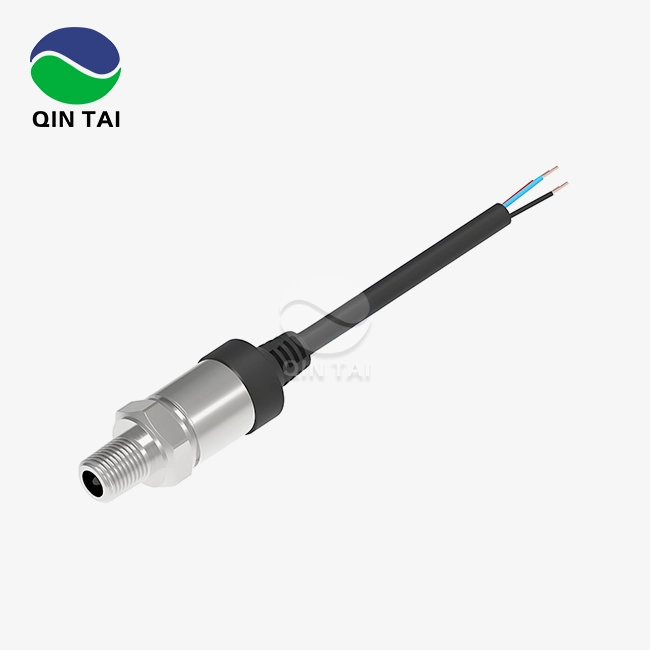
The QS-P105 can handle pressures from -1/0 bar to 600 bar, which makes it one of the most versatile single-model capacitive pressure sensors on the market. It can measure with an accuracy of ≤ ±0.5% FS and a zero temperature drift below 0.03% FS/°C (2–50 bar range), which meets the high standards of both diesel OEM production lines and aftermarket repair applications. Supply power ranges from 2 to 30 VDC, which makes integration easier across a wide range of ECU designs and panel instruments.
Enhancing Industrial Efficiency and Performance with Capacitive Pressure Sensors
When integrated correctly, capacitive pressure sensors last longer and measurements stay accurate over production rounds that can last for years.
Here are the main things that big industrial settings do to get the most out of pressure measuring devices:
- Calibration at commissioning: Before the system goes live, it must be proven to have a zero output of ±0.2 mV/V at 23°C. Keeping track of baseline numbers helps with making predictive maintenance and speeds up the process of finding problems later on.
- Safety overload margin: The QS-P105 has a safety overload limit of 200% FS. This buffer protects against pressure spikes that happen when heavy trucks and excavators are cold-started, preventing diaphragm rupture without the need for separate overpressure protection valves.
- IoT and real-time data integration: Connecting analog sensor outputs to edge computing modules lets you keep an eye on things all the time. Facilities report measured reductions in unplanned downtime because pressure deviations are caught before they become mechanical failures.
These practices collectively lower the total cost of ownership and the amount of money needed for upkeep over the sensor's useful life.

Procurement Guide: How to Buy Capacitive Pressure Sensors with Confidence
In the B2B world, choices about what to buy aren't just based on unit price—especially when selecting a capacitive pressure sensor. The total value of a supplier relationship is affected by lead time, minimum order quantities, the ability to customize, and technical support after the sale.
If you buy directly from the manufacturer instead of going through a multiple-tier distributor, you skip the markup stages and get direct access to engineering support. When OEMs place large orders, direct sourcing lets them get unique interfaces, wire lengths, connector types, and calibrated pressure ranges, which is something that middlemen don't usually do.
As a major OEM partner, Qintai has provided sensors to Weichai Power, Yuchai Power, and Quanchai Power. This shows that they have the mass production control and quality stability that people in charge of large-scale procurement need. Along with CE, UL, and Ex approvals, the company has ISO 9001 and IATF 16949 certifications, which makes supplier qualification audits a lot easier.
Conclusion
Capacitive pressure sensors are very important in diesel systems that don't pollute, generator sets that last a long time, and places where precise process control is needed. Because they are more stable at high temperatures, work well across a wide range of pressures, and have low nonlinearity, they are a good choice for situations where accuracy and durability are important. Instead of going with the cheapest choice, pick a certified, experienced maker that can do mass production and real customization support. This will pay off over the life of your equipment.
FAQ
How accurate are capacitive pressure sensors compared to piezoelectric types?
Piezoelectric devices can only measure dynamic events, but capacitive sensors can measure both standing and moving pressure just as well. Capacitive designs usually get ≤ ±0.5% FS in steady-state accuracy with little thermal drift, which makes them better than piezoresistive choices in places where temperatures change.
What is the typical operating temperature range for industrial-grade pressure sensors?
The QS-P105 and other industrial capacitive sensors can work in temperatures ranging from -40°C to 135°C, which is the full temperature range that can be found in diesel engine rooms, mine shafts, and outdoor generator areas.
Which industries gain the most from capacitive pressure transducer technology?
Diesel engine OEMs, SCR/DPF integrators, generator set manufacturers, and industrial process automation users always get the most value. This is because they need long service intervals, a wide range of pressures, and to follow strict safety or emission rules.
Can these sensors be customized for specific OEM requirements?
Yes. Custom pressure levels, connector types, output signals, and diaphragm materials are all possible with reputable makers. Including the manufacturer's engineering team early in the product development cycle lowers the risk of integration issues and speeds up the production process.
Partner with Qintai for Reliable Capacitive Pressure Sensor Solutions
Qintai was founded in 2001 and has the largest market share of any OEM capacitive pressure sensor seller in China. Diesel engine builders around the world believe their certified, long-lasting sensing solutions. The QS-P105 can be used for tasks from vacuum to 600 bar and can be fully customized. Contact our engineering team directly at info@qt-sensor.com or visit qt-sensor.com to request datasheets, discuss OEM/ODM requirements, or explore volume pricing.

References
1. IEEE Sensors Journal — "Capacitive Pressure Sensor Design and Signal Conditioning for Industrial Applications," 2021.
2. Sensors and Actuators A: Physical — "Temperature Compensation Techniques in Ceramic Capacitive Pressure Sensors," 2020.
3. SAE International Journal of Engines — "DPF Differential Pressure Monitoring for Euro VI Compliance," 2022.
4. Measurement: Journal of the International Measurement Confederation — "Performance Evaluation of MEMS and Capacitive Pressure Transducers in Harsh Environments," 2019.
5. Journal of Industrial Electronics and Applications — "IoT-Integrated Pressure Sensing for Predictive Maintenance in Heavy Machinery," 2023.
6. ISA Transactions — "Selection Criteria for Industrial Pressure Sensors in Process Automation," 2021.

Our customers’ satisfaction speaks for our quality — contact us to experience the same reliable service.