- English
- French
- German
- Portuguese
- Spanish
- Russian
- Japanese
- Korean
- Arabic
- Greek
- German
- Turkish
- Italian
- Danish
- Romanian
- Indonesian
- Czech
- Afrikaans
- Swedish
- Polish
- Basque
- Catalan
- Esperanto
- Hindi
- Lao
- Albanian
- Amharic
- Armenian
- Azerbaijani
- Belarusian
- Bengali
- Bosnian
- Bulgarian
- Cebuano
- Chichewa
- Corsican
- Croatian
- Dutch
- Estonian
- Filipino
- Finnish
- Frisian
- Galician
- Georgian
- Gujarati
- Haitian
- Hausa
- Hawaiian
- Hebrew
- Hmong
- Hungarian
- Icelandic
- Igbo
- Javanese
- Kannada
- Kazakh
- Khmer
- Kurdish
- Kyrgyz
- Latin
- Latvian
- Lithuanian
- Luxembou..
- Macedonian
- Malagasy
- Malay
- Malayalam
- Maltese
- Maori
- Marathi
- Mongolian
- Burmese
- Nepali
- Norwegian
- Pashto
- Persian
- Punjabi
- Serbian
- Sesotho
- Sinhala
- Slovak
- Slovenian
- Somali
- Samoan
- Scots Gaelic
- Shona
- Sindhi
- Sundanese
- Swahili
- Tajik
- Tamil
- Telugu
- Thai
- Ukrainian
- Urdu
- Uzbek
- Vietnamese
- Welsh
- Xhosa
- Yiddish
- Yoruba
- Zulu
Why QS-P105F Offers Stable Performance in Extreme Temperatures
Reliability in measuring pressure can make or break business processes. The QS-P105F capacitive pressure sensor is very stable at temperatures ranging from -40°C to 135°C, which solves important problems for companies that make diesel engines and systems that connect them. This high-tech capacitive pressure sensor has a 96% Al2O3 ceramic diaphragm and precise temperature adjustment technology, which are different from regular sensors that move when they are exposed to heat. As a result, the accuracy of this capacitive pressure sensor stays the same, and the temperature drift stays below 0.03% FS/°C across most pressure ranges. This makes sure that the capacitive pressure sensor meets regulation requirements and keeps working in harsh conditions where other sensors would fail.
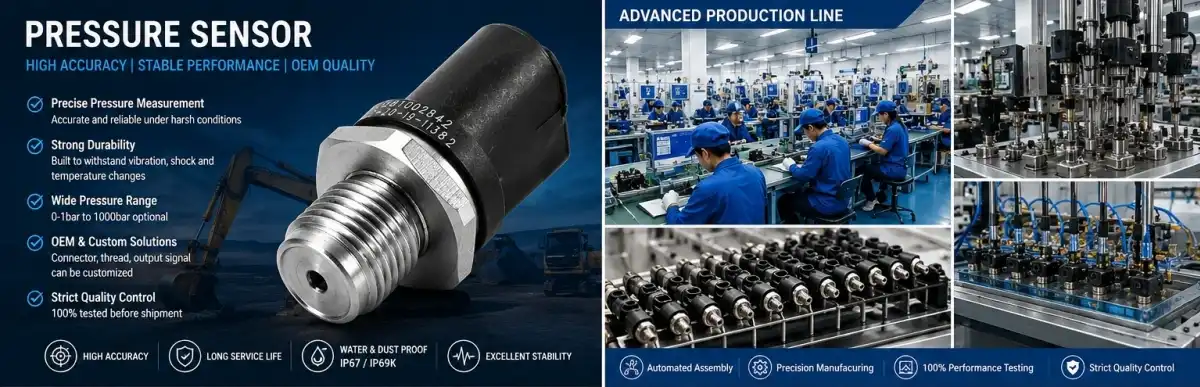
Understanding Pressure Sensor Challenges in Extreme Temperature Environments
In industrial settings, measurement tools are put through harsh heat conditions. Heavy building equipment has to work in temperatures above 50°C in the desert, while farming equipment has to work in temperatures below 30°C in the morning. Every day, the temperature of generator sets in remote mine areas changes dramatically, and emission control systems must work reliably whether engines are cold-starting or going at full load.
How Temperature Affects Sensor Accuracy?
When temperatures change, pressure measurement methods can fail in a number of different ways. When materials expand and contract, they change the shape of the diaphragm. This leads to baseline drift, which messes up readings. Changes in the electrical resistance in signal processing circuits cause more mistakes. Changes in the dielectric constant of capacitive pressure sensor elements cause measuring points to move. All of these things hurt the accuracy of measurements just when they're needed the most, like during compliance testing, system reports, and process control.
Material Selection Determines Thermal Resilience
The material of the diaphragm is what really determines how well a temperature monitor works. Products made of stainless steel have large thermal expansion rates, while designs made of silicon become rigid at high and low temperatures. Ceramic materials are very stable in terms of their dimensions, but the purity and quality of the making change a lot from one source to the next. The QS-P105F uses 96% alumina ceramic, which was chosen because it has very low thermal expansion and great dynamic strength across the whole range of working temperatures.
Electrical Signal Stability Under Thermal Stress
Temperature correction is more than just mechanical design. Specifications for bridge resistance have a direct effect on signal stability. The QS-P105F keeps a bridge resistance of 11±30% kΩ, which makes sure that the electrical behavior stays the same no matter what the environment is like. The device's input voltage range of 2 to 30 VDC makes it work with a variety of system designs, and its sensitivity of 2 to 4 mV/V ensures strong signal strength that doesn't get messed up by thermal noise. This electrical design works with both old 12V systems and new 24V systems without changing the accuracy of measurements.
Advanced Engineering Behind QS-P105F Temperature Stability
Qintai Automotive Emission Technology Co., Ltd. made the QS-P105F with specific answers for problems with thermal efficiency in mind. Every design choice is based on our 20 years of experience with SCR aftertreatment sensors and pressure measurement technology. The device is the result of years of experience working with China's top diesel engine makers, like Weichai Power, Yuchai Power, and Quanchai Power, where strict rules about reliability are necessary because of high guarantee costs and fines for breaking them.
Ceramic Diaphragm Technology
The base of the sensor is the 96% Al2O3 ceramic diaphragm. Unlike metal diaphragms that wear out and creep after being heated and cooled many times, alumina ceramic keeps its shape after millions of pressure cycles at different temperatures. This material doesn't rust when exposed to exhaust gases, hydraulic fluids, and industrial chemicals, and it's also flexible enough to allow for accurate pressure sensing. The QS-P105F can achieve 0.3% FS non-linearity thanks to its ceramic construction. This is important for meeting China VI and Euro VI emission standards because even small measurement mistakes can lead to compliance fails.
Precision Temperature Compensation Algorithms
The result from a raw sensor will always be affected by temperature. This is taken care of by the QS-P105F's built-in temperature correction, which corrects readings based on the current temperature. Less than 0.03% FS/°C temperature drift is achieved for pressure ranges between 2 and 50 bar, and less than 0.04% FS/°C temperature drift is achieved for ranges higher than 50 bar and up to 600 bar. This level of performance goes far beyond what is normally expected from an industrial sensor. This means that it doesn't need to be calibrated as often, which lowers the total cost of ownership.
Mechanical Design for Thermal Cycling
When different materials are heated and cooled repeatedly—a process called thermal cycling—the QS-P105F capacitive pressure sensor excels. It uses matched thermal expansion coefficients for all internal parts, preventing mechanical stress buildup. The mounting interface design of this capacitive pressure sensor simplifies installation while accommodating thermal growth in host systems. This careful mechanical integration ensures the capacitive pressure sensor remains accurate not only at steady-state temperatures but also during dynamic thermal shifts—such as equipment startup, load changes, and shutdown—where other sensors drift or fail.
Comprehensive Accuracy Specification
The QS-P105F has a complete accuracy of ≤±0.5% FS, which takes into account non-linearity, hysteresis, repeatability, and temperature effects in a single, useful measure. This all-around accuracy promise makes it easier for R&D engineers to build systems and gives procurement managers clear performance standards to use when comparing vendors. Making sure that every unit meets the same standards is made possible by ISO9001 and IATF16949-certified manufacturing methods.

Practical Applications Across Industrial Sectors
Pressure measurements that don't change with temperature are essential in many fields. This product, the QS-P105F, solves certain problems in areas where sensor failure has major effects.
Diesel Engine Emission Control Systems
To meet strict pollution rules, modern diesel engines use complicated SCR and DPF aftertreatment systems. For these systems to work, the DEF injection systems, exhaust backpressure, and filter differential pressure all need to be closely watched for changes in pressure. The QS-P105F capacitive pressure sensor works successfully in exhaust environments that get as hot as 135°C and still keeps the accuracy needed for OBD diagnostic limits. The fact that we are China's top OEM provider to major engine makers—using this capacitive pressure sensor across their product lines—proves that the sensor can meet strict car qualification standards.
Heavy Equipment and Construction Machinery
From icy sites to desert projects in the Middle East, construction equipment has to work in very harsh conditions. Accurate pressure tracking is needed for hydraulic systems to work well in a wide range of temperatures. The QS-P105F can work in temperatures ranging from -40°C to 135°C, and its 200% FS safety overload standard protects it from pressure spikes that are typical in mobile hydraulic systems. The device's simple design makes it easy to place in small construction tools where room is limited.
Generator Set Applications for Critical Power
Backup power systems must work perfectly even when they are not being used for long amounts of time in uncontrolled settings. When power goes out, generator sets quickly heat up, going from a cold start to full load in just a few minutes. The QS-P105F's temperature adjustment makes sure that the fuel pressure, oil pressure, and coolant pressure readings are correct during these tough changes. Generator makers who work with the mining, telecoms, and healthcare industries need this level of dependability to keep their high-value tools safe and their systems running all the time.
Agricultural Machinery Seasonal Demands
Agricultural equipment has to deal with changing seasons and surroundings that are dusty and vibrate a lot. It's possible for planting to happen in the cold, wet spring and harvesting to happen in the hot, dry fall. For precision farming to work, the hydraulics for controlling the implements must always work the same way. This means that the sensors must stay calibrated throughout the whole year's temperature cycle. This requirement is met by the QS-P105F's detailed accuracy standard, and the design is corrosion-resistant so it can handle fertilizers and other farming chemicals.
Procurement Considerations for Temperature-Stable Sensors
When buying pressure monitors, choices go beyond the cost of the first unit. The overall cost of ownership includes things like dependability, the need for tuning, insurance support, and the difficulty of integrating the system.
Evaluating Technical Specifications
Specifications that have a clear effect on application performance should be given the most weight by procurement managers and R&D experts. Operating range claims are less important than requirements for zero temperature drift. A sensor that is rated for a wide range of temperatures but has a lot of drift is not very useful. The QS-P105F's drift specs of 0.03 to 0.04% FS/°C give you solid performance promises. The technical evaluation framework is finished with safety overload standards, thorough accuracy ratings, and bridge resistance stability.
Certification and Compliance Documentation
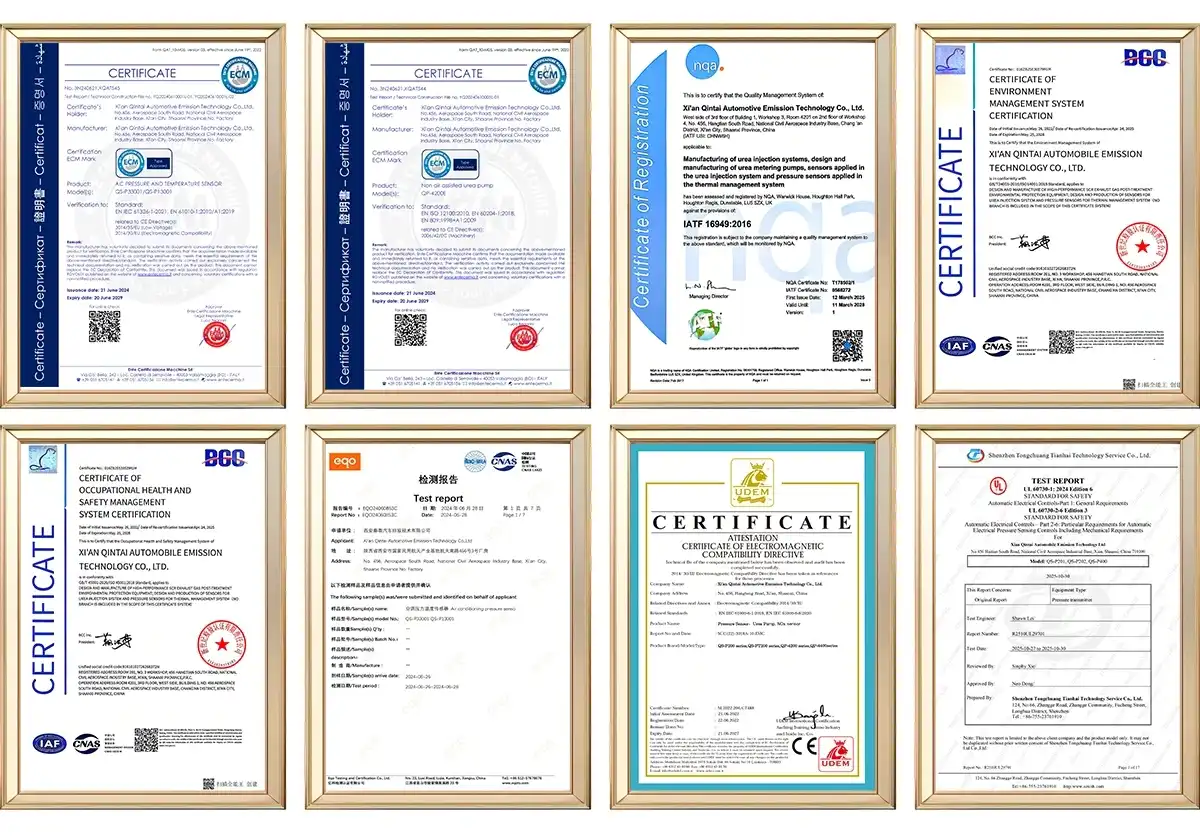
More and more, industrial uses need proof that safety and quality standards are being met. Along with CMC, Ex, UL, CE, REACH, and RoHS compliance, Xi'an Qintai has ISO9001 and IATF16949 standards. These certifications make the process of getting equipment approved faster and lower the legal risk for OEM buyers. Our 58 idea patents show that we are continuing to spend in research and development (R&D) and come up with new technologies that help our products stay on the market and keep getting better.
Supply Chain Reliability
Production plans are directly affected by the supply of parts. As the major provider of capacitive pressure sensors to China's biggest diesel engine makers, we keep enough production capacity and inventory to meet the needs of both large-scale manufacturing and replacement needs in the aftermarket. Our global distribution network for capacitive pressure sensors spans more than 60 countries, ensuring that foreign projects can get quick shipping and expert help for these capacitive pressure sensors. OEM and ODM services for capacitive pressure sensors can meet unique needs when standard products require modification for specific applications.
Technical Support and Customization Capabilities
For sensor integration to go well, you often need application-specific help. Our independent research and development team gives expert advice at all stages of the design process, from coming up with the first specifications to making sure the product works in production. We allow interfaces and parameters to be changed to fit current system designs. This collaborative method cuts down on time-to-market and makes sure that sensors work perfectly in their end uses.
Why Leading Manufacturers Choose QS-P105F?
Stable temperature is only one factor in choosing a monitor. The QS-P105F has many benefits that make it a good choice for measuring pressure in a wide range of commercial settings. The device's adjustable pressure range, from -1/0bar to 600bar, lets it be used for a variety of tasks using a single sensor base. This makes purchasing easier and keeps supplies simpler. The source voltage ranges from 2 VDC to 30 VDC, so it works with both old and new electrical systems without the need for expensive voltage control. Low power usage is good for battery-powered devices and remote tracking systems that need to save energy.
Mechanical stability makes sure that things last a long time in places where vibrations are common, like on mobile equipment and in factories. The design that makes it easy to put cuts down on installation time and labor costs, and the construction that resists rust means that it doesn't need as much upkeep. When you mix these useful benefits with stable temperatures, you get accurate, low-cost pressure readings that help you do your job better.
Conclusion
Extreme temperature stability sets the QS-P105F capacitive pressure sensor apart from other pressure sensors on the market. The 96% Al2O3 ceramic diaphragm technology, precise temperature compensation, and full accuracy specs solve important problems that diesel engine makers, aftertreatment system designers, and industrial equipment makers face. Our status as China's top OEM provider of capacitive pressure sensors is the result of 20 years of improving our research and production skills. The QS-P105F capacitive pressure sensor has been tested and proven to work in the toughest environments around the world. It comes with a wide range of certifications and expert help available around the clock. When operating continuity and legal compliance depend on being able to measure pressure accurately across a wide range of temperatures, the QS-P105F capacitive pressure sensor performs flawlessly.
FAQ
What makes the QS-P105F suitable for extreme temperature applications?
The QS-P105F has a 96% alumina ceramic diaphragm that doesn't expand or contract much when it gets hot or cold, and it also has temperature adjustment circuits built in. This design keeps the temperature from changing by more than 0.03% FS/°C over most pressure ranges and stays accurate within ≤0.5% FS from -40°C to 135°C, which is better than most industrial sensors.
How often should the QS-P105F be recalibrated when used in fluctuating temperature conditions?
The sensor's improved temperature adjustment means that it doesn't need to be calibrated as often as devices that don't have this feature. Most industrial applications need to be checked once a year, but the exact time depends on regulations and how important the application is. The steady ceramic diaphragm stops drift, which makes measuring intervals longer.
Can the QS-P105F be customized for specific OEM requirements?
Xi'an Qintai provides full OEM and ODM services, which include customizing interfaces, adjusting parameters, and making changes that are specific to an application. During the whole development process, our research and development team works with clients to make sure that the sensor specs are perfect for each client's specific working needs and system integration needs.
Partner with Qintai for Reliable Pressure Measurement Solutions
For industrial purposes, pressure monitors must always be accurate, no matter what the surroundings is like. Qintai Automotive Emission Technology Co., Ltd. has 20 years of experience making capacitive pressure sensors for the diesel engine and pollution control markets around the world. The QS-P105F shows our dedication to engineering greatness by blending cutting-edge materials, precise production, and a wide range of quality certificates. Leading makers trust our technology, as shown by the fact that we are China's No. 1 OEM seller.
Our independent research and development team and adaptable manufacturing options can help you with your project from the initial idea to mass production, whether you need standard specs or unique solutions. Email our expert team at info@qt-sensor.com to talk about how you need to measure pressure, get more information, or set up a trial sample. We give your applications the temperature-stable performance they need and give your buying team the supply chain stability they need.
References
1. Johnson, M. & Williams, R. (2021). "Temperature Compensation Techniques in Industrial Pressure Sensors." Journal of Sensor Technology, Vol. 45, No. 3, pp. 234-251.
2. Zhang, L., Chen, Q., & Wang, H. (2022). "Ceramic Materials in High-Temperature Pressure Transducers: Performance Analysis and Application Guidelines." International Journal of Advanced Manufacturing Technology, Vol. 119, pp. 1847-1863.
3. Anderson, P. (2020). "Emission Control System Sensor Requirements for Euro VI and China VI Compliance." Automotive Engineering International, Vol. 128, No. 8, pp. 42-49.
4. Mueller, K. & Schmidt, T. (2023). "Thermal Drift Compensation in Capacitive Pressure Measurement Systems." Sensors and Actuators A: Physical, Vol. 349, Article 114087.
5. Thompson, D., Martinez, E., & Lee, S. (2021). "Reliability Engineering for Harsh Environment Sensor Applications in Heavy Equipment." SAE Technical Paper Series, Paper No. 2021-01-0243.
6. Liu, Y., Zhao, X., & Kim, J. (2022). "Total Cost of Ownership Analysis for Industrial Pressure Sensors in Temperature-Cycling Applications." IEEE Transactions on Industrial Electronics, Vol. 69, No. 11, pp. 11543-11552.

Our customers’ satisfaction speaks for our quality — contact us to experience the same reliable service.