- English
- French
- German
- Portuguese
- Spanish
- Russian
- Japanese
- Korean
- Arabic
- Greek
- German
- Turkish
- Italian
- Danish
- Romanian
- Indonesian
- Czech
- Afrikaans
- Swedish
- Polish
- Basque
- Catalan
- Esperanto
- Hindi
- Lao
- Albanian
- Amharic
- Armenian
- Azerbaijani
- Belarusian
- Bengali
- Bosnian
- Bulgarian
- Cebuano
- Chichewa
- Corsican
- Croatian
- Dutch
- Estonian
- Filipino
- Finnish
- Frisian
- Galician
- Georgian
- Gujarati
- Haitian
- Hausa
- Hawaiian
- Hebrew
- Hmong
- Hungarian
- Icelandic
- Igbo
- Javanese
- Kannada
- Kazakh
- Khmer
- Kurdish
- Kyrgyz
- Latin
- Latvian
- Lithuanian
- Luxembou..
- Macedonian
- Malagasy
- Malay
- Malayalam
- Maltese
- Maori
- Marathi
- Mongolian
- Burmese
- Nepali
- Norwegian
- Pashto
- Persian
- Punjabi
- Serbian
- Sesotho
- Sinhala
- Slovak
- Slovenian
- Somali
- Samoan
- Scots Gaelic
- Shona
- Sindhi
- Sundanese
- Swahili
- Tajik
- Tamil
- Telugu
- Thai
- Ukrainian
- Urdu
- Uzbek
- Vietnamese
- Welsh
- Xhosa
- Yiddish
- Yoruba
- Zulu
Beginner’s Guide to Pressure and Temperature Transmitters
Working with diesel engine manufacturing or aftertreatment systems requires knowledge of dual-function sensor devices. A tiny Pressure and Temperature transmitter continually monitors both parameters and sends precise data to your control systems. These devices prevent overpressure and overheating in engines, compressors, and hydraulic systems while guaranteeing process efficiency and regulatory compliance. This handbook gives purchasing managers assessing vendors and R&D engineers defining emission control system components the practical information they need to make educated sensing solution selections.
Understanding Pressure and Temperature Transmitters
By merging two measuring capabilities formerly installed separately, dual-parameter sensing devices have altered industrial monitoring. Monitoring process conditions continually, these sensors translate physical changes into standardized electrical signals that control systems can read.
What Makes These Devices Essential?
Integrated sensing solutions provide vital operations duties. They simultaneously measure pressure and temperature, transmit accurate signals for process automation or safety systems, protect pumps and compressors from overpressure or overheating, and ensure manufacturing and energy system efficiency and product quality. Continuous data flow helps your team spot issues before they become costly failures.
Core Measurement Technologies
Understanding the technologies behind these gadgets explains their reliability. Pressure is measured using ceramic sensors or piezoresistive devices that transform mechanical stress into electrical information. Media compatibility and long-term stability make the ceramic pressure sensor ideal for monitoring engine oil, refrigerants, and hydraulic fluids. Most temperature measurements employ NTC or RTD thermistors. NTC thermistors are perfect for monitoring coolant temperatures, exhaust gas conditions, and hydraulic fluid states in diesel engine applications because to their rapid reaction times and high accuracy in the -40°C to 130°C range.
Advantages of Combined Measurement
Including both tasks in one package has operational benefits. In tight equipment installations, employing one sensor instead of two simplifies installation and saves space. The integrated design avoids measurement correlation problems from employing sensors at multiple places, improving accuracy. Low installation costs, simplified wiring, and simplified maintenance make it cost-effective. Heavy-duty 304 stainless steel structure offers long-term equipment life in industrial applications with vibration, temperature cycling, and chemical exposure.
How to Choose the Right Pressure and Temperature Transmitters for Your Industrial Needs?
Your application needs and operational environment must be considered while choosing a dual-parameter sensor. Informed decisions at this point save costly retrofits and assure regulatory compliance.
Defining Your Application Requirements
First, thoroughly document your operational settings for a Pressure and Temperature transmitter. Determine your application's pressure range—0-5 bar for light-duty monitoring or 0-40 bar for high-pressure hydraulics. Consider regular and exceptional operating conditions while determining the temperature range. Devices suitable for -40°C to 130°C with SCR and DPF pressure ranges are needed for diesel engine applications matching China VI or Euro VI emission requirements. Check your pressure medium: engine oil, POE oil, refrigerant, gas, or water. Selection and reliability of sensor materials depend on media compatibility.
Evaluating Technical Specifications
Accuracy standards affect system performance and compliance. Look for equipment with ±1.0% full-scale accuracy for pressure and temperature readings. Our technical team designed the QS-PT225 with a ceramic pressure sensor and precision NTC thermistor to meet this accuracy criteria. Maintain a ±3% total error band over the whole temperature range for dependable performance during seasonal temperature changes and thermal cycling. Analog voltage outputs like 0.5V to 4.5V DC work well with current engine control units and aftertreatment system controllers.
Comparing Interface and Connection Options
Process connections must match system infrastructure. While standard threads like G1/4, M12×1.5, and M10×1 suit most diesel engine and hydraulic applications, customization choices offer flexibility for unusual installations. Industry-standard electrical connections should be easy for professionals to find and service. The TE 1-967640-1 connection is reliable and widely available. Recommended mounting torque is 10-20 N·m to prevent thread or sensor component damage during installation.
Assessing Durability and Environmental Protection
Ruggedness depends on operating conditions. Equipment supporting construction, agriculture, and generators faces vibration, dampness, dust, and severe temperatures. Stainless steel probe and housing prevent corrosion and offer mechanical endurance. Electronics are protected from vehicle electrical transients by overvoltage protection up to 32V DC. Reverse polarity protection reduces field service calls and warranty claims by preventing installation mistakes from harming the device.
Installation, Calibration, and Maintenance Best Practices
Proper installation and maintenance enhance ROI and ensure measurement accuracy during the device's lifespan.
Installation Guidelines for Optimal Performance
Choose a spot carefully for your Pressure and Temperature transmitter. Avoid dead zones, flow turbulence, and temperature gradients by positioning the sensor to appropriately depict process conditions. Make sure the mounting placement allows electrical connections and maintenance. Before installation, clean the threaded port of dirt, old sealant, and corrosion that might harm the sensor or seal. Apply thread sealant or PTFE tape per manufacturer's instructions, avoiding the pressure port, where it might obstruct the sensing device. Tighten to the recommended torque range to avoid thread damage and sensor element stress, as well as leaks and vibration-induced loosening.
Calibration Procedures and Scheduling
Modern sensors are factory-calibrated, but post-installation testing ensures appropriate operation. Connect the sensor to a calibrated pressure source and precision thermometer, then compare output signals to reference values over the operational range. Record outcomes and variations from requirements. Depending on your quality management system and application criticality, schedule verification calibrations. ISO/IATF accreditation is verified annually by several diesel engine manufacturers and aftertreatment system integrators. High-vibration or extreme-temperature applications may require more frequent testing.
Maintenance Practices That Extend Service Life
Inspections detect problems before they fail. Monthly inspect electrical connections for corrosion, looseness, or insulation damage. Check the sensor body for corrosion, thread leaks, and physical damage. Check output signals for drift or abnormal behavior that may indicate sensor deterioration. Clear clutter from the sensor area. Cleaning solvents that damage seals and coatings should be avoided. Service records should include installation dates, calibration results, repairs, replacements, and operational conditions. These records detect reliability patterns and improve replacement intervals.
Where and How to Procure Pressure and Temperature Transmitters?
Strategic procurement optimizes total cost of ownership by providing authentic items with technical support.
Sourcing from Qualified Suppliers
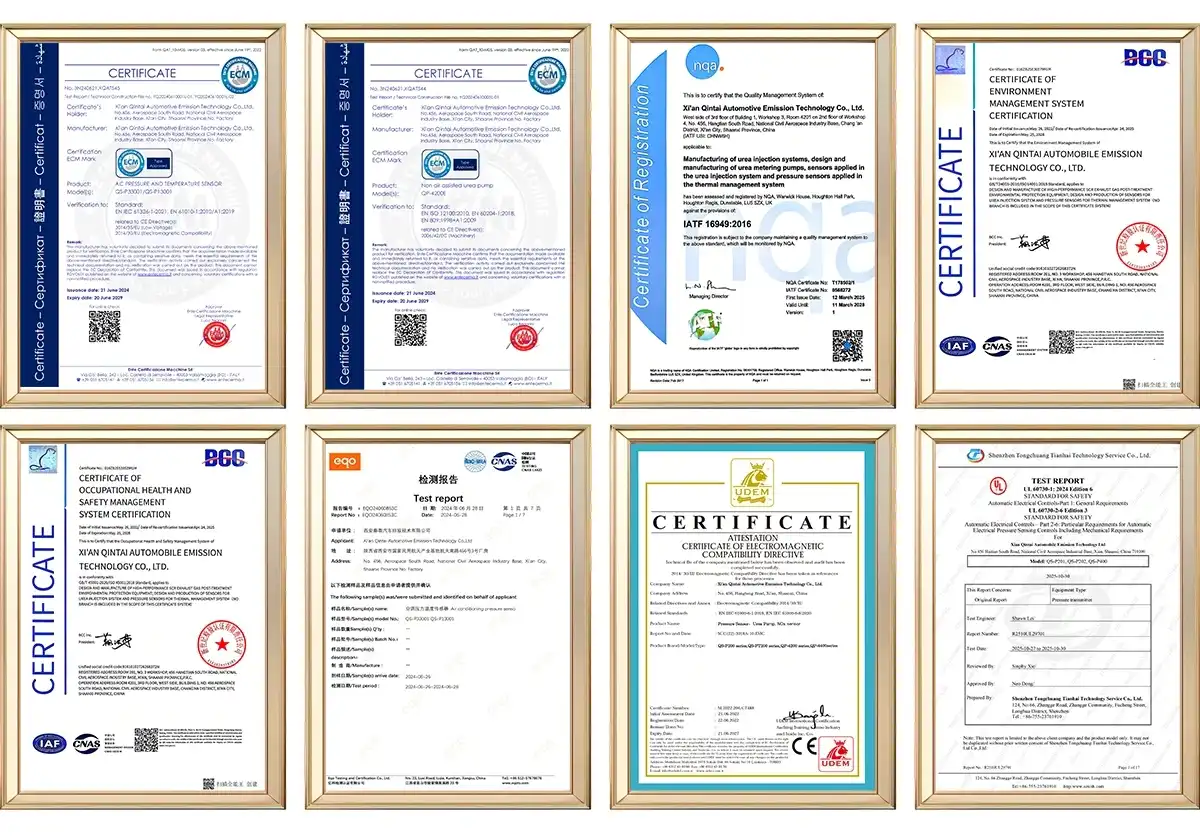
Partner with industry-specific quality system-certified manufacturers or distributors for your Pressure and Temperature transmitter. IATF 16949 accreditation for automotive and diesel engine applications means the provider meets strict automotive quality standards. ISO 9001 is a quality standard. Suppliers should include dimensions drawings, wiring diagrams, performance curves, and application notes. This documentation simplifies design integration and troubleshooting. Ask the supplier for CE marking for European exports, UL certification for North American uses, and REACH/RoHS compliance for environmental standards.
Evaluating Supplier Capabilities for Long-Term Partnership
Look beyond product specs for supplier competencies that support your company goals. Mass manufacturing important if an OEM needs thousands of products per month with constant quality. Discuss production lead times, minimum orders, and inventory management. Aftertreatment system integrators require sensors that work with several controller systems and configurable interfaces. Technical assistance response time impacts development and field troubleshooting. Ask similar application customers for references and technical question response times.
Understanding Pricing and Value Considerations
Unit pricing is important, but total cost of ownership is preferable. Include purchase price, installation labor, wiring and connections, calibration and commissioning, ongoing maintenance, and projected service life. Bulk purchase gives cost savings, however inventory carrying costs and obsolescence risk must be considered. International purchase requires consideration of payment terms, shipping expenses, and customs. Your investment is protected by manufacturers' extensive warranties on materials and workmanship for appropriate periods. Replacement parts, technical support, and repair services increase value after the sale.
Conclusion
Dual-parameter sensing technology like the Pressure and Temperature transmitter is dependable and cost-effective for industrial measurement applications such as diesel engine pollution control, hydraulic systems, and HVAC equipment. Understanding basic technologies, selection criteria, installation best practices, and procurement methods helps you enhance performance and reduce costs. When specifying sensors for new equipment designs or seeking aftermarket replacements, precision, durability, and supplier support assure efficiency and compliance in competitive markets. The integration of pressure and temperature into compact, resilient packages is a major improvement over separate-sensor methods.
FAQ
Q1: What distinguishes a transmitter from a basic sensor?
A: Transmitters convert raw inputs from sensors into control system-compatible outputs. Transmitters have electronics for amplification, linearization, and temperature correction to maintain accuracy in different environments. This signal conditioning is critical in industrial settings where long cable lengths, electrical noise, and temperature variations weaken sensor signals.
Q2: How often should I calibrate these devices?
A: Application criticality, regulatory requirements, and environmental severity determine calibration frequency. Annual verification meets most moderate-duty quality management systems. Semi-annual or quarterly verification may be needed for critical safety systems or applications with severe temperatures, pressures, or vibration. Important for regulated sectors and certified quality systems: calibration records showing national standards traceability.
Q3: Can integrated transmitters match the accuracy of separate devices?
A: Modern integrated designs match or exceed the precision of independent instruments. The QS-PT225 achieves ±1.0% full-scale accuracy for pressure and temperature. Eliminating geographic gap between sensing locations enhances measurement correlation and represents process conditions more accurately than widely spaced sensors.
Partner with Qintai for Reliable Pressure and Temperature Transmitter Solutions
Xi'an Qintai Automotive pollution Technology's technical team knows the problems of achieving pollution laws while reducing costs and manufacturing schedules. Since 2001, we've developed sensing solutions for diesel engine aftertreatment systems, becoming China's top OEM supplier. Quality ceramic pressure sensor technology and precise NTC thermistors give our QS-PT225 dual-parameter transmitter the accuracy and dependability your applications need. Our IATF 16949, ISO 9001, CE, UL, REACH, and RoHS-compliant products exceed global regulatory standards, and our customisation capabilities match your individual needs. As a trusted Pressure and Temperature transmitter manufacturer in 60 countries, we provide quick technical support and dependable delivery. Contact info@qt-sensor.com to discuss your needs and obtain comprehensive specs for assessment.

SENSOR+TEST, June 9 – 11, 2026
We look forward to your visit,warmly welcome to our booth 1-634!
Get your free ticket online now:
https://www.sensor-test.de/service/ticket/?52790
References
1. Liptak, B.G. (2018). Instrument Engineers' Handbook, Volume One: Process Measurement and Analysis. CRC Press, Fifth Edition.
2. Webster, J.G. & Eren, H. (2014). Measurement, Instrumentation, and Sensors Handbook: Spatial, Mechanical, Thermal, and Radiation Measurement. CRC Press, Second Edition.
3. Johnson, C.D. (2016). Process Control Instrumentation Technology. Pearson Education, Eighth Edition.
4. International Society of Automation (2019). ISA-51.1-1979 (R2019) - Process Instrumentation Terminology. ISA Standards and Practices.
5. Bentley, J.P. (2005). Principles of Measurement Systems. Pearson Education Limited, Fourth Edition.
6. Dunn, W.C. (2019). Introduction to Instrumentation, Sensors, and Process Control. Artech House Publishers.
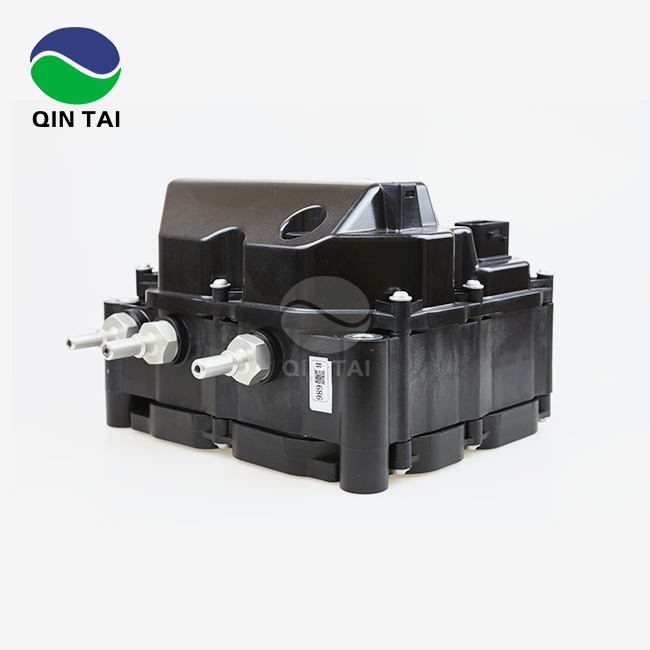
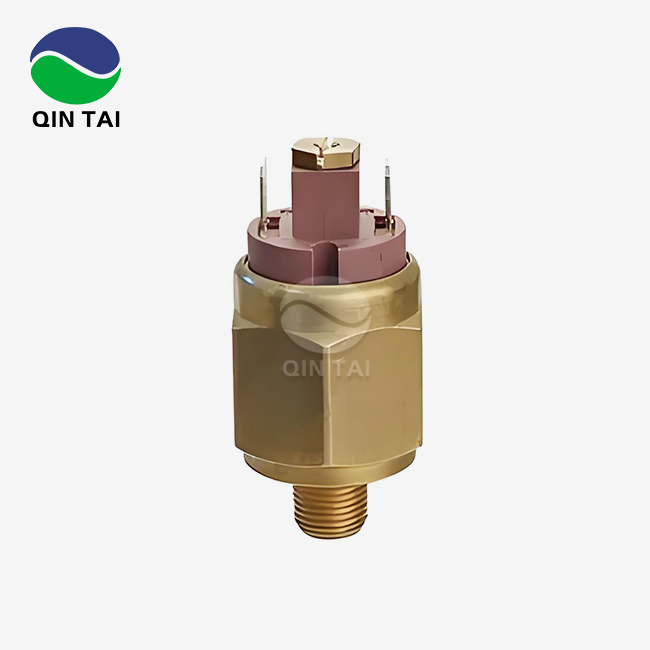

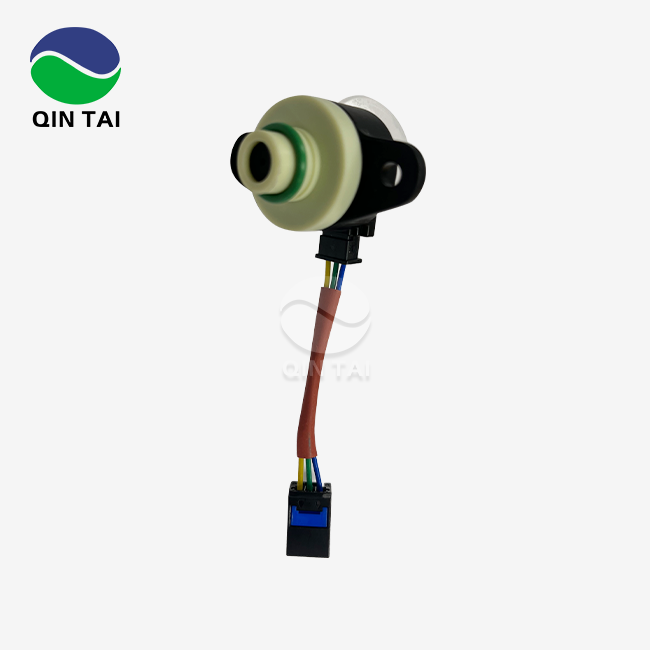

Our customers’ satisfaction speaks for our quality — contact us to experience the same reliable service.