- English
- French
- German
- Portuguese
- Spanish
- Russian
- Japanese
- Korean
- Arabic
- Greek
- German
- Turkish
- Italian
- Danish
- Romanian
- Indonesian
- Czech
- Afrikaans
- Swedish
- Polish
- Basque
- Catalan
- Esperanto
- Hindi
- Lao
- Albanian
- Amharic
- Armenian
- Azerbaijani
- Belarusian
- Bengali
- Bosnian
- Bulgarian
- Cebuano
- Chichewa
- Corsican
- Croatian
- Dutch
- Estonian
- Filipino
- Finnish
- Frisian
- Galician
- Georgian
- Gujarati
- Haitian
- Hausa
- Hawaiian
- Hebrew
- Hmong
- Hungarian
- Icelandic
- Igbo
- Javanese
- Kannada
- Kazakh
- Khmer
- Kurdish
- Kyrgyz
- Latin
- Latvian
- Lithuanian
- Luxembou..
- Macedonian
- Malagasy
- Malay
- Malayalam
- Maltese
- Maori
- Marathi
- Mongolian
- Burmese
- Nepali
- Norwegian
- Pashto
- Persian
- Punjabi
- Serbian
- Sesotho
- Sinhala
- Slovak
- Slovenian
- Somali
- Samoan
- Scots Gaelic
- Shona
- Sindhi
- Sundanese
- Swahili
- Tajik
- Tamil
- Telugu
- Thai
- Ukrainian
- Urdu
- Uzbek
- Vietnamese
- Welsh
- Xhosa
- Yiddish
- Yoruba
- Zulu
Best Pressure and Temperature Transmitters for Harsh Industrial Sites
When operating in demanding environments — think diesel engine bays, hydraulic systems, or generator sets running in mining operations — choosing the right pressure and temperature transmitter is not optional. It directly affects system safety, regulatory compliance, and long-term operational cost. After reviewing technical specifications, industry applications, and real-world performance data, the Qintai QS-PT225 stands out as one of the most practical dual-output sensing solutions available for harsh industrial sites today.

Understanding Pressure and Temperature Transmitters in Harsh Industrial Sites
What These Devices Actually Do
A pressure transmitter changes the pressure of gasses, liquids, or vapors into a standard electrical signal, usually 4–20 mA or 0.5–4.5 V DC, so that it can be controlled and monitored from afar. A temperature emitter uses NTC thermistors or RTDs to measure the temperature and sends out an electrical signal that corresponds to that temperature. When both functions are built into one unit, procurement teams save money on wires, cut down on installation time, and get rid of the measurement correlation mistakes that happen when two sensors are placed in different places.
Why Harsh Environments Are a Real Problem
Sensing devices in industrial places are subject to extreme changes in temperature, chemical exposure, mechanical stress, and water getting in. For example, the coolant in a diesel engine's aftertreatment system is often above 100°C, and the drivetrain is always vibrating.
These conditions make sensor drift and physical wear happen faster. Devices that don't have enough ingress protection (IP67 or higher) or housings that don't rust break down early, which can cause unplanned downtime and compliance issues with emission standards like Euro VI or China VI.
Key Durability Features to Look For
When shopping for sensors, people should look for ones with housings made of stainless steel, burst pressure ratings that have been checked, and operating temperature ranges that go well below freezing. Certifications like ATEX, IECEx, and CE show that safety performance has been checked. For long-term field reliability, both overvoltage safety and reverse polarity protection are important. This is especially true for mobile equipment where wiring mistakes are frequent.
Top-Rated Pressure and Temperature Transmitters for Industrial Use
Established Global Brands and Their Strengths
A lot of people know Emerson's Rosemount line for differential pressure sensors that work with HART and are used in oil and gas processing. For safety-critical process loops, Endress+Hauser has strong SIL-rated options. Engineers who work on big plants like ABB and Honeywell because their products work with both HART and digital busses. When there are organized maintenance plans and specialized instrumentation teams in fixed sites, these names work well.
Where Compact Dual-Output Sensors Fit
Large industrial pressure and temperature transmitter are not useful for companies that make diesel engines, companies that integrate SCR/DPF, or aftermarket service networks. These parts need a small, dual-output device that can send both pressure and temperature data from a single process link. This would make the installation smaller without lowering the accuracy. This is exactly what the Qintai QS-PT225 was designed to do.
The QS-PT225: Dual Measurement in One Package
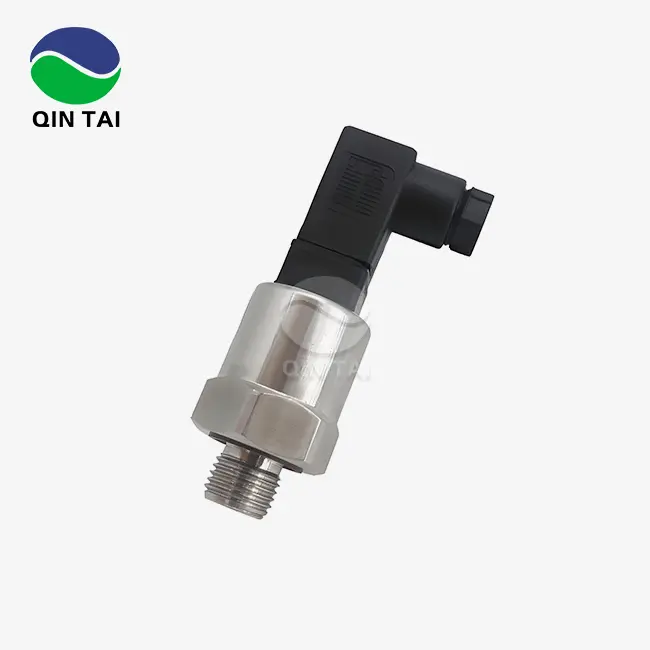
A ceramic pressure sensor and an NTC thermistor are both built into the QS-PT225, which has a body made of 304 stainless steel. As a whole, it has an error band of ±3% from -30°C to 130°C and can measure pressure and temperature with an accuracy of ±1.0% F.S.
It works with standard ECU and PLC input circuits because the output is 0.5V to 4.5V DC (ratiometric). Pressure goes from 0 to 5 Bar to 0 to 40 Bar, and custom choices are possible. Engine oil, POE oil, refrigerant, gas, and water are all compatible media. This covers most heavy-duty diesel and HVAC uses.

How to Choose the Best Pressure and Temperature Transmitter for Harsh Environments
Define Your Environmental and Process Parameters First
Before comparing products, write down the exact conditions of the site, such as the temperature range, the frequency of the expected vibrations, the type of chemical exposure, and the pressure medium that will be used. For a diesel engine coolant circuit, you need a device that can work continuously at least 130°C and can handle mixtures of water and glycol. POE oil compatibility is important for HVAC or cooling systems. One of the most common reasons for early failure is that the sensor is not matched to the media.
Evaluate Accuracy, Certifications, and Signal Compatibility
Different applications have different accuracy needs. To make sure that dosing is accurate, most SCR system integrators need ±1% F.S. or better. Check that the device has the right approvals. For European markets, it should have CE, RoHS, and REACH; for automotive OEM supply chains, it should have IATF 16949.
Before you place your order, you should make sure that the signal from the pressure and temperature transmitter will work with the control architecture you already have (0.5–4.5V ratiometric, 4–20 mA, or CAN). The QS-PT225 has a 4.75V to 5.25V supply and a 0.5V to 4.5V DC output, so it can easily connect to normal car and industrial ECU inputs.
Procurement Factors That Matter at Scale
Lead time, minimum order number, and long-term supply consistency are very important in OEM settings where a lot of products are made. OEM and ODM customization is possible with Qintai. This includes process connections (G1/4, M12×1.5, M10×1), pressure ranges, and connector configurations. Qintai has been the top OEM sensor source for Weichai Power and Yuchai Power in China for a long time and has ISO 9001 and IATF 16949 certifications. Their production is always the same because they have documented quality processes in place.

Installation, Calibration, and Maintenance Best Practices
Choosing the Right Mounting Location
Place the transmitter away from strong vibrations and direct sources of heat. For engine uses, putting the sensor on a bracket that keeps it from being affected by drivetrain vibrations greatly increases its useful life. The QS-PT225 recommends a mounting torque of 10–20 N·m. Staying within this range keeps the seal intact and prevents thread damage. The safe pressure range is 1.5 to 2 times the nominal range, and the burst pressure is 10 MPa G. This gives enough room for error in case of a pressure spike.
Calibration Intervals and Procedures
For harsh environments, adjust when the system is first set up and then every 6 to 12 months, based on how hard it is used. When using mixed units like the QS-PT225, calibration should check both the pressure and temperature output at the same time. Across the whole operating range, compare the device's output to a standard that can be tracked. Write down any offsets and use adjustment factors at the processor level if the sensor stays within its total error band.
Troubleshooting Signal Drift and Common Faults
It's common for mixed sensing units to lose their signals. This is because the NTC element is stressed by thermal cycling, or the ceramic pressure sensor membrane gets contaminated over time. First, make sure there are no loose connectors. The QS-PT225 uses a TE 1-967640-1 connector that is approved for use in automotive settings. If the output stays at the rail voltage, it means that the device has been damaged by overvoltage. The device is protected up to 32V DC, but overvoltage that lasts longer than that can damage the sensing element permanently.
Future Trends and Innovations in Pressure and Temperature Transmitters
IoT Integration and Predictive Diagnostics
Devices that send health status information along with process data, such as the pressure and temperature transmitter, are becoming more common in industrial sensing. Smart receivers with built-in monitoring can spot drift patterns before they cause a failure, which helps preventative maintenance programs. Generator sets in remote mine sites or backup power installations can avoid costly unplanned power outages by getting early notice when sensors start to fail.
Advanced Materials and Miniaturization
Ceramic sensor elements, like those in the QS-PT225, are becoming more popular over steel diaphragm designs because they don't react with chemicals and stay stable over time in corrosive environments. Packaging keeps getting smaller while still meeting all industrial standards. This makes it possible to fit them into smaller engine spaces and hydraulic lines.
Sustainability and Energy Efficiency
Because the QS-PT225 only needs 15 mA of input current, it draws less power when it's connected to a battery or a hybrid system. Sensors from Qintai that come with RoHS and REACH compliance paperwork are useful for OEMs and system integrators that have to make products that are better for the environment.

Conclusion
It's not enough to just compare brand names when choosing the right pressure and temperature transmitter for a tough industrial site. You also need to match technical specs to real-world conditions. The QS-PT225 from Qintai is a useful and inexpensive solution that combines ceramic pressure sensing and NTC temperature measurement in a single stainless steel unit that can handle temperatures from -40°C to 130°C. It's a good choice for diesel engine makers, SCR system integrators, and aftermarket service providers because it has two outputs, a wide pressure range, and OEM customization support.
FAQ
What is the difference between a pressure transmitter and a temperature transmitter?
A pressure transmitter measures mechanical force per unit area in a fluid or gas and converts it to an electrical signal. A temperature transmitter measures thermal energy using elements like thermistors or RTDs and outputs a corresponding signal. Combined units like the QS-PT225 deliver both outputs from a single device, reducing installation complexity.
How often should I calibrate a dual-output transmitter in harsh conditions?
For high-vibration or high-thermal-cycling environments — such as diesel engine aftertreatment systems — calibrate every 6 months. In more stable industrial settings, annual calibration is generally acceptable. Always follow the manufacturer's specification sheet and document all calibration results.
Are wired transmitters more dependable than wireless in extreme environments?
Wired transmitters generally offer more consistent signal integrity in environments with high electromagnetic interference, metallic shielding, or temperature extremes. Wireless options have improved substantially but remain more suitable for monitoring applications where occasional data latency is acceptable. For safety-critical control loops, wired connections remain the standard.
Can the QS-PT225 handle refrigerants and hydraulic fluids?
Yes. Compatible media include engine oil, POE oil, refrigerant, gas, and water. The ceramic sensing element and 304 stainless steel wetted parts resist chemical attack from these common industrial fluids.
Get a Quote from Qintai — Your Trusted Pressure and Temperature Transmitter Supplier
Since 2001, Qintai has been a supplier of precision tracking technology to major diesel engine OEMs. They have certifications from IATF 16949, ISO 9001, CE, and IATF. The QS-PT225 dual-output sensor is small and has been used in the field, but it is accurate enough for use in factories. Our engineering team is ready to help you whether you need standard setups or fully personalized solutions for pressure and temperature transmitters for mass production. To get a sample or a quote for production, email us at info@qt-sensor.com or go to qt-sensor.com right now.
References
1. Instrument Engineers' Handbook: Process Measurement and Analysis — Béla Lipták, CRC Press, 2003
2. ISA-5.1 Instrumentation Symbols and Identification — International Society of Automation, 2009
3. Sensors and Actuators A: Physical — Elsevier Journal, Volume 280, 2018
4. Euro VI Emission Regulation Technical Overview — European Commission, 2019
5. IATF 16949:2016 Automotive Quality Management Standard — International Automotive Task Force, 2016
6. Industrial Pressure Measurement: Fundamentals and Applications — Thomas Kernen, Wiley-VCH, 2012

Our customers’ satisfaction speaks for our quality — contact us to experience the same reliable service.