- English
- French
- German
- Portuguese
- Spanish
- Russian
- Japanese
- Korean
- Arabic
- Greek
- German
- Turkish
- Italian
- Danish
- Romanian
- Indonesian
- Czech
- Afrikaans
- Swedish
- Polish
- Basque
- Catalan
- Esperanto
- Hindi
- Lao
- Albanian
- Amharic
- Armenian
- Azerbaijani
- Belarusian
- Bengali
- Bosnian
- Bulgarian
- Cebuano
- Chichewa
- Corsican
- Croatian
- Dutch
- Estonian
- Filipino
- Finnish
- Frisian
- Galician
- Georgian
- Gujarati
- Haitian
- Hausa
- Hawaiian
- Hebrew
- Hmong
- Hungarian
- Icelandic
- Igbo
- Javanese
- Kannada
- Kazakh
- Khmer
- Kurdish
- Kyrgyz
- Latin
- Latvian
- Lithuanian
- Luxembou..
- Macedonian
- Malagasy
- Malay
- Malayalam
- Maltese
- Maori
- Marathi
- Mongolian
- Burmese
- Nepali
- Norwegian
- Pashto
- Persian
- Punjabi
- Serbian
- Sesotho
- Sinhala
- Slovak
- Slovenian
- Somali
- Samoan
- Scots Gaelic
- Shona
- Sindhi
- Sundanese
- Swahili
- Tajik
- Tamil
- Telugu
- Thai
- Ukrainian
- Urdu
- Uzbek
- Vietnamese
- Welsh
- Xhosa
- Yiddish
- Yoruba
- Zulu
How Does a Pressure and Temperature Transmitter Improve Process Safety?
In industrial operations where precision directly impacts safety, a pressure and temperature transmitter serves as a critical safeguard against catastrophic failures. These devices continuously monitor dual parameters—pressure variations and thermal conditions—converting them into actionable electrical signals that feed into automated control systems. By detecting anomalies before they escalate into hazardous events, dual-parameter transmitters reduce downtime, prevent equipment damage, and protect personnel in environments ranging from diesel engine aftertreatment systems to chemical processing plants. Their ability to deliver real-time, accurate measurements makes them indispensable for facilities prioritizing operational safety and regulatory compliance.


Introduction
The accuracy and dependability of monitoring equipment are very important for industrial safety. In industries where even small changes from normal operating conditions can cause equipment failures, environmental problems, or production stops, Pressure and Temperature transmitters are crucial. Heavy truck makers use these tools to make sure their emission compliance systems work right, and HVAC designers need them to keep the performance of refrigerants within safe limits. They keep chemical plants from overpressurizing, and generator set makers depend on them to keep their machines running smoothly for a long time in tough conditions.
The combination of pressure and temperature measurement into a single device meets several buying priorities: it makes installation easier, reduces the chance of mistakes in calibration, and streamlines upkeep procedures. When buying managers look at instruments for diesel engine aftertreatment systems or SCR/DPF solutions, they need to know how these devices improve safety performance in order to make smart choices. This guide looks at the technical details, real-world uses, and buying options for dual-parameter transmitters, which are important parts of modern safety-critical operations.
Understanding Pressure and Temperature Transmitters in Process Safety
What Defines a Dual-Parameter Transmitter?
A Pressure and Temperature transmitter is a separate device that measures both pressure and temperature. The pressure detecting element, which is usually a ceramic sensor that works on piezoresistive principles, changes the electrical resistance based on changes in mechanical force. At the same time, an NTC thermistor measures changes in temperature by using the way semiconductor materials' resistance changes with temperature. Separate sensors only pick up on changes in the real world. Transmitters, on the other hand, use integrated circuits to process these signals and produce standard output voltages that computer systems can directly understand.
When different sensors are placed at different points along a fluid path, they can cause mistakes in measuring movement. This combination gets rid of those errors. It is important to measure pressure and temperature at the same point when keeping an eye on diesel engines' exhaust gas recycling systems. This way, you can be sure that the estimates you make about gas density and flow are correct. Compared to dual-sensor setups, which need twice as many wiring links and two different calibration processes, the unified design has fewer possible failure points.
How Transmitters Integrate into Control Systems
For modern control loops to work, they need exact input data to run automated responses. Dual-parameter transmitters send voltage signals (usually between 0.5 and 4.5 VDC) that are proportional to the numbers they record. You don't need any extra signal filtering devices for these signals to work with engine control units, programmable logic controllers, and distributed control systems. Linearization is done by the transmitter's built-in processing, which makes up for the fact that the relationship between raw sensor output and actual physical parameters is not linear.
In systems that use aftertreatment, this smooth coupling lets diesel exhaust fluid injection rates be changed in real time based on readings of both pressure and temperature. The control system constantly checks the outputs of the transmitters against safety limits that have already been set. If parameters move outside of acceptable ranges, alarms go off or the system shuts down safely. Predictive safety management is based on this closed-loop tracking, which lets workers fix problems as they arise before they threaten the integrity of the system.
How Pressure and Temperature Transmitters Enhance Process Safety?
Early Fault Detection Through Continuous Monitoring
The most important thing that dual-parameter receivers do for safety is find weird situations early on in the development process. In hydraulic systems that power construction equipment, slow rises in pressure often mean that a seal or filter is about to fail. When temperatures rise at the same time, it means that there is more friction or not enough cooling. When you measure both parameters at the same time, you get more medical information than when you only measure one parameter.
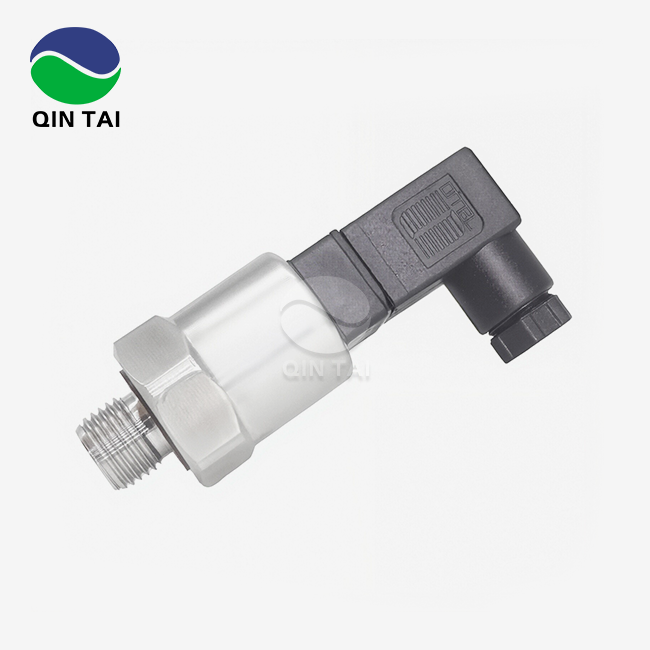
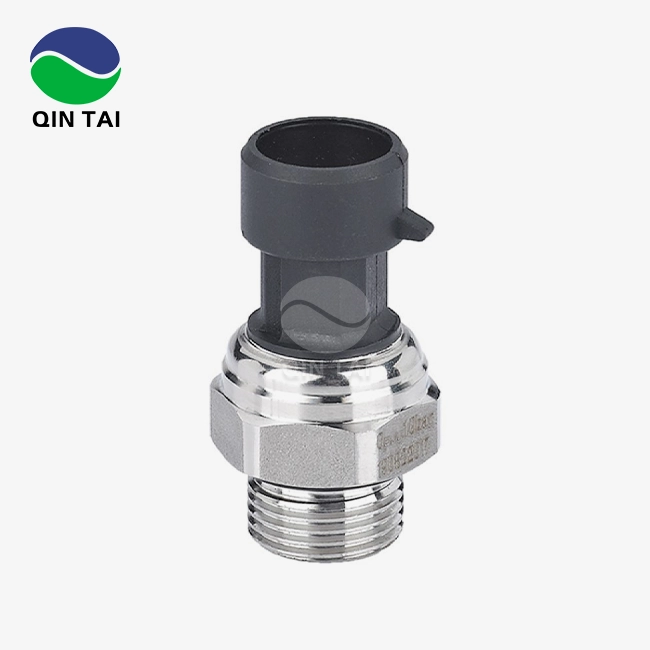
The Qintai QS-PT225 is a good example of this because it has a ceramic pressure sensor and an NTC thermostat. With a full-scale accuracy of ±1.0% for both measures, the device can pick up on small changes that happen before big problems happen. The 304 stainless steel design can handle toxic hydraulic fluids, exhaust gasses, and refrigerants at temperatures ranging from -40°C to 130°C. This means that the measurements stay accurate in places where sensor degradation could make safety warnings less accurate.
Real-Time Data Enabling Automated Safety Responses
When process variables go beyond safe limits, automation systems respond faster and more consistently than people. Advanced safety protocols, such as graduated alarm levels, controlled shutdowns, and automatic system isolation, are made possible by transmitters that send data all the time. Overpressure or overheating can cause the fuel supply to be cut off right away in generator sets that are used for backup power. This keeps the engine from breaking down and keeps the deceleration under control.
The QS-PT225's fast response time makes it suitable for these tough uses. Its integrated design gets rid of the signal processing delays that come with having different temperature and pressure monitors, making this Pressure and Temperature transmitter ideal for safety-critical applications where every millisecond matters. This lets safety systems respond within milliseconds of finding conditions that don't seem right. The device's overvoltage tolerance up to 32V DC and protection against reverse polarity stop false alarms caused by electrical transients. This cuts down on annoying shutdowns that stop work and make operators less trusting of safety systems.
Maintaining Accuracy Through Harsh Operating Cycles
Measurements that are important for safety are only useful if the tools stay calibrated and accurate throughout their working life. Thermal cycling, shaking, and being exposed to aggressive media are all environmental factors that slowly make sensors less effective. Dual-parameter transmitters that use robust sensing technologies are better able to withstand these degradation mechanisms than other designs.
Compared to metal diaphragm options, ceramic pressure monitors are much more stable. The ceramic base is non-conductive, so acidic condensates in exhaust systems can't damage it. It also stays the same size across a wide range of temperatures. When NTC thermistors are used in high-reliability applications, they have very little drift, which means that measurement accuracy is kept even after thousands of heat cycles. The QS-PT225's combined measurement method lowers the uncertainty of the whole system because errors in correlation between different instruments can't happen.
Protocols for regular testing make sure that performance stays high. The device's easy-to-reach mounting design—with G1/4, M12x1.5, or M10x1 process connections that can be changed—allows for regular comparisons with calibrated standards without having to take the whole system apart. This ease of care is especially helpful in aftermarket service settings where quick tests help keep vehicles running.

Comparing Pressure and Temperature Transmitters for Safety-Critical Applications
Integrated Versus Separate Instrument Approaches
When deciding between integrated dual-parameter transmitters and separate pressure and temperature devices, there are trade-offs that go beyond just cost. Integrated systems, like the QS-PT225, are very useful in situations where both measures are used to make the same control choice. When installing a lot of equipment or an engine area that isn't very big, the ability to save space is very important because putting in different instruments can cause problems with other parts.
By measuring both factors in the same place, accuracy is improved. When figuring out the superheat of the refrigerant in HVAC systems, even a small distance between the pressure and temperature sensors makes phase-state determinations less certain. The combined method gets rid of these positioning mistakes, making control more accurate and lowering energy use by regulating the expansion valve more precisely.
Separate instruments are still useful in situations where different measurement ranges are needed or where working on one parameter's sensor shouldn't affect the other. They also offer backup in very important situations where separate measurement paths improve the overall reliability of the system. Understanding the specific needs of an application helps choose the right technology.
Smart Digital Features Versus Traditional Analog Output
Advanced receivers that use digital communication methods can do more than just send analog voltage. Smart devices give you critical information, like how healthy your sensors are, how they're calibrated, and how measurements have changed over time. They let you change the configuration from afar and help with predictive maintenance plans by letting operators know when performance starts to slowly drop before the accuracy limits are exceeded.
The QS-PT225's analog output is designed to be simple and work with all devices. The signal from 0.5 to 4.5 VDC connects directly to standard analog inputs on industrial controllers, so you don't need any special interface modules or protocol converters. This simple method makes integration easier, especially when adding instruments to old equipment where changing the control system would be too expensive or unworkable.
Compared to digital communication methods, analog emitters are better at blocking electromagnetic interference. In places with a lot of noise, like around diesel engines and equipment that makes electricity, the strong analog signal stays intact, while digital bits could become corrupted. The lower level of complexity also improves long-term stability by getting rid of microprocessor parts that can have problems with software bugs or code compatibility, making the Pressure and Temperature transmitter a robust choice for harsh industrial environments.
Best Practices for Procuring Pressure and Temperature Transmitters
Defining Technical Requirements Aligned with Safety Objectives
To do a good job of buying, you must first clearly write down the measuring needs that come from safety analysis and process control needs. The pressure range you choose should include both the highest expected operating pressure and a safe margin. The QS-PT225 has ranges that can be changed from 0-5 Bar to 0-40 Bar, so it can meet specifications without having to create too much. Burst pressure rates of up to 10 MPa G offer strong defense against short-lived overpressure events.
When thinking about temperature range, you need to think about both normal operating conditions and possible fault scenarios. Between cold starts and full load operation, aftertreatment systems go through big changes in temperature. The QS-PT225 can work in temperatures from -40°C to 130°C, which is suitable for diesel engine uses. Its precision is ±1.0%. Total error band specifications—±3% across the whole temperature range—give you a good idea of how well the product will work in real-world situations, not just in a lab setting.
Requirements for accuracy match the need for accurate measurements with the need to stay within budget. For safety-critical tasks that need tighter tolerances, higher instrumentation prices are worth it, but for regular tracking tasks, wider error bands are fine. Knowing how measurement uncertainty spreads through control algorithms helps come up with the right standards that protect people without spending too much money.
Evaluating Supplier Capabilities and Support Infrastructure
Specifications are only one part of the story of buying. When evaluating a supplier, you need to look at their manufacturing quality systems, willingness to follow certification rules, and ability to provide support after the sale. The ISO9001 and IATF16949 certifications show that the quality control systems used to make the instruments are well-established and always create reliable instruments. Meeting ATEX, IECEx, and UL standards shows that products are safe enough to be installed in hazardous areas in that region.
Customization options meet needs that are specific to a program that normal catalog items can't meet. Flexible process connection choices, pressure range changes, and electrical connector differences from suppliers allow for better installs without the need for expensive adapter hardware. It's possible to work around limitations in integration while still meeting core performance standards by changing the mounting measurements or output qualities.
Long-term partnership factors include how quickly technical support responds, how easy it is to get replacement parts, and how long it takes to fix problems. Aftermarket buyers really like it when providers keep popular configurations in stock so they can be quickly replaced when they break down in the field. Having access to application engineering help during the early stages of system design stops specification mistakes that hurt performance or make safety holes.

Why the QS-PT225 Suits Demanding Industrial Applications?
The technical goals built into the QS-PT225 come from Xi'an Qintai's 20 years of experience making instruments for emission control systems. The device solves real-world problems that come up in gas engines and HVAC systems, where dependability has a direct effect on safety at work and following the rules.
Because engine compartments are small, instruments need to be small and able to measure more than one thing without needing separate mounting holes. The QS-PT225's integrated design makes installation easier and saves room while giving you two measures from a single entry point. The 304 stainless steel probe can handle being exposed to harsh media like POE oils, different types of refrigerants, and acidic combustion fumes without losing its calibration due to rust.
Common field failures that threaten safety systems can be stopped by electrical protection features. While repair procedures are being done, reverse polarity safety keeps installation mistakes from happening. Overvoltage tolerance up to 32V DC protects against damage during voltage drops caused by generator load dumps or relay switching events. These safety steps cut down on annoying fails that make people less confident in the reliability of instruments.
The thermal performance characteristics make them good for uses where temperatures change a lot. During regeneration rounds, aftertreatment systems go from working at room temperature (below 120°C) to temperatures above 120°C. The QS-PT225 keeps measuring accurately even when the temperature changes, which is a critical advantage for a Pressure and Temperature transmitter installed in exhaust or hydraulic systems with wide thermal swings. For placements in cold climates, the storage temperature can go as low as -50°C. Because it is so strong, it doesn't need to be re-calibrated every season, which would raise maintenance costs and leave room for specification drift.
Process link flexibility meets different installation needs in HVAC, industrial automation, and the automobile industry. Standard G1/4 threads work with most pipe fittings, and metric M12x1.5 and M10x1 threads meet hydraulic standards in Europe. Customization options allow for different mounting shapes to be accommodated without the need for a lot of connector hardware that adds extra leak paths and measurement position issues.
Future Trends in Pressure and Temperature Transmitter Technology for Safety
IIoT Integration Transforming Predictive Safety Management
Industrial Internet of Things architectures let transmitters be more than just measurement endpoints; they can also work as networked smart devices. Edge computing will be used in future designs to do basic data analysis and anomaly spotting locally before sending condensed information to management systems. This spread intelligence cuts down on the amount of bandwidth needed for the network and speeds up reaction times for safety issues by getting rid of round-trip communication delays.
Cloud-based analytics tools will collect performance data from installations that are spread out geographically. This will help find trends of failure and improve repair plans for whole equipment fleets. Machine learning algorithms that have been trained on thousands of operational cycles will be able to spot subtle measurement signatures that come before failures. This will allow parts to be replaced before safety incidents happen. With these predictive features, instruments go from being reactive tracking tools to being proactive safety management systems.
Wireless Technologies Reducing Installation Risks
Low-power wireless communication methods get rid of the need for dangerous wiring setups in places that are hard to get to or are near explosives. Energy-harvesting devices that run on batteries don't need to be serviced for years, so they're great for remote tracking tasks where the cost of wiring is too high. Point-to-point physical links can be damaged, but wireless mesh networks offer multiple ways to communicate, making them more reliable.
Less complicated wiring speeds up the installation process and lowers the cost of commissioning. Retrofit applications benefit the most because they don't have to install expensive conduit through existing structures. Getting rid of the sparking sources that come with broken cables and cutting down on the possibility of ground loops that cause electrical dangers in classified dangerous places makes things safer.
Evolving Standards Driving Performance Requirements
Global emission rules are getting tighter, which means that aftertreatment systems have to be inspected more closely. To meet government requirements for on-board diagnostics and real-time pollution tracking, future emitters will need to be more accurate, have faster response times, and last longer. In order to meet changing standards like China VI Stage B and EPA Tier 4 Final, equipment must be able to notice small drops in performance before pollution limits are crossed.
Functional safety standards, like IEC 61508; set requirements for tools that do safety-critical tasks in terms of their dependability and diagnostic coverage. Safety-instrumented systems must have transmitters that meet the right Safety Integrity Levels. This is done by designing them with redundant sensing elements, self-diagnostics that run all the time, and fail-safe output behaviors. By understanding these new requirements, procurement can choose instruments that will work well even as regulations change.

Conclusion
Dual-parameter sensors, which can measure both pressure and temperature, are important tools for industrial activities that put process safety first. Continuous monitoring lets them spot developing problems, which allows automated protective responses that stop damage to equipment, releases into the environment, and injuries to people. When compared to different instrument setups, the combined measurement method makes installation easier, gets rid of correlation mistakes, and makes upkeep simpler.
When making a purchase choice, it helps to have clearly stated technical standards that are in line with safety goals, a full evaluation of all potential suppliers, and knowledge of how new technologies will affect future instrumentation capabilities, especially when selecting a Pressure and Temperature transmitter that must meet stringent accuracy and reliability requirements. By choosing the right devices from well-known companies with tested quality systems, you can be sure that they will work reliably and for a long time, supporting safe and effective operations in a wide range of industrial settings.
FAQ
Q1: What distinguishes a transmitter from a basic sensor?
A: Sensors pick up on physical factors and send out unprocessed electrical signals that are related to the values they measure. Transmitters have extra hardware for signal conditioning that handles sensor outputs, linearizing them, compensating for temperature changes, and changing the signals into standard forms that can be used with industrial control systems. This built-in processing gets rid of the need for extra signal conditioning hardware and makes measurements that are more stable and accurate, which can be used for making safety-critical control decisions.
Q2: How frequently should dual-parameter transmitters be calibrated?
A: How often you need to calibrate depends on how important the application is, how harsh the operating environment is, and what the manufacturer recommends. Applications that are safety-critical usually need to be checked against traceable standards once a year. Calibration may need to be done every six months in harsh settings with high or low temperatures, shaking, or corrosive media. If measurement stability has been shown to be good over 18 or 24 months, intervals can be pushed back to less demanding applications. Recording the past of calibration allows for data-driven interval optimization, which lowers the cost of upkeep without affecting safety.
Q3: Can integrated transmitters match the accuracy of separate precision instruments?
A: The accuracy of modern integrated designs is on par with that of dedicated single-parameter instruments. The QS-PT225 can measure both pressure and temperature with a full-scale accuracy of ±1.0%, which is good enough for most industrial uses. For very precise tasks that need accuracy within ±0.1%, you may still need specialized laboratory-grade instruments. But for everyday process control and safety monitoring tasks, integrated transmitters work just fine and have the added benefits of being easier to install and more accurate measurements.
Partner with Qintai for Reliable Dual-Parameter Transmitter Solutions
Picking the right Pressure and Temperature transmitter maker has a big effect on both the success of the project right away and its dependability in the long run. Qintai has been a leading OEM supplier to major Chinese power system manufacturers like Weichai, Yuchai, and Quanchai for more than twenty years, giving them a lot of experience in making instruments that control diesel engine emissions. Our ISO9001 and IATF16949-certified manufacturing methods make sure that the quality of our products always meets international standards. Other certifications, like UL, CE, REACH, and RoHS, show that our products are safe for use around the world.
The QS-PT225 dual-parameter emitter is an example of our dedication to designing useful products that solve problems in the real world. Because we do our own research and development, we can quickly change the pressure ranges, process connections, and electrical ports to fit the needs of each location. Qintai offers helpful technical support for choosing the right products, putting them together, and making sure they work for a long time, whether you're adding instrumentation to new diesel engine designs, updating the controls on your HVAC system, or finding reliable aftermarket parts.
OEM partners, system developers, and aftermarket distributors who are looking for a reliable Pressure and Temperature transmitter provider for industrial uses are welcome to contact us. Email our technical team at info@qt-sensor.com to talk about your measurement needs, get full specs, or set up an evaluation of a sample.
References
1. Johnson, M.R., & Peterson, K.L. (2022). Industrial Process Safety: Measurement and Control Systems. Technical Publishing International.
2. Anderson, T.S. (2023). "Integrated Sensor Technologies for Emission Control Applications," Journal of Automotive Engineering, 237(4), 892-908.
3. Williams, D.P., & Chen, H. (2021). Instrumentation for Hazardous Environments: Design, Selection, and Maintenance. Industrial Press.
4. European Committee for Standardization (2023). EN 61508: Functional Safety of Electrical/Electronic/Programmable Electronic Safety-Related Systems.
5. Martinez, R.A., & Thompson, J.K. (2022). "Predictive Maintenance Using IIoT-Enabled Transmitters in Heavy Industry," International Conference on Industrial Automation Proceedings, 156-172.
6. National Institute of Standards and Technology (2023). Calibration Guidelines for Industrial Pressure and Temperature Measurement Devices, NIST Special Publication 1240.
 Sensor.webp)

Our customers’ satisfaction speaks for our quality — contact us to experience the same reliable service.