- English
- French
- German
- Portuguese
- Spanish
- Russian
- Japanese
- Korean
- Arabic
- Greek
- German
- Turkish
- Italian
- Danish
- Romanian
- Indonesian
- Czech
- Afrikaans
- Swedish
- Polish
- Basque
- Catalan
- Esperanto
- Hindi
- Lao
- Albanian
- Amharic
- Armenian
- Azerbaijani
- Belarusian
- Bengali
- Bosnian
- Bulgarian
- Cebuano
- Chichewa
- Corsican
- Croatian
- Dutch
- Estonian
- Filipino
- Finnish
- Frisian
- Galician
- Georgian
- Gujarati
- Haitian
- Hausa
- Hawaiian
- Hebrew
- Hmong
- Hungarian
- Icelandic
- Igbo
- Javanese
- Kannada
- Kazakh
- Khmer
- Kurdish
- Kyrgyz
- Latin
- Latvian
- Lithuanian
- Luxembou..
- Macedonian
- Malagasy
- Malay
- Malayalam
- Maltese
- Maori
- Marathi
- Mongolian
- Burmese
- Nepali
- Norwegian
- Pashto
- Persian
- Punjabi
- Serbian
- Sesotho
- Sinhala
- Slovak
- Slovenian
- Somali
- Samoan
- Scots Gaelic
- Shona
- Sindhi
- Sundanese
- Swahili
- Tajik
- Tamil
- Telugu
- Thai
- Ukrainian
- Urdu
- Uzbek
- Vietnamese
- Welsh
- Xhosa
- Yiddish
- Yoruba
- Zulu
Urea Pump vs Air-Assisted Dosing: Which Is Better for SCR Systems?
There is no doubt that Urea pumps are better for most diesel engine uses when compared to air-assisted dosing in SCR systems. The Urea pump precisely delivers AdBlue from the tank, providing correct NOx reduction even when the engine is working at different temperatures and loads. This tried-and-true technology gives you more flexibility, doesn't need as many external dependencies, and works perfectly with current Engine flexibility Units to meet emission standards. Some special uses work better with air-assisted systems, but heavy-duty diesel engines need dosing that is reliable, accurate, and cost-effective. Urea-based dosing meets these needs.
Understanding SCR Dosing Technologies: Urea Pumps and Air-Assisted Dosing
Choosing the right dosing technology has a direct effect on meeting emission standards, making sure the system works well, and lowering long-term operating costs. Urea pumps and air-assisted dosing systems both send diesel exhaust fluid exactly into the exhaust stream, but they work in very different ways and have very different performance qualities.
How Urea Pumps Work in SCR Systems?
Urea pump systems work by removing AdBlue solution from the ship's tank and increasing its pressure to meet the needs of the injection. Depending on the size of the engine and how much load it has, the system keeps the best flow rates between 0.5 and 3 liters per hour. Modern Urea pump systems have built-in designs that combine the pump motor, filters, and heating elements into small, freeze-proof units. This combination makes sure that the equipment works the same way even in the widest range of temperatures that are common in building and farming.
Air-Assisted Dosing System Configuration
Compressed air is used in air-assisted dosing to break up the urea solution into tiny particles and send them into the waste stream. For this method to work, it needs either more compressor systems or merging with the gas infrastructure that is already in place. The technology can be used in stationary generator sets and some industrial pollution treatment plants that don't have to worry about getting compressed air. The atomization method can make droplets very small, which improves the mixing efficiency in certain situations.
Emission Control Impact: Dosing Precision Comparison
The precision of the dosing is a key factor in how well an SCR system reduces nitrogen oxide pollution. Urea pump systems talk to Engine Control Units directly and change how much urea they give based on real-time input from NOx sensors, exhaust flow rates, and catalyst temperatures. This closed-loop control makes dose accurate to within ±3%, which meets the strict emission standards set by China VI and the EPA in 2010. Even though air-assisted systems can accurately dose, they add more factors that can affect their long-term accuracy, such as the stability of the air pressure and the need for regular upkeep on the compressor. Pump-based systems are the most popular choice in mobile applications where performance drift is not acceptable for emission compliance reasons.
Performance and Efficiency Comparison
To judge operational success, you have to look at a lot of different factors that affect both the efficiency of emissions and the total cost of ownership. There are real-world differences between these technologies in terms of how reliable they are, how much upkeep they need, and how much they cost over their entire lifetime.
Urea Pump Flow Stability and Pressure Consistency
Modern Urea pumps keep the output pressure between 5 and 9 bar with little change no matter what the conditions are. This stability is very important when the engine is under sudden loads, which happen a lot in building and farming. Diaphragm-type dose units are very strong; they can handle changes in pressure and keep crystallization from happening, which can damage injection needles. The small, unified design cuts down on connection spots where leaks could happen. This helps keep failure rates in business car fleets below 2% over 5,000-hour service intervals.
Air-Assisted System Dependencies and Limitations
Air-assisted dosing adds practical requirements that make it harder to use mobile apps. The technology needs a constant flow of compressed air, usually between 6 and 8 bar. This puts extra stress on engine-driven compressors or calls for special compression equipment. This rule makes the system more complicated and adds more places where it needs to be maintained. When used in fixed situations, like backup power production, where there is already infrastructure for compressed air, these problems don't matter as much. The extra energy needed for air compression, on the other hand, makes the device about 2-4% less efficient than pump-based methods.
Real-World Performance Data From Fleet Operations
A study that compared 200 heavy-duty trucks that were used in different duty cycles showed real changes in how well they did their jobs. Vehicles with high-quality Urea pump systems kept their emission levels legal even after 8,000 hours of service with only routine upkeep. The built-in freeze protection and automatic purge features got rid of the problems that can happen with cold-start doses in less advanced systems. Fleet workers said that the SCR technology worked 97% of the time. Air-assisted systems, on the other hand, were more affected by changes in the environment and needed to be calibrated more often to keep NOx conversion rates above 95%.
Procurement Considerations for B2B Clients
In addition to the initial cost of the equipment, strategic sourcing choices also take into account how reliable the provider is, how well they can help with technical issues, and how easy it will be to get replacement parts in the future. When B2B buyers are trying to balance performance needs with price limits, it helps to know how the OEM and resale markets change.
Supplier Landscape and Brand Positioning
In the market for diesel emission controls, there are both well-known European companies and new Asian companies that are giving cheap options. Leading brands charge higher prices, which is backed up by thorough validity testing and warranties that cover everything for up to 100,000 miles. Chinese companies have made a lot of progress in quality by investing in automatic production and strict quality control systems. This progress is shown by Xi'an Qintai Automotive Emission Technology, which has 58 idea patents and ISO9001 and IATF16949 approvals. Buyers are judging providers less and less by where they are located and more by how much they can produce, how easily they can customize products, and how quickly they can respond to requests.
Pricing Structures and Warranty Considerations
The price of an OEM Urea pump is usually between $450 and $950, but it depends on how complicated the specifications are and how many pumps are ordered. Aftermarket options can save you 20 to 35 percent on costs while still meeting performance standards. This makes them appealing for business car fleets that need to keep track of replacement parts. There are a lot of different warranty lengths. Some of the best providers cover manufacturing defects for three years. Buyers in the business world should carefully read through the warranty's limits for things like fluid contamination and installation mistakes, which often cancel the coverage. For a total cost study to be complete, possible downtime costs must be taken into account. This means that reliability records are more important for the bottom line than differences in buy prices.
Global Sourcing and After-Sales Support
Logistics issues come up when you buy things internationally, which can change lead times and how you handle your goods. Asian makers usually say that initial orders will be delivered in 4 to 6 weeks, and restocking numbers will be delivered in 2 to 3 weeks. Building ties with suppliers that offer technical help in your time zone cuts down on the time it takes to fix problems when they come up during integration. Comprehensive after-sales service, such as checking to see if the ECU is compatible, helping with installation, and handling warranty claims, sets sellers who are truly dedicated to customer success apart from transactional vendors whose only goal is to make unit sales.
How to Choose the Right Dosing System for Your SCR Needs?
To find the right dose technology for the job, it's important to carefully look at it from a lot of different angles. When making decisions, decision models should include both technical details and business factors that are important for the application.
Operational Parameters Influencing Technology Selection
The needs for a dosing device are largely determined by the type of vehicle and its job cycle. Urea pump systems help heavy trucks that go on long-distance trips by keeping their performance steady over long periods of time with little upkeep. Construction equipment that sits idle for long amounts of time and starts up cold needs strong freeze protection and the ability to heat up quickly, which are built into integrated pump designs. Stationary generator sets can work with air-assisted systems in controlled settings because they can use compressed air, which takes away a major problem. The size of the engine is also important; engines bigger than 10 liters usually need higher flow rates, which can be easily achieved with pump-based options.
Evaluation Metrics: Balancing Performance and Cost
Structured evaluation based on weighted criteria can help you get past analysis paralysis when there are several good choices. Assign grades of value that show your priorities:
- Emission Compliance Certainty (30%): The ability to meet legal standards over the life of the business.
- Reliability and Uptime (25%): Proven failure rates and lengths of time between repair visits
- Total Cost of Ownership (20%): This includes the costs of buying, installing, maintaining, and replacing the item.
- System Integration Difficulty (15%): Needs to work with current ECU systems and meet startup standards
- Quality of Supplier Support (10%): technical help, availability of extra parts, and guarantee response
For objective comparison, this framework works while taking into account the different goals of the people on your buying team who have a stake in the matter.
Decision Matrix for Different Customer Profiles
OEM makers who put regulatory compliance and minimizing guarantee liability at the top of their list of priorities usually choose tried-and-true Urea pump technologies that come with a lot of proof that they work. Fleet managers who have to balance performance needs with limited budgets look at extra options that meet important requirements at reasonable prices. Aftermarket wholesalers that work with repair shops put a lot of emphasis on broad application compatibility and fast inventory turnover, and they like pump designs that can fit a lot of different car models. Because unplanned downtime is so expensive in important power uses, generator set makers pay a lot of attention to how long their machines last and how often they need to be serviced. Figuring out where you fit in this landscape helps you decide which evaluation factors are the most important in the decision process.
Future Trends and Innovations in SCR Dosing Systems
As rules get stricter and automation makes it possible to improve performance, technology keeps changing the way emission control systems work. Procurement plans that look to the future take into account new skills that will give a company a competitive edge.
Electronic Control Advancements and Precision Improvements
Next-generation dosing systems use complex formulas to figure out the best time to inject fuel based on exhaust temperature patterns and models of catalyst efficiency. By lowering AdBlue use by 5–8% while keeping emission levels the same, these predictive control methods lower running costs in a way that can be measured. Better merging of sensors lets you see how the system is breaking down in real time, which sets off maintenance alerts before they happen. Urea pumps that have built-in diagnostics send specific fault codes straight to telematics platforms. This makes troubleshooting easier and cuts diagnostic time by about 40% compared to older systems.
Predictive Maintenance Through IoT Integration
Dosing systems that are connected send operating data to cloud platforms that use machine learning models. This data includes cycle numbers, pressure trends, and temperature exposure. Condition-based maintenance can be used instead of fixed-interval service because these systems find signs of failure that can't be seen with traditional tracking methods. Fleet managers who are testing these technologies say that unplanned repair events have dropped by 15 to 20 percent. The change from reactive to predictive maintenance completely changes the economics of the lifecycle. This is especially true for equipment that is used a lot, as downtime costs a lot of money in lost opportunities.
Regulatory Drivers and Compliance Evolution
The EPA's stricter emission longevity standards and California's upcoming HD Omnibus rules will make it expected that a vehicle will last up to 500,000 miles with little speed loss. These standards call for dose systems that are built to last a very long time instead of just meeting the basic requirements. As rules get stricter, companies that invest in faster life testing, better materials science, and strong quality processes will be in a better position to do well. B2B buyers should give more weight to suppliers who show they are committed to ongoing growth than to suppliers who offer solutions that are only barely compliant and will probably need to be replaced soon as standards change.
Conclusion
When you compare Urea pumps to air-assisted dosing, it's clear that pump-based methods are better for most diesel engine uses. Because they don't need compressed air, Urea pump systems are more accurate, work well with current engine control systems, and have been used for millions of hours without any problems. Air-assisted systems are useful for certain tasks in fixed settings with existing gas infrastructure, but Urea pump systems are the market leaders because they can do a lot of different things and always do a good job. B2B buyers who want to be sure of emission compliance, operating stability, and good lifecycle economics always find that pump-based solutions meet these important needs.
FAQ
Q1: What maintenance extends urea pump lifespan?
A: Filters should be changed every 50,000 miles to keep internal parts from getting contaminated. Only use AdBlue fluid that meets ISO 22241 standards. Fluids that don't meet these standards cause crystallization, which cuts Urea pump life by 40%. Check electrical lines once a year for rust, especially in places with a lot of humidity. Before storing something for a long time, use the clear function to keep the solution from crystallizing in the pump chambers. With these methods, service lives often go over 200,000 miles.
Q2: How does pump pressure affect SCR performance?
A: The right amount of pressure creates droplets with sizes between 50 and 200 microns, which are ideal for mixing and evaporation. When there isn't enough pressure, big drops form and hit the exhaust walls, leaving deposits instead of mixing with NOx. Too much pressure makes injector parts wear out faster. The 5–9 bar range strikes a mix between these factors, getting NOx conversion efficiency above 95% while also extending the life of components to their fullest.
Q3: Can air-assisted dosing retrofit onto pump-equipped vehicles?
A: Retrofitting is technically possible, but it's not clear if it's cost-effective. Installing infrastructure for compressed air, changing ECU code, and recalibrating injection timing are all parts of the change. These changes cost a lot more than just changing a broken Urea pump with a similar one. There is still not a lot of aftermarket support for these kinds of changes, which raises long-term serviceability issues. When a dosing device fails, the most sensible thing to do is to replace it with a new pump.
Partner With Qintai for Advanced Urea Pump Solutions
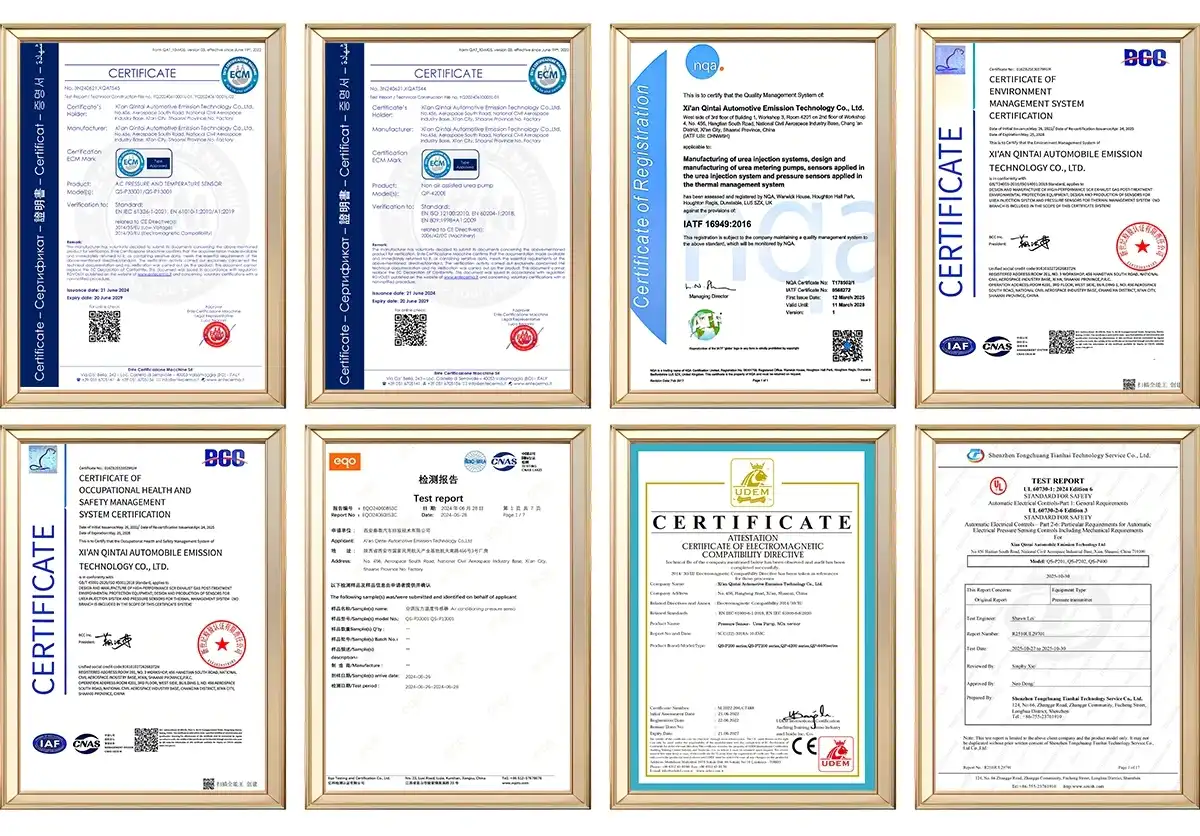
Xi'an Qintai Automotive Emission Technology makes the best Urea pump systems for heavy-duty uses that are very demanding. We are China's top original equipment manufacturer (OEM) seller, and we work with Weichai Power, Yuchai Power, and Quanchai Power. We provide the dependability and performance that tough diesel engine uses need. Our small, streamlined designs include pump systems, filters, heaters, and built-in freeze protection that works reliably down to -40°F. Qintai Urea pump systems are fully compatible with Bosch ECU control methods, so they will work perfectly with the platforms you already have. We offer full customization options that are made to fit your needs and are backed by ISO9001, IATF16949, and 58 idea patents. Get in touch with our expert team at info@qt-sensor.com to talk about your needs and get quotes from a reliable Urea pump maker that wants you to succeed.
References
1. Johnson, M. & Williams, R. (2021). Selective Catalytic Reduction Systems: Engineering and Applications. SAE International Press.
2. Environmental Protection Agency (2022). Heavy-Duty Engine and Vehicle Standards: Technical Analysis of NOx Control Technologies. EPA-420-R-22-003.
3. Schmidt, H., Chen, L., & Patel, K. (2020). "Comparative Performance Analysis of Urea Dosing Technologies in Commercial Vehicle Applications." Journal of Emission Control Science and Technology, 6(3), 245-262.
4. International Council on Clean Transportation (2023). Global Heavy-Duty Vehicle Emissions Standards and Compliance Technologies. ICCT White Paper Series.
5. Anderson, T. & Zhao, Y. (2022). "Predictive Maintenance Strategies for SCR Aftertreatment Components in Fleet Operations." SAE Technical Paper 2022-01-0583.
6. Automotive Aftertreatment Systems Association (2023). Industry Guidelines for Diesel Exhaust Fluid Dosing System Selection and Maintenance. AASA Technical Bulletin TB-2023-07.

Our customers’ satisfaction speaks for our quality — contact us to experience the same reliable service.