- English
- French
- German
- Portuguese
- Spanish
- Russian
- Japanese
- Korean
- Arabic
- Greek
- German
- Turkish
- Italian
- Danish
- Romanian
- Indonesian
- Czech
- Afrikaans
- Swedish
- Polish
- Basque
- Catalan
- Esperanto
- Hindi
- Lao
- Albanian
- Amharic
- Armenian
- Azerbaijani
- Belarusian
- Bengali
- Bosnian
- Bulgarian
- Cebuano
- Chichewa
- Corsican
- Croatian
- Dutch
- Estonian
- Filipino
- Finnish
- Frisian
- Galician
- Georgian
- Gujarati
- Haitian
- Hausa
- Hawaiian
- Hebrew
- Hmong
- Hungarian
- Icelandic
- Igbo
- Javanese
- Kannada
- Kazakh
- Khmer
- Kurdish
- Kyrgyz
- Latin
- Latvian
- Lithuanian
- Luxembou..
- Macedonian
- Malagasy
- Malay
- Malayalam
- Maltese
- Maori
- Marathi
- Mongolian
- Burmese
- Nepali
- Norwegian
- Pashto
- Persian
- Punjabi
- Serbian
- Sesotho
- Sinhala
- Slovak
- Slovenian
- Somali
- Samoan
- Scots Gaelic
- Shona
- Sindhi
- Sundanese
- Swahili
- Tajik
- Tamil
- Telugu
- Thai
- Ukrainian
- Urdu
- Uzbek
- Vietnamese
- Welsh
- Xhosa
- Yiddish
- Yoruba
- Zulu
What Are the Symptoms of a Failing Nox Sensor in Diesel Truck Engines?
A failing NOx sensor usually shows up as a check engine or SCR warning light, stored fault codes such as P2201 or P20EE, reduced power, and engine derating. You may also see unusual Diesel Exhaust Fluid (DEF) use, a failed emissions test, or live-data readings that make no sense for the engine load. Damaged wiring or a loose connector can point the same way. These signs do not prove the sensor is dead, because poor DEF, dosing faults, or exhaust leaks can trigger the same alerts. I recommend testing the whole aftertreatment system before you buy a replacement.
The sensor reports nitrogen oxide levels to the engine control unit (ECU), which adjusts SCR dosing to meet EPA and Euro VI rules. When it fails, trucks face derating, downtime, failed inspections, and costly emergency repairs. This guide helps fleet managers, engineers, and buyers find the true fault, test the system correctly, and choose a compatible replacement.
How a NOx Sensor Works in a Diesel Aftertreatment System
What a NOx Sensor Measures
If you drive a diesel car, a NOx sensor will check the exhaust for nitrogen oxides, mostly nitric oxide and nitrogen dioxide. When you heat a zirconia ceramic cell, oxygen ions move inside it. The first thing it does is control how much oxygen is in the air. Next, it shows NOx as a small current of electricity. A control module turns it into data and sends it to the ECU over the CAN bus. It helps the ECU figure out how much DEF to use and see how well the SCR converter is working. An EPA rule from 2010 says that heavy-duty NOx can't be more than 0.2 grams per brake horsepower-hour. It is important that the module, harness, connector, and sensing element all work together. It might look like the sensor is broken if any of them are broken.
Upstream and Downstream Positions
Most new trucks have two sensors. It tells the ECU how much NOx is leaving the engine and is located in front of the SCR converter. This tells the ECU how much DEF to add. The screen that shows up after the conversion is like a report card. If the ECU sees high NOx, it may set a code, turn on the warning light, and slow down the engine. Too much DEF can also make ammonia leak, which some NOx sensors mistake for NOx. Because they do different things and often have different part names, you can't always switch them. Make sure you know where it is before you order.
Platform Differences Across Truck Brands
This part talks about where to put the NOx sensor, what kind of link to use, and what tools you'll need. It is important to know that Volvo, Mercedes-Benz, Cummins, and Scania all have their own CAN signals, mounting points, and harness patterns. Adding farm and building tools makes things more interesting. A sensor that works with one engine might not really be able to talk to another ECU. Make sure that the OE number, engine type, production year, and pollution standard all match before you buy something. When people order, they often make the mistake of getting a sensor that fits the exhaust pipe but can't talk to the truck.
Common Symptoms of a Failing NOx Sensor
Warning Lights and Fault Codes
Check engine or SCR light is often the first sign. After that, a scan tool might show P2200, P2201, or P20EE. P2201 is about the NOx sensor range or performance in bank 1, and P20EE is about the SCR efficiency being less than the threshold in bank 1. Some brands use codes in different ways, so make sure you check the repair manual. Write down all the new, pending, and old numbers before you clear anything. Codes that are still being worked on often show that the issue is getting worse. This gives the fleet time to fix things up before the derate.
Derating, Power Loss, and Fuel or DEF Changes
If the ECU doesn't trust the NOx data, it may lower the power, put the car into limp mode, or stop it from going faster. People say it feels like the power goes out all of a sudden or like the truck won't move. The ECU could also change the settings for the engine, which could make the amount of DEF used change more or less than usual. The gas mileage might also change. These changes cost money because of the time they take to make and the tows. This is why I never see a derate as a sign of a bad NOx sensor. You might also have these signs if your DPF is clogged, your dose is off, or your EGR is stuck.
Failed Tests, Odd Readings, and Physical Damage
If a pollution test fails, it could mean that NOx levels are too high. You can also have live data that doesn't make sense, like a value that stays the same or a reading that is the same downstream as upstream while DEF is dosing. After that, check the gear. You should look for damage from heat, a loose mount, soot and oil on the sensor body, and wires that are burned or chafed. In this group is insulation that is cracked and has green corrosion on it. Damage is often the cause of strange readings, and it's much cheaper to fix a circuit than to buy a new NOx sensor.

Why NOx Sensors Fail and How to Diagnose Them?
Heat, Vibration, and Contamination
A NOx sensor lives in a rough spot. Waste heat, regeneration cycles, and sudden changes in temperature all put a lot of stress on the ceramic element. It breaks out wires and makes mounts come loose. Things that are dirty, like soot, oil, coolant, and DEF, can block the sensing surface. The element can get hurt over time by compounds of lead or sulfur. When it comes to power, corroded connectors, bad lines, and CAN faults can all cause signal delays. It won't fail again if you run something the right way. Be sure the sensor is in the right place and that it is tightened to the right pressure. Also, keep the wire away from any moving or hot parts and make sure it meets the emissions standard.
Faults That Mimic Sensor Failure
There are a few things that can cause NOx codes, but the sensor is fine. If the NOx reading is off, it could be because of bad DEF, a weak DEF injector, an exhaust leak before the sensor, an old SCR converter, or a problem with the EGR. Deionized water mixed with 32.5% urea is what ISO 22241 calls for, and DEF should have that. Find the root cause to save money. You need to get a new good NOx sensor to clear the code. This holds the truck over until the real fix can be made.
NOx Sensor vs. Oxygen Sensor
These two parts look alike but do unique tasks. When engines mix air and fuel, a sensor that measures the amount of oxygen in the air helps them get the mix just right. Many types of the NOx sensor can also measure oxygen to help keep the process under control after treatment. Because their signals, connectors, and software are different, an oxygen sensor can't be used instead of a NOx sensor. The NOx sensors upstream and downstream might also be different. Bought items should be checked for more than just thread size. Buyers should also look at OE cross-references, connection form, and position.
Step-by-Step Testing and Calibration
Start with codes and feeds. Then check the sensor, wiring, and exhaust for damage or leaks. And a tool to check the CAN, power, ground, and heater circuits. The EGR, compressor, DPF, and SCR converter should all be checked. Along with the engine load, exhaust temperature, and DEF dose, you should also compare the NOx levels upstream and downstream. It's important to replace the NOx sensor if it turns out to be the issue. After that, clear the codes and make any changes or tweaks that the engine maker asks for. Finally, test the car on the road. If the same thing fails more than once, you need to keep track of the fix, the miles, and the supplier.
Choosing and Buying a Replacement NOx Sensor
OEM vs. Aftermarket Comparison
Price by itself is not a good sign. To get the best deal, you should look at things like fit, signal stability, ECU communication, connector design, harness length, heat protection, the need for calibration, and the terms of the guaranty. Some of the OE brands that set the standard are Mercedes-Benz, Volvo, Cummins, Bosch, and Scania. The interface can be matched by qualified aftermarket makers, but they will charge more for a high-quality NOx sensor. Add the price to the time it takes to arrive, the time it takes to set up, the time it takes to be down, and the chance that something will go wrong to get the real cost. A less expensive sensor that breaks easily costs more than a better one that only needs to be installed once most of the time.
Buying Online for Fleet and B2B Orders
Before you place an order, make sure you know the model of the truck, the engine, the production year, the pollution standard, the position of the NOx sensors, the OE number, the type of link, and any problem codes. Find out how much stock they have and where their warehouse is located. The time it takes to ship and the paperwork that needs to be filled out for imports can change when repairs need to be done. If you want to buy in bulk or as a wholesaler, check the minimum orders, mixed-SKU options, freight, duties, and paperwork. When you need to make quick repairs, having parts on hand can cut down on downtime. But only if the seller confirms that the description fits your needs.
Evaluating a Dependable NOx Sensor Supplier
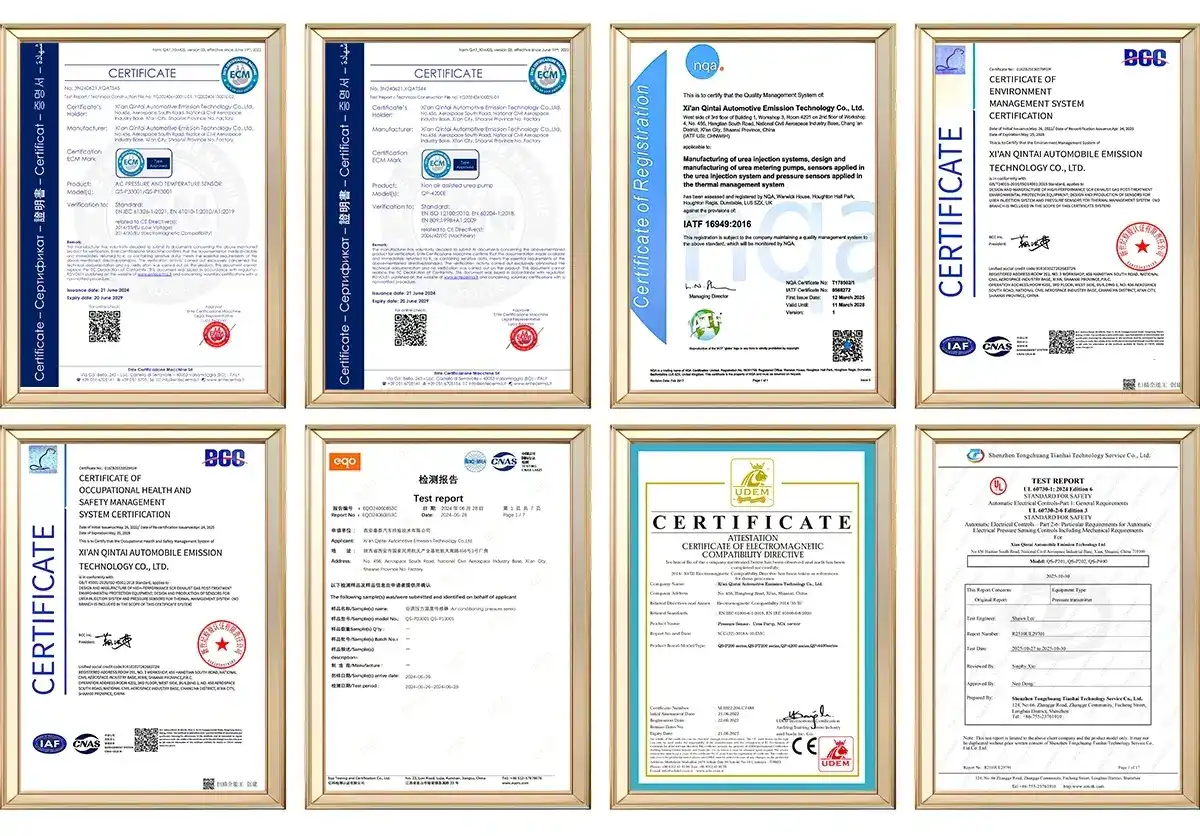
Technical help, a lot of different uses, and correct OE cross-references are all things that a good supplier should offer. You should ask about things like batch tracking, end-of-line testing, stability tests, interface tests, and checking the machine as it comes in. Check how they handle guarantees, how much experience they have with exporting, and how many return orders they have. Qintai is a national tech company that was founded in 2001. It has REACH, CE, ISO9001, IATF16949, CMC, Ex, UL, CE, RoHS, and 58 idea patents. This business gives a lot of power to Weichai Power, Yuchai Power, and Quanchai Power. Anyone that you ask for proof will give it to you.
Qintai NOx Sensor Features for Diesel Applications
Response, Startup, and Service Life
It takes less than 1400 ms for the Qintai NOx sensors to respond, which is 33% to 66% of the final value. This lets the SCR system adapt to changes in the exhaust. With a time of less than 165 seconds, it turns off and starts up much faster than the norm in the business. In this way, the emission control can begin to work more quickly after a cold start. It can be used for up to 6,000 hours, which is longer than most in the business. This means that a fleet will need fewer replacements and will have to spend less on repairs.
Poisoning Resistance and Interface Compatibility
Diesel smoke has bad things in it. Pollution from lead and sulfur doesn't hurt Qintai NOx sensors much, which helps them keep their signal accuracy for longer. Because the design is sealed and waterproof, it works very well and sends a stable signal. You can change the connectors and cable lengths for different uses. You can also change the look and feel of the interface to match popular OEM goods. This program can connect to more than 300 different kinds of protocols. One more thing that Qintai does is offer OEM and ODM services. These help integrators who need custom ports and settings by taking care of the whole process, from design to mass production.
Technical Specifications
The following are the parameters that engineers and buying teams are most interested in:
| Parameter | Specification |
|---|---|
| NOx measuring range | 0~2500 ppm |
| NOx accuracy | ±10 ppm (0~100 ppm); ±10% (100~500 ppm); ±15% (500~1500 ppm); ±30% (1500~2500 ppm) |
| O2 measuring range | 0%~21% |
| O2 accuracy | ±0.2% (0%~5%); ±4% (5%~21%) |
| Response time | <1400 ms (33% to 66% final value) |
| Supply voltage | 9~32 V |
| Light-off time | <165 s |
| Operating temperature (NOx) | 100°C to 800°C |
| Exhaust gas temperature | -40°C to 800°C |
| Cable temperature range | -40°C to 200°C |
| Mounting thread | M20x1.5 |
These numbers can help engineers make sure that the electrical, heat, and mechanical parts are right for the job before they place an order.
Conclusion
If your NOx sensor stops working, you may see warning lights, codes such as P2201 or P20EE, the engine detuning, unusual DEF or fuel use, failed emissions tests, live data that doesn't make sense, or wires that are broken. Because these signs can also be caused by bad DEF, wrong doses, exhaust leaks, EGR faults, and SCR converter wear, they don't show that the sensor is broken. Most real failures are caused by things like too much heat, vibration, dirt, or issues with the electricity. You need to check the codes, circuits, and live data in a planned way to tell them apart. A NOx sensor and an oxygen sensor are also not the same, so the position, OE reference, connection, and pollution standard must all be the same. Buyers need to look at more than just the price. They need to see how much it costs all together, any paperwork, and written specs.
FAQ
How long does a NOx sensor last?
Look at the data that came with it to find out how long it will last based on heat, duty cycle, and contamination. Qintai states that their NOx sensor can last up to 6000 hours.
Can I still drive if my NOx sensor is broken?
Sometimes the ECU will cut power or speed, even if the truck can still run. It could fail an inspection. Make a check soon.
Does P20EE always mean the sensor is broken?
No, P20EE says the SCR isn't working right. This can happen if the DEF is bad, the dose is wrong, there are exhaust leaks, or the SCR converter is worn out. Check before you change the NOx sensor.
Can a NOx sensor be fixed or cleaned?
The clay part and the electronics are both sealed, so cleaning them might not always work. If a NOx sensor has been shown to be broken, it needs to be replaced. Any wires or connections that are broken should also be fixed.
Can I use the same monitor on more than one brand of truck?
Everything must match: the software, the OE number, the position, the connector, the emissions standard, and the number of tries. Qintai can make custom interfaces and works with more than 300 different communication ways.
Contact Qintai for a NOx Sensor Quote and Compatibility Check
Qintai is a national high-tech company started in 2001. They can help you find a NOx sensor that works with your engine, connector, and protocol. We have been making NOx sensors for a long time, and have customers in over 60 countries. We can make custom wire lengths and do OEM and ODM work. Send your engine type, OE number, sensor location, fault codes, and amount to info@qt-sensor.com.
References
1. Federal Register, 2001. Control of Air Pollution from New Motor Vehicles: Heavy-Duty Engine and Vehicle Standards and Highway Diesel Fuel Sulfur Control Requirements.
2. Official Journal of the European Union, 2011. Commission Regulation (EU) No 582/2011 on Euro VI Heavy-Duty Vehicle Emissions.
3. International Organization for Standardization, 2019. ISO 22241-1: Diesel Engines, NOx Reduction Agent AUS 32, Quality Requirements.
4. International Journal of Applied Ceramic Technology, 2005. A Brief Overview on Automotive Exhaust Gas Sensors Based on Electroceramics.
5. SAE Technical Paper 970858, 1997. Performance of Thick Film NOx Sensor on Diesel and Gasoline Engines.
6. Bosch Automotive Handbook, 2018. 10th Edition.

Our customers’ satisfaction speaks for our quality — contact us to experience the same reliable service.