- English
- French
- German
- Portuguese
- Spanish
- Russian
- Japanese
- Korean
- Arabic
- Greek
- German
- Turkish
- Italian
- Danish
- Romanian
- Indonesian
- Czech
- Afrikaans
- Swedish
- Polish
- Basque
- Catalan
- Esperanto
- Hindi
- Lao
- Albanian
- Amharic
- Armenian
- Azerbaijani
- Belarusian
- Bengali
- Bosnian
- Bulgarian
- Cebuano
- Chichewa
- Corsican
- Croatian
- Dutch
- Estonian
- Filipino
- Finnish
- Frisian
- Galician
- Georgian
- Gujarati
- Haitian
- Hausa
- Hawaiian
- Hebrew
- Hmong
- Hungarian
- Icelandic
- Igbo
- Javanese
- Kannada
- Kazakh
- Khmer
- Kurdish
- Kyrgyz
- Latin
- Latvian
- Lithuanian
- Luxembou..
- Macedonian
- Malagasy
- Malay
- Malayalam
- Maltese
- Maori
- Marathi
- Mongolian
- Burmese
- Nepali
- Norwegian
- Pashto
- Persian
- Punjabi
- Serbian
- Sesotho
- Sinhala
- Slovak
- Slovenian
- Somali
- Samoan
- Scots Gaelic
- Shona
- Sindhi
- Sundanese
- Swahili
- Tajik
- Tamil
- Telugu
- Thai
- Ukrainian
- Urdu
- Uzbek
- Vietnamese
- Welsh
- Xhosa
- Yiddish
- Yoruba
- Zulu
Which Capacitive Pressure Sensor Specs Matter Most in Selection?
The specs that matter most when you choose a capacitive pressure sensor are pressure range with overload rating, accuracy stated with its test conditions, temperature drift, output signal, supply voltage, and wetted material compatibility. Start with the application, because the medium, temperature, and pressure spikes decide which numbers carry the most weight. Then compare nonlinearity, zero drift, and operating temperature on the same basis across suppliers. Finally, check certifications, documentation, and sample test results. I wrote this guide for OEM engineers, buyers, integrators, and distributors who need a clear way to compare datasheets before ordering.

Start With the Application and Mechanical Needs
Define the Application Before Comparing Capacitive Pressure Sensor Specs
I always begin with the user's needs instead of the datasheet. The first thing you need to do is choose whether you need absolute, differential, vacuum, gauge, or compound pressure. Building sensors and figuring out what they mean are different for each type. Next, make a note of whether the pressure changes quickly or stays the same. This will let you know how long you have to act. Then write down where the installation is, what the medium is, the temperature range, the humidity, the vibrations, and the noise from the electricity. It doesn't matter how good the sensor looks on paper; it might not work if the medium attacks the diaphragm or if engine vibration reaches the connection. In the long run, writing down these facts can save weeks of checking samples.
Pressure Range and Overload Capacity
Choose a range that is not too big, but big enough to cover both everyday use and short spikes. It's not very accurate for sensors that read 600 bar but only use 5 bar because they only use a small part of their range. Something bad could happen if the range is too small. When the pump starts up or the valves turn, it's important to know the difference between the rated range, the proof pressure, and the burst pressure. The QS-P105 is marked with a safety overload of 200% FS. In other words, a 100-bar unit can handle 200-bar surges. The numbers should also be converted before people in the US check the prices, since 100 bar is the same as 1,450 psi.
Mechanical Construction and Materials
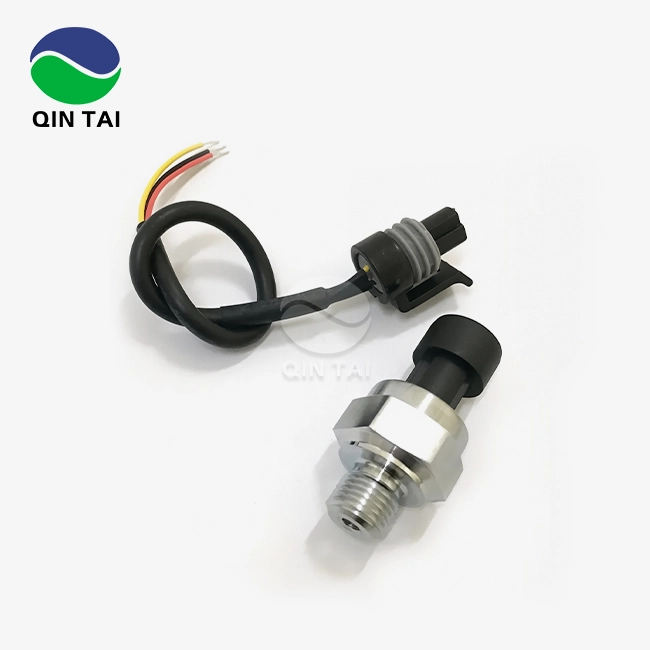
Your materials' service life will depend on how wetted they are and how they are attached. It's important that the metal, how it's sealed, the housing, and the type of thread on the diaphragm all match the medium and port on your machinery. Ceramic diaphragms, like the 96% Al2O3 in the QS-P105 capacitive pressure sensor, don't wear down or rust easily, which is good for rough or dirty media. Do not forget to check the thread size, O-ring material, leakage rate, ingress protection grade, and fixing position before you place your order. A small difference, like an NPT port meeting a metric thread, can stop a line of work while adapters are being made.
Accuracy, Stability, and Temperature Performance
Accuracy, Sensitivity, and Resolution
If you don't know what the numbers mean, they don't mean much. If the number is ±0.5% FS, it means that the full scale can be off by that much. In other words, a 10 bar sensor might be off by 0.05 bar. You should also look for nonlinearity, hysteresis, and stability, along with zero shift. Find out what range of temperatures the figure shows as well. mV/V is the unit of sensitivity for bridge-type outputs. It tells you how much signal you get for every volt of supply. The QS-P105F is accurate to within 0.5% FS, sensitive to 2 to 4 mV/V, and nonlinear to 0.3% FS. Your amp, cable, and converter can also change how clear your signal is.
Long-Term Stability and Calibration
Drift costs money after the game is over. The zero shift, long-term drift, and calibration interval of a sensor show how often it needs to be replaced or recalibrated. There is a zero shift of less than 0.2 mV/V in the QS-P105F at 23°C. It is important to find out how the suppliers test for stability and if there are calibration records for each batch. There are general ways to judge the performance of process tools in standards like IEC 61298. This means that you can ask for tests in a consistent way. When a lot of units need to work the same, OEM production is the best place to have steady zero behavior.
Temperature Compensation and Environmental Limits
The electronics, the distance between the electrodes, and the stiffness of the diaphragm all change when a sensor gets hot. In other words, zero and span can move. The working, compensated, and storage ranges should all be kept separate. This is because a big operating range does not always mean high accuracy. The QS-P105F capacitive pressure sensor can work in temperatures ranging from -40°C to 135°C. Its zero temperature drift won't change more than 0.03% FS/°C between 2 and 50 bar or more than 0.04% FS/°C between 50 and 600 bar. In this case, 0.03% FS/°C over a range of 30°C can add up to 0.9% FS zero shift. Check out the vibration, humidity, and electrical noise at the construction site as well.
Electrical Output and Technology Choice
Output Signal and Supply Voltage
Before you use the result, make sure it works with your controller. There are analog voltage, millivolt, and 4–20 mA outputs that can be used with PLCs and industrial controls. I²C, SPI, and CAN are some examples of digital interfaces that can be used with embedded or networked designs. It is important to check the excitation voltage, the shielding, the grounding, the length of the cable, and the type of connector. The QS-P105F can work with any power source that has 2 to 30 VDC. It has a bridge resistance of 11±30% kΩ, which gives power planners some options. Devices that run on batteries can also use it since it doesn't need a lot of power. Make sure that your front-end amplifier can handle data that is millivolts per volt before you finish the circuit.
Integration With Controllers and Aftertreatment Systems
People who work with electronics want to make sure that a sensor works well with what they already have. Before the first prototype is made, make sure your circuits team knows what kind of output, supply range, and connector you want. To boost and condition a millivolt bridge output, you need amplification. Make sure your ECU or signal board has it. Talk to the seller to find out if the interface or settings can be changed. Qintai specializes in SCR aftertreatment and sensors for diesel engines since 2001. They can be changed to fit different needs. As soon as possible, get a picture, a sample, and proof of the specs for engine jobs. This way, the software and wiring teams can work from the same numbers.
Capacitive Pressure Sensor Comparison: Which Technology Is Best?
The formula C = ε₀εᵣA/d is used to find the change in the space between an electrode that doesn't move and a diaphragm that does. This design is good for work with low pressure and batteries because it is very sensitive and doesn't use much power. Capacitive pressure sensor designs need to shield and ground themselves because they can pick up electromagnetic noise. Most of the time, strain gauge and piezoresistive sensors can measure higher pressures for less money. Piezoelectric devices can handle shocks and changes that only last a short time, but they can't hold a static reading. You should think about how a technology responds to pressure, temperature, overload, signal type, cost, and how hard it is to combine before you choose it.

Matching Specs to Applications and the Qintai QS-P105
Matching Specs to Common B2B Applications
Skills needed for various jobs vary in priority. Low-pressure systems in medical, lab, and HVAC need to be very sensitive, make very little noise, and stay at zero. For high-precision static measurements to work, they need to be able to be repeated again and again with little change. Systems that move quickly need to be able to react and filter quickly as well. Vibration, heat, and dirty media are the worst things that can happen to heavy-duty engines, generator sets, and construction equipment. Give details about the package's size, power consumption, custom calibration, and how consistent each batch is for OEM buyers. Make a small list of your most important needs before you ask for quotes. Everyone who wants to sell will have to answer the same questions.
Qintai QS-P105: Key Features
The QS-P105 has these main features. It's made to handle high pressure, doesn't rust, is easy to put together, and can be changed to fit your needs. It has a safety overload of 200% FS, a sensitivity of 2 to 4 mV/V, a nonlinearity of 0.3% FS, and a bridge resistance of 11±30% kΩ. It has a supply range of 2 to 30 VDC, which gives you more choices. It also uses little power, which makes it good for battery-powered designs. Most buyers want to know how good the signal is, how to protect against pressure spikes, and how stable the output is. These features answer those questions.
QS-P105F Technical Specifications
| Parameter | Specification |
|---|---|
| Model | QS-P105F |
| Pressure range | -1/0 bar, 2, 5, 10, 20, 30, 40, 50, 80, 100, 200, 400, 600 bar |
| Sensitivity | 2...4.0 mV/V |
| Non-linearity | 0.3% FS |
| Zero temperature drift | <0.03% FS/°C (2-50 bar), <0.04% FS/°C (50-600 bar) |
| Zero shift | <0.2 mV/V |
| Supply voltage | 2...30 VDC |
| Zero output | ±0.2 mV/V (23℃) |
| Safety overload | 200% FS |
| Overall accuracy | ≤±0.5% FS |
| Diaphragm material | 96% Al2O3 |
| Bridge resistance | 11±30% kΩ |
| Operating temperature | -40°C to 135°C |
To give you an idea, 200 bar is equal to 2,900 psi and 600 bar is equal to 8,700 psi.
Where the QS-P105 Fits in OEM and Industrial Projects
There is a range of products that can be used on many pressure points on an engine, generator set, or machine. The range goes from -1/0 bar to 600 bar. Because it has a ceramic diaphragm and can handle up to 135°C of heat, it can be used in rough and hot service. Qintai offers OEM and ODM services, which include designing products and mass production. Customers can also request changes to suit their needs. Please make sure that the model fits your pressure medium and approval needs before you place your order. Also, I think you should ask for a sample and test it on your own tools before you place a big order.
Supplier Evaluation and Verification Before Volume Purchase
Supplier and Manufacturer Evaluation
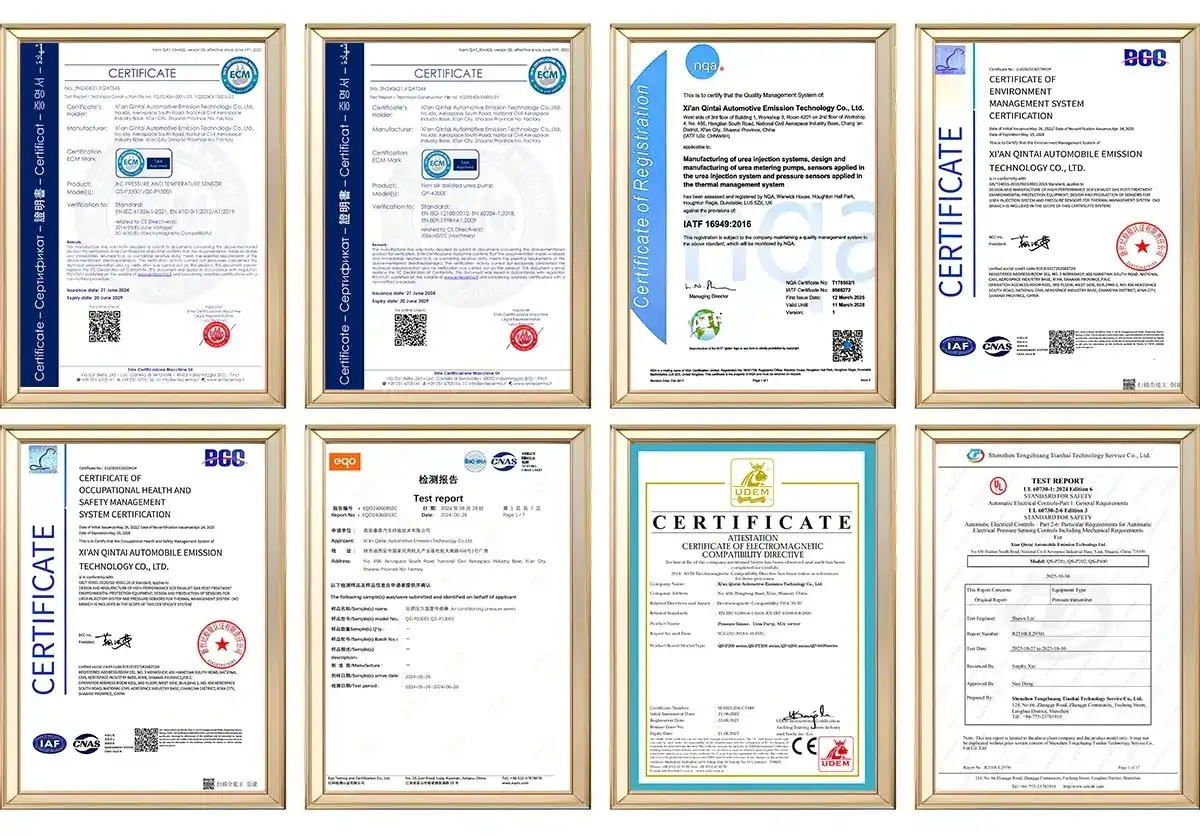
A good supplier gives you more than just a datasheet. For example, you could ask for dimension drawings, installation notes, information on overloads, definitions of accuracy, information on the material, calibration certificates, and records of compliance. Check the level of engineering, the ability to make changes, the capability of production, the quality control, and the history of on-time supplies. In 2001, Qintai, a national high-tech company, was set up. It is certified by ISO9001, IATF16949, CMC, Ex, UL, CE, REACH, and RoHS. It has also applied for 58 invention patents and is one of the main suppliers to Weichai Power, Yuchai Power, and Quanchai Power. Look at prices by how much they cost all together, including calibration, minimum order, shipping, and warranty. Make sure you know which certificates work with your model capacitive pressure sensor.
A Practical Selection Checklist and Common Mistakes
Do the things on this list in the right order. It is important to specify the pressure type, range, and medium. Check to see what you need in terms of accuracy, temperature, vibration, and sealing. As well as the supply voltage and connection, make sure that the controller fits. Finally, get samples from each supplier and rate them on how well they perform, how well they follow compliance, and how much they charge all together. Most of the time, mistakes are made because the range is too big and resolution is lost, the accuracy figure has no test conditions, temperature drift is ignored, or the controller cannot read the output. You might have to pay more for things like recalibration, downtime, or late shipping if you try to get the lowest unit price. Before you decide what to do, think about these costs.
Sample Verification Before Volume Purchase
Pressure, temperature, medium, vibration, and mounting are all real-life situations that should be used to test the samples. Compare the numbers to a calibrated standard and write down how they behave at zero, when there is no signal, when there is noise, how long it takes to respond, how repeatable they are, and how they react to overload. Before the test starts, decide what pass-or-fail means. Then, make sure that the production units use the same materials, inspection standards, and way of calibrating as the tested samples. When something is approved, it should come with drawings, records of testing, compliance statements, guarantee terms, and a way to let people know about changes. Once that file is full, you can be sure that your technical, buying, and management teams will give the provider the green light.
Conclusion
To choose a capacitive pressure sensor, all you have to do is match a short list of specs to what you should use it for. Since the sensor can handle a wide range of pressures and overloaded conditions, it is safe from spikes. But accuracy, nonlinearity, and zero drift are only useful when you know how to test them. When the sensor is out in the real world, its working boundaries and temperature factors show how it works. Its output type and supply voltage let us know if it works with the controller. When there are big changes in voltage or pressure, another technology might work better. Capacitive pressure sensor designs, on the other hand, work best for sensitive, low-power tasks. The QS-P105F data shows how these numbers look on a datasheet. The supplier's paperwork, licenses, and testing of samples show that the output units match the approved samples.
FAQ
Which capacitive pressure sensor specs matter most?
I rank pressure range with overload rating, accuracy with stated test conditions, temperature drift, output signal, supply voltage, and wetted materials first. Make sure you know the medium, temperature, and pressure spikes before you compare datasheets. The order changes based on how it is used.
Should I choose analog or digital output?
For embedded or networked designs, digital connections work best. On the other hand, analog outputs work best with PLCs and basic controls. If you don't want to buy and pay for extra gear, choose the type that your controller can read directly.
What supply voltage does the QS-P105F accept?
The QS-P105F can handle voltages from 2 to 30 VDC. Because it doesn't need much power, it can be used in battery-powered gadgets. The wide supply range also helps designers plan for power.
Can Qintai customize a sensor for my project?
Yes, Qintai does offer OEM and ODM services that let you change how a product works and looks from the design stage all the way through mass production. Send an email to info@qt-sensor.com with your pressure range, medium, temperature, output, and volume of the capacitive pressure sensor.
Request a Capacitive Pressure Sensor Quote From Qintai
Qintai can help you choose the best capacitive pressure sensor for your engine, generator, or other piece of gear. We are a company that sells capacitive pressure sensors. We have our own research and development team, are certified by ISO9001 and IATF16949, and offer both OEM and ODM service. We could share datasheets, come up with a model, and set up samples. Contact us and tell us about your pressure range, medium, temperature, output, and annual amount in an email to info@qt-sensor.com.
References
1. Handbook of Modern Sensors: Physics, Designs, and Applications, 2016
2. Sensor Technology Handbook, 2005
3. Measurement, Instrumentation, and Sensors Handbook, 2014
4. IEC 61298-2: Process Measurement and Control Devices, General Methods and Procedures for Evaluating Performance, Part 2: Tests Under Reference Conditions, 2008
5. International Journal of Engineering and Technology, "MEMS Capacitive Pressure Sensors: A Review on Recent Development and Prospective," 2013
6. Instrument Engineers' Handbook, Volume 1: Process Measurement and Analysis, 2003

Our customers’ satisfaction speaks for our quality — contact us to experience the same reliable service.