- English
- French
- German
- Portuguese
- Spanish
- Russian
- Japanese
- Korean
- Arabic
- Greek
- German
- Turkish
- Italian
- Danish
- Romanian
- Indonesian
- Czech
- Afrikaans
- Swedish
- Polish
- Basque
- Catalan
- Esperanto
- Hindi
- Lao
- Albanian
- Amharic
- Armenian
- Azerbaijani
- Belarusian
- Bengali
- Bosnian
- Bulgarian
- Cebuano
- Chichewa
- Corsican
- Croatian
- Dutch
- Estonian
- Filipino
- Finnish
- Frisian
- Galician
- Georgian
- Gujarati
- Haitian
- Hausa
- Hawaiian
- Hebrew
- Hmong
- Hungarian
- Icelandic
- Igbo
- Javanese
- Kannada
- Kazakh
- Khmer
- Kurdish
- Kyrgyz
- Latin
- Latvian
- Lithuanian
- Luxembou..
- Macedonian
- Malagasy
- Malay
- Malayalam
- Maltese
- Maori
- Marathi
- Mongolian
- Burmese
- Nepali
- Norwegian
- Pashto
- Persian
- Punjabi
- Serbian
- Sesotho
- Sinhala
- Slovak
- Slovenian
- Somali
- Samoan
- Scots Gaelic
- Shona
- Sindhi
- Sundanese
- Swahili
- Tajik
- Tamil
- Telugu
- Thai
- Ukrainian
- Urdu
- Uzbek
- Vietnamese
- Welsh
- Xhosa
- Yiddish
- Yoruba
- Zulu
Top 5 Aftertreatment Dosing Unit Benefits for Fleet Operators
Running a modern diesel fleet means staying ahead of tightening emission laws, rising fuel costs, and growing pressure to prove environmental responsibility. One component that directly affects all three areas is the aftertreatment dosing unit — the device responsible for injecting Diesel Exhaust Fluid (DEF) into the exhaust stream so the SCR catalyst can convert harmful NOx into harmless nitrogen and water. Choosing the right dosing unit affects compliance status, operating costs, uptime, and procurement efficiency. This article walks through five concrete benefits that make this technology worth a closer look for fleet operators and OEM procurement teams alike.
Enhanced Emission Control and Regulatory Compliance
How Dosing Units Support SCR Performance
The right amount of DEF must be put into the device for it to work right. If the dosing module sends the wrong amount of fluid, the catalyst might not reduce NOx enough or use too much urea. This could lead to crystals and clogged filters. A finely tuned aftertreatment dosing unit makes sure that the injection stays in the right stoichiometric window. The EPA or Euro VI real-world drive emissions (RDE) tests will not pass if this is present.
Meeting Euro VI and EPA Tier 4 Final Requirements
Some NOx emissions must be less than 0.4 g/kWh under the new rules for Euro VI and EPA Tier 4. This is a big change from the old rules. Fleet owners could be fined, have their routes cut back, or even be told they can't drive in some places if they can't show they're following the rules. There needs to be a urea pumping system that works well with the other parts and a measured pressure monitor that can check flow at 0–12 bar and be accurate to within 1.5% full scale.
Environmental and CSR Value
Not only does less waste follow the rules, it also makes the ships look better to everyone. Contractors for a lot of transportation jobs now have to report Scope 1 pollution. When bidding and reporting on ESG, it's very helpful for operators to be able to regularly show that NOx levels have gone down through proper aftertreatment.
Improved Fuel Efficiency and Operational Cost Savings
Precision Dosing Reduces Waste
Many of the time, old-style DEF pumps add too much fluid when the load is light. It costs more to run the pump and loses fluid this way. Closed-loop dose systems can now read the NOx monitor data and the exhaust gas temperature right away. After that, the amount of fuel added changes based on what the catalyst needs.
Lower Maintenance Frequency
When extra urea doesn't react in the catalyst chamber, ammonium sulfate crystals form. This is because of better DEF doses, which can cut the amount of fluid used by 8–12% compared to older open-loop systems. There are doors to the injectors and the DPF that are blocked by these crystals. It's going to cost a lot to fix these blocks because parts need to be changed or cleaned out by hand. There is a lot less buildup as long as the aftertreatment dosing unit keeps the right dose and volume. This means that fixing cars takes longer and technicians work on each one for less time.
Onboard Diagnostics Integration
Most dosing units today talk to each other through the CAN bus of the car and send data to the ECU and the rental telemetry platform. Maintenance teams can find problems with pressure drops or sensor drift, like the P204B fault code for signal range mistakes, thanks to this link, before they make the whole system stop working. Early signs cut down on stops on the side of the road and keep the cost of ownership the same.
Increased Durability and Reliability Under Harsh Conditions
Material and Design Standards
Parts of construction and heavy cars are always in contact with a liquid urea solution that is 32.5%. These parts are also hit by vibrations from the road and temperature changes from -40°C to +125°C. Good aftertreatment dosing units have diaphragms made of 316L stainless steel or PPS (Polyphenylene Sulfide). They also have IP69K-rated housings that keep out fine dust and high-pressure wash-down water, and piezoresistive MEMS technology to keep the signal stable. The goals for service life are 15,000 to 20,000 hours in the field, so these specs aren't just words.
Freeze-Cycle Resilience
At -11°C, AdBlue/DEF freezes and gets about 9% bigger. The sensing diaphragm in a dose unit will break when it gets cold because it doesn't hold anything. The unit will go into limp mode and the pressure warning will stop right away. There is a buffer structure inside the best units that can handle this growth without any damage to the hardware or signal shift. For fleets that work in northern states or high up at mine sites, this is very important.
Supplier Support and Warranty Coverage
It doesn't matter how long something says it will last if you can't get new parts or help from a professional. When purchasing managers look at different sellers, they should make sure that the ones they pick sell common wear items, can answer technical questions quickly, and offer warranties with terms that match how long the car is expected to last. Keep the same sources for a long time when OEMs plan programs for mass production. This lowers the risk of sourcing.
Compatibility and Flexibility With Various Fleet Applications
Adapting to Diverse Engine Platforms
Most of the time, a group doesn't use just one type of engine. There are different types of flow requirements for long-haul trucks, farm tractors, generator sets at mine sites, and naval auxiliary engines. The ECUs must also be tuned to meet these requirements. An aftertreatment dosing unit with standard threads (M10×1 or M12×1.5) and output signals that can be analog (0.5V–4.5V) or digital (SENT protocol) can be used with many systems without having to change the wires for each one.
Modular Systems for Future Regulatory Changes
The rules for clean air are always changing. The aftertreatment system doesn't have to be replaced all the way when new rules come out. Not at all. With a modular architecture dosing system, they can just change out sensor parts or the firmware. This method keeps investments safe and cuts down on the time needed to switch gears when tight deadlines from the government appear out of nowhere.
Telematics and Fleet Management Integration
Telematics screens can show data from dose units that lets fleet managers see how much DEF is being used, how the pressure is changing, and a history of any problems that have happened with any of the cars in the fleet. This data is used from a central operations tool to plan routes, set up preventative maintenance, and keep records that are needed by law.
Simplified Procurement and After-Sales Experience for Fleet Managers
Evaluating Total Cost of Ownership
Outline for buying only has one line with the price put on it. The unit price, the expected DEF savings, the average number of faults, the warranty coverage, and the cost of unplanned downtime for each event are all compared more accurately. It's likely that the more expensive aftertreatment dosing unit will cost less over three years than the cheaper one if it has a better mean-time-between-failure (MTBF) record.
Bulk Purchasing and Inventory Planning
Standardized part numbers help fleet owners who have repair shops in one place keep all of their cars in good shape. It's easier to keep track of a lot of different SKUs when providers offer OEM and ODM production, which includes setting up guidelines, custom labels, and packing. To handle high demand during busy maintenance times, they should make sure they have extra stock on hand. The lines will stop working if they don't, and each unit will cost more to fix.
Supplier Qualification and Certification Checks
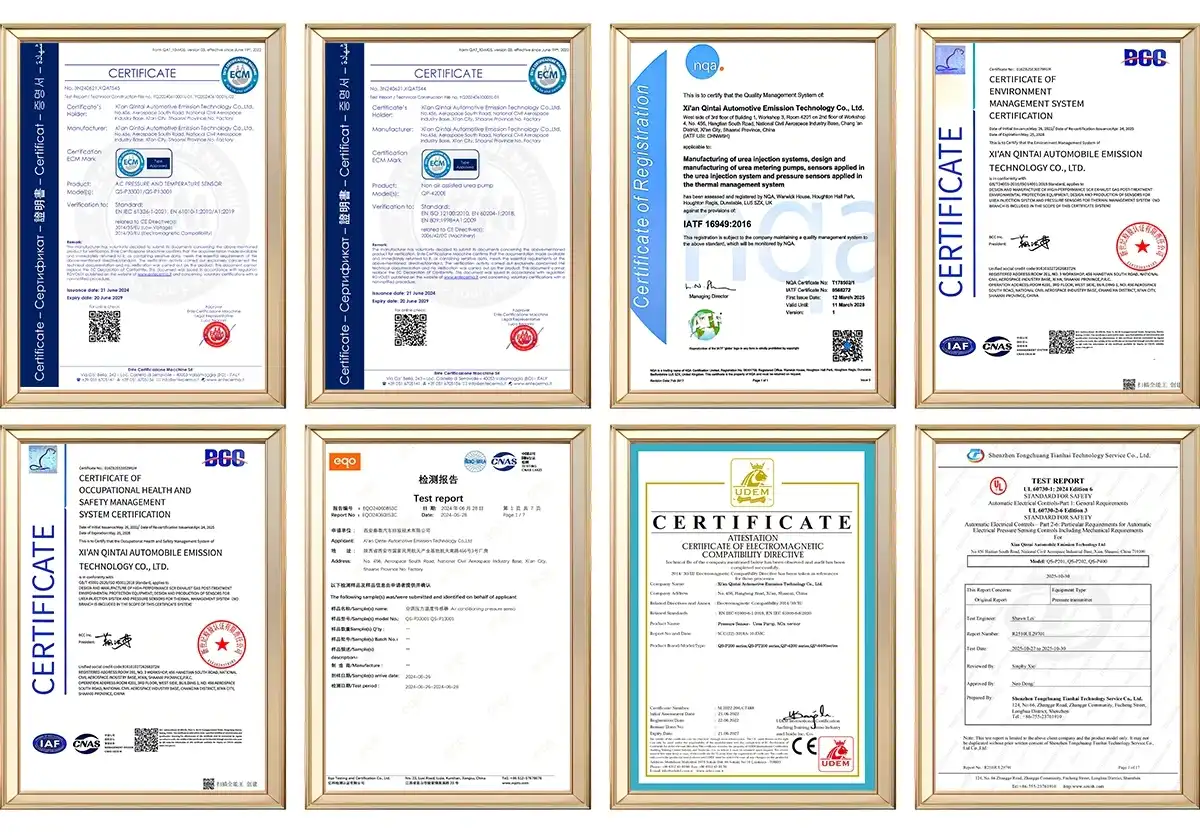
Before teams buy dose units, they should check to see if the company has both ISO9001 and IATF16949 quality management certifications. Plus, they should make sure that the goods have any local approvals they need, like CE, UL, or REACH/RoHS follow-through. This proof shows that the factory has kept track of its processes, which is what most companies that make big trucks and machinery need to get OEM approval.
Conclusion
To get the most out of your diesel fleet, pay close attention to the parts that manage pollution, gas mileage, and system life. All five of these things can be changed by a well-defined aftertreatment dosing unit: following the rules, running costs, reliability in the field, cross-platform adaptability, and how much it costs to buy. This will help operators keep prices low and meet new standards. When they choose parts, they should look at the technical specs and the seller's name. It's true and has worked before.
FAQ
What causes the P204B fault code in SCR systems?
Some signals are moving around because the urea pressure sensor is old or the pins that connect it are dirty. If you see the number P204B, this is likely the case. If the wires are gold-plated, this kind of failure is much less likely to happen with the sensor link.
Can one dosing unit work across different truck brands?
Most of the time, the pin sizes are the same, but the ECU needs to be set to send an analog or SENT signal. Make sure that both devices can receive the texts before you place your order.
How does a dosing unit handle DEF freezing?
When the quality units are turned on, they have a store inside that can handle the extra 9% amount of frozen DEF. This keeps the sensing diaphragm safe during cold starts.
What is the expected service life?
Dosing monitors that are well-made and used in normal work cars should last between 15,000 and 20,000 hours of normal use.
What certifications should I look for in a supplier?
If a seller has base certificates like IATF16949, ISO9001, CE, UL, REACH, and RoHS, it means they manage and make products that meet international quality standards.
Partner With Qintai for Your Aftertreatment Dosing Unit Supply
Since 2001, Xi'an Qintai Automotive Emission Technology Co., Ltd. has set up SCR aftertreatment systems and made parts for them. The company is licensed by IATF16949 and ISO9001 to make aftertreatment dosing units and has 58 idea patents. This business sells a lot of things to Weichai Power, Yuchai Power, and Quanchai Power. Most of the market in China is made up of it. More than 60 countries get the goods. If you want to get their specs or a group price, you can email them at info@qt-sensor.com or go to qt-sensor.com.
References
1. SAE International Journal of Engines — "Urea Dosing Accuracy and NOx Conversion Efficiency in Heavy-Duty SCR Systems," SAE International, 2021.
2. Transportation Research Record — "Real-World NOx Emissions from Heavy-Duty Diesel Trucks Under Euro VI Conditions," National Academies Press, 2022.
3. Diesel Progress — "Advances in DEF Dosing Module Design for Commercial Fleets," Diesel Progress, 2020.
4. Journal of Cleaner Production — "Cost-Benefit Analysis of SCR Aftertreatment Technologies for Long-Haul Trucking," Elsevier, 2021.
5. FleetOwner Magazine — "How Telematics and Emissions Controls Are Converging in Fleet Management," FleetOwner, 2023.
6. ACEA (European Automobile Manufacturers' Association) — "Euro VI Heavy-Duty Engine Emission Limits and Compliance Reporting," ACEA Technical Report, 2022.

Our customers’ satisfaction speaks for our quality — contact us to experience the same reliable service.