- English
- French
- German
- Portuguese
- Spanish
- Russian
- Japanese
- Korean
- Arabic
- Greek
- German
- Turkish
- Italian
- Danish
- Romanian
- Indonesian
- Czech
- Afrikaans
- Swedish
- Polish
- Basque
- Catalan
- Esperanto
- Hindi
- Lao
- Albanian
- Amharic
- Armenian
- Azerbaijani
- Belarusian
- Bengali
- Bosnian
- Bulgarian
- Cebuano
- Chichewa
- Corsican
- Croatian
- Dutch
- Estonian
- Filipino
- Finnish
- Frisian
- Galician
- Georgian
- Gujarati
- Haitian
- Hausa
- Hawaiian
- Hebrew
- Hmong
- Hungarian
- Icelandic
- Igbo
- Javanese
- Kannada
- Kazakh
- Khmer
- Kurdish
- Kyrgyz
- Latin
- Latvian
- Lithuanian
- Luxembou..
- Macedonian
- Malagasy
- Malay
- Malayalam
- Maltese
- Maori
- Marathi
- Mongolian
- Burmese
- Nepali
- Norwegian
- Pashto
- Persian
- Punjabi
- Serbian
- Sesotho
- Sinhala
- Slovak
- Slovenian
- Somali
- Samoan
- Scots Gaelic
- Shona
- Sindhi
- Sundanese
- Swahili
- Tajik
- Tamil
- Telugu
- Thai
- Ukrainian
- Urdu
- Uzbek
- Vietnamese
- Welsh
- Xhosa
- Yiddish
- Yoruba
- Zulu
Urea Dosing Pump Guide: How to Choose the Right Industrial Model
Your urea dosing pump should be compatible with your SCR system regarding flow, pressure, voltage, materials and control signals. Be sure the supplier can show testing and keep your volume. The ECU instructs a urea dosing pump to deliver diesel exhaust fluid via the tank to the injector. A poor match might cause under-dosing, crystallisation, injector clogging and higher maintenance costs. Who this book is for This book is aimed at distributors, purchasing managers, R&D engineers and system architects. Therefore, buyers have to choose standards, technologies, hazards and supplier checks.
What Is a Urea Dosing Pump and How Does It Work?
First, make sure everyone knows what each part does and where it fits in the system.
Definition and Function of a Urea Dosing Pump
Known as a DEF urea pump or doser pump. A urea dosing pump pumps diesel exhaust fluid from the tank to the dosing module at SCR system pressure. DEF—deionized water with 32.5% urea—has ISO 22241 quality criteria. Basic transfer pumps are not dosing pumps. A transfer pump doesn't require low pressure to fill a tank. The dosing pump must maintain pressure for the injector to measure tiny quantities properly. Some providers offer a whole supply module with a filter, heater, and sensors, so check the pricing.
Urea Dosing Pump Working Principle
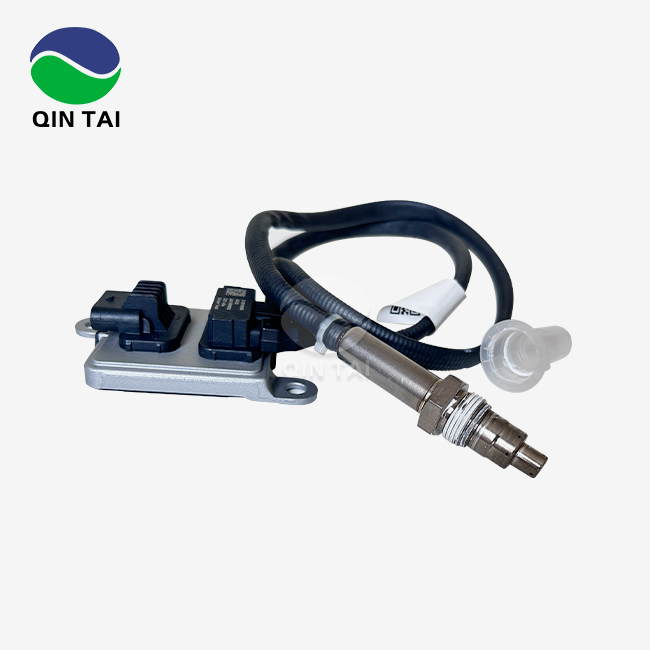
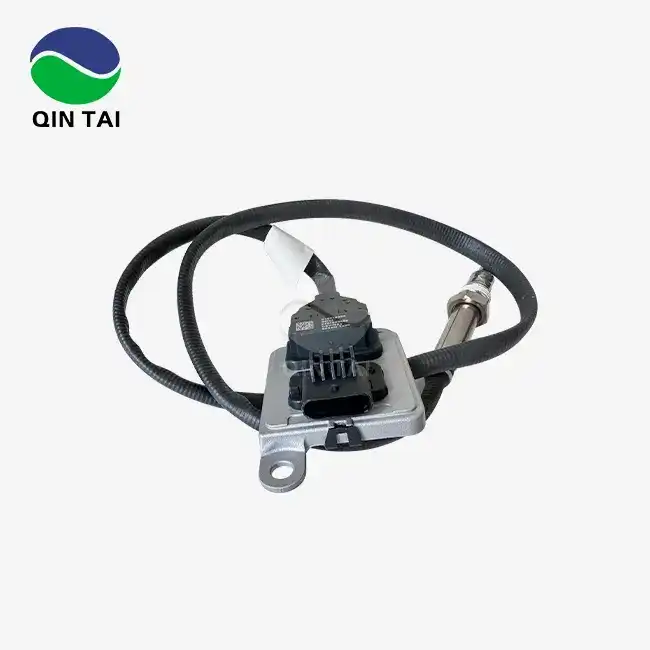
The ECU calculates exhaust fluid demands from NOx sensor data, engine load, and exhaust flow. It controls the pump and controller. The pump filters, pressurises, and transfers fluid to the dosage module. Pressure sensors inform controllers the goal value so they can retain it. Positive displacement uses a diaphragm or piston to move a fixed quantity of material every stroke. A purging cycle is commonly undertaken after engine shutdown. This clears fluid lines and reduces crystals and freeze damage.
How the Pump Supports SCR and AdBlue Systems
Adding fluid to an SCR system produces ammonia. The catalyst converts nitrogen oxides to water and nitrogen. Dosing accurately is crucial since the 2010 EPA heavy-duty regulation restricts NOx to 0.2 grams per brake horsepower-hour. Without adequate fluid, NOx stays in the exhaust. AdBlue waste and ammonia slip might result from excess fluid. Euro VI and China VI, which employ SCR for heavy-duty diesel engines, follow the same logic. The pump is in the center of this chain because the injector only measures what it supplies at the proper pressure.
Key Specifications to Check Before Selecting an Industrial Urea Dosing Pump
A full list of features is more useful than comparing prices. It's mostly about these three things.
Flow Rate and Urea Dosing Capacity
Start with dosage range, not maximum flow. Urea usage is usually 2%–3% of diesel fuel. Peak fuel flow can estimate demand for urea pump diesel projects, then engine data can verify it. Check minimum and maximum flow. Running a pump over its peak demand wastes energy, loses control at low flow, and makes noise. Write down "idle," "peak NOx," and the vehicle supply voltage, commonly 12V or 24V. A mine generator set may operate at full load for hours, therefore its dosage profile is different from a city bus.
Pressure Requirements and System Pressure Stability
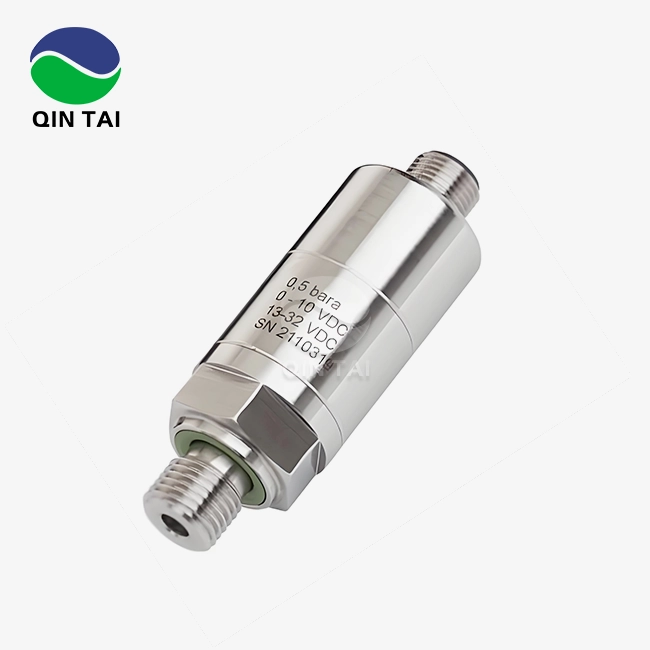
Flow is meaningful without consistent pressure for the urea dosing pump. The injector sprays fluid as pressure varies, and swings affect spray quality and exhaust mixing. Match the pump to the injector and ECU approach, not the number, since SCR generations have different pressure targets. Request the flow-versus-pressure curve and maximum pressure. Watch the pump when the supply line is lengthy or the filter is full. Also, test the controller-pressure sensor interface. Qintai produces pressure sensors and aftertreatment parts, therefore we examine this interaction.
Precision, Control, and Communication Requirements
The controller and pump must communicate. Know what control, feedback, and diagnostic signals the ECU needs. Qintai urea pumps use Bosch ECU-compatible SCR control methods. They tell the ECU to adjust dosage depending on NOx sensor input, engine load, and exhaust flow. Use a different controller? Tell us about the interface early. Ask the supplier whether they can modify connections and specifications often for integrators. Check moist materials since faulty metals and seals cause leaks and corrosion.

Urea Dosing Pump Comparison: Which Technology Is Best?
There is no one design that works for every job. It depends on the flow, pressure, duty cycle, and environment to make the right choice.
Diaphragm vs. Piston Urea Dosing Pumps
With a diaphragm pump, the fluid stays away from the moving parts, which helps stop leaks and allows for accurate dosing. They're also good at dealing with changes in pressure. With tight volume control, piston pumps can reach higher pressures, but their seals wear down over time and need to be fixed. Both types make pulses, so you might need a damper or a way to control them. Most of the time, a diaphragm design works well for projects that need moderate pressure and often service. If you need high pressure with low flow, you should look at a piston design. Ask each supplier for information on how long the exact model will last.
Stainless Steel vs. Plastic Urea Dosing Pumps
Urea solution corrodes copper, brass, zinc, and carbon steel. It doesn't cling to stainless or advanced plastics. Stainless steel can endure harsh handling and heavy industrial usage or pressure. It costs and weighs more. Engineered polymers save money and weight in vehicles, buses, and tractors. Check more than the label for grade. Urea should not enter seals, gaskets, or fittings. Keep fluids away from copper and zinc coatings and alloys. Good materials make a pump last longer than cheap ones.
Low-Flow vs. High-Flow Urea Dosing Pumps
Low-flow models are used in engines that only have one injector and don't put out much NOx. High-flow models are good for big engines, systems with a lot of injection points, or industrial exhaust systems. Most people make the mistake of oversizing. It's harder to tune the control loop when there is too much capacity because it makes low-flow less controllable and uses more power.
The opposite problem happens when you undersize the urea dosing pump. There is too much demand for the pump to handle, so NOx gets through. The system may then throw a fault. Include a small amount of extra space for error, and check the results at both the lowest and highest dose levels. If your project has more than one injection point, you will need to figure out each one separately.
Common Urea Dosing Pump Problems and How to Avoid Them
Many failures are caused by mistakes in the specifications or the way the parts are put together, not by the pump itself.
Crystallization, Blockage, and Poor Shutdown Control
When fluid sits in hot or cold lines for a long time, or when the exhaust is too cool to break up the droplets, urea crystals form. It builds up in the nozzle, on the pipe wall, and even inside the pump sometimes. A heater keeps the DEF from freezing, which can happen at 12°F (-11°C). A shutdown purge clears the lines of fluid. Clean fluid is also important. Make sure you only use ISO 22241 DEF and keep funnels and containers just for it. The small Qintai design includes a pump, a filter, and a heater. It also has built-in freeze protection and a purge function that take care of these problems at the component level.
Ignoring Voltage, Communication, or Mounting Compatibility
Even if a pump looks good on paper, it might not work when it's put in place. A 12V model on a 24V truck can get too hot or break, and a 24V part on a 12V system doesn't work well. When connectors, signal types, or messages don't match, fault codes are sent or the pump stays idle. Mounting is also important. Heavy trucks, construction equipment, and tractors can shake things up so much that weak brackets and fittings break.
The size and direction of the ports and hoses can change the path and trap air. Before you place an order, make a list of all the electrical, communication, and mechanical interfaces. When buying aftermarket parts, people should make sure that the replacement connector and mounting points are the same as the original ones. This cuts down on installation time and returns.
Selecting Only by Urea Dosing Pump Price
The cheapest quotation for the urea dosing pump may increase the cost. You should consider the price per device, failures, time wasted, warranty claims, shipment delays, and part replacement labour. A truck waiting for a pump loses money. OEMs pay extra for batch-to-batch changes due to calibration difficulties. In addition to pricing, request test findings, warranty, and lead time. Look at the pump's lifetime cost. Buyers obtain competitive quotations when they immediately write down flow, pressure, and voltage. This simplifies negotiations for buyers and provides technical teams a compelling reason to agree.
How to Select a Dependable Urea Dosing Pump Manufacturer or Supplier
The technical, purchasing, and management teams all have different opinions on a supplier, so the proof needs to meet the needs of all three.
Technical Capability and Product Range
Find out whether the provider manufactures its own items or sells others'. Xi'an Qintai Automotive Emission Technology Co., Ltd. is a national high-tech firm founded in 2001. We design, manufacture, sell, and service pressure sensors for diesel engines with SCR aftertreatment. Our distinct research and development team improves goods and has submitted for 58 innovation patents. We sell pumps and sensors, so integrators may purchase compatible components. Ask each provider to demonstrate how their pumps function with your sensors and ECU.
OEM, ODM, and Custom Urea Dosing Pump Support
Qintai provides OEM and ODM services from product design to mass manufacturing. We offer customisation for specialised applications. As a major supplier to Weichai Power, Yuchai Power, and Quanchai Power, we understand engine manufactures' item count and consistency needs. Integrators adjust interfaces and settings. Genset and mining clients may discuss site temperature and dust. Briefly state the purpose, flow, pressure, voltage, control technique, and quantity. That way, our engineers can offer precise responses instead of generic ones.
Quality Control, Testing, and Documentation
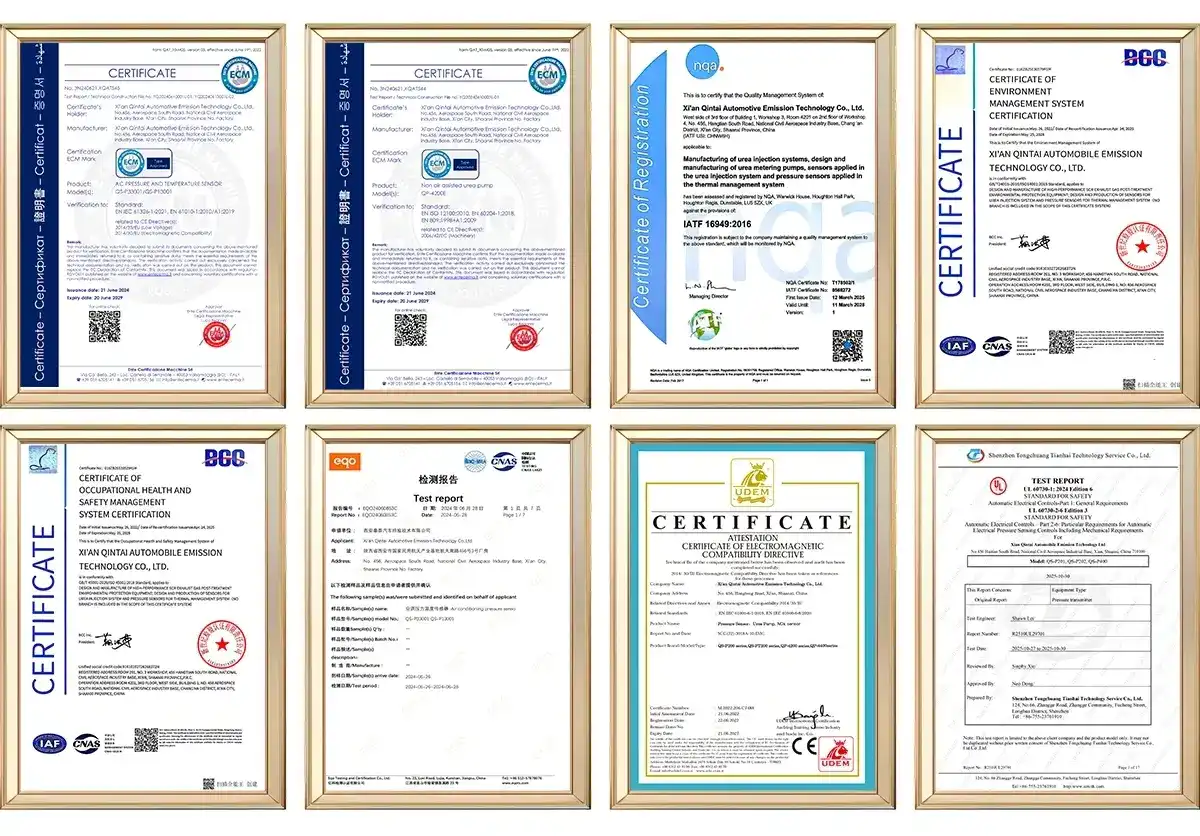
Start with certificates. It possesses ISO 9001, IATF 16949, CMC, Ex, UL, CE, REACH, and RoHS certifications. OEM buying teams worry about the automotive quality management standard. Still, ask any provider for flow calibration, pressure and leak test results, endurance statistics, and batch tracking. Request formal statements concerning the material and guarantee. We sell in over 60 countries and regions, including Europe, the Middle East, and South America, so our workforce is accustomed to extensive documentation.
Conclusion
It's important to make sure that the urea dosing pump you choose works with the whole SCR system. At a stable pressure, the pump moves DEF to the dosing module. The accuracy of the pump affects NOx control under rules like EPA 2010, Euro VI, and China VI. Buyers should first define the voltage, dosing range, pressure curve, and ECU interface. This is because control is lost if these values are too big or too small.
Housings made of stainless steel or plastic, diaphragms or pistons, low-flow or high-flow models—all of these are good for different duty cycles and budgets. Most problems are caused by crystallization, poor purge control, interface mismatches, or buying based only on price. To find out if the specification will work in service and high volume production, look at the supplier's engineering depth, certifications, test records, and ability to make changes.
FAQ
What Is the Function of a Urea Pump?
At the right pressure, the urea pump moves AdBlue from the tank to the dosing module. Precision dosing is possible for lowering NOx, and flow and pressure stay the same for catalyst performance.
What Are the Advantages of Qintai Urea Pumps?
They are small and have a pump, a filter, and a heater all in one. They give accurate doses at all temperatures, protect against freezing, have a purge function, last a long time, and use little power and make little noise.
How Is the Urea Pump Controlled?
It talks to the ECU, which controls the amount of dosing based on the load on the engine, the flow of exhaust, and feedback from the NOx sensor.
Are Qintai Urea Pumps Compatible With Bosch ECU?
Qintai urea pumps are made to work with certain SCR control strategies that work with Bosch ECUs. Send information about your controller so that our engineers can make sure it's a match.
How Do I Estimate the Required Flow Rate?
Start with how much fuel is used. Most of the time, DEF use is between 2% and 3% of diesel use. To be sure, multiply peak fuel flow by that range and check with engine data.
Request a Urea Dosing Pump Quotation From Qintai
Our engineers will help you choose the best urea dosing pump based on your application, flow, pressure, voltage, control method, interface dimensions, quantity, and delivery date. As a manufacturer of urea dosing pumps, we work with OEM customers and trading agents all over the world. We can support OEM/ODM and custom orders. Email info@qt-sensor.com to get samples or a quote on a large order, or go to qt-sensor.com for more information about the product.
References
1. ISO 22241-1: Diesel Engines—NOx Reduction Agent AUS 32—Part 1: Quality Requirements, 2019.
2. EPA, Control of Air Pollution from New Vehicle Vehicles: Heavy-Duty Engine and Vehicle Specifications and Highway Diesel Fuel Sulphur Control Requirements, 2001.
3. Regulation (EC) Number 595/2009 on Type Approvals of Autos and Engines for Heavy duty Vehicle Emissions (Euro VI), 2009.
4. Limits and Measuring Methods for Diesel-Fueled Heavy-Duty Vehicle Emissions (China VI), 2018.
5. W. A. Majewski and M. K. Khair, Diesel Emissions and Control, SAE international, 2006.
6. 2016 IATF 16949: Automotive Production and Relevant Spare Parts Organization Quality Management System Requirements.

Our customers’ satisfaction speaks for our quality — contact us to experience the same reliable service.