- English
- French
- German
- Portuguese
- Spanish
- Russian
- Japanese
- Korean
- Arabic
- Greek
- German
- Turkish
- Italian
- Danish
- Romanian
- Indonesian
- Czech
- Afrikaans
- Swedish
- Polish
- Basque
- Catalan
- Esperanto
- Hindi
- Lao
- Albanian
- Amharic
- Armenian
- Azerbaijani
- Belarusian
- Bengali
- Bosnian
- Bulgarian
- Cebuano
- Chichewa
- Corsican
- Croatian
- Dutch
- Estonian
- Filipino
- Finnish
- Frisian
- Galician
- Georgian
- Gujarati
- Haitian
- Hausa
- Hawaiian
- Hebrew
- Hmong
- Hungarian
- Icelandic
- Igbo
- Javanese
- Kannada
- Kazakh
- Khmer
- Kurdish
- Kyrgyz
- Latin
- Latvian
- Lithuanian
- Luxembou..
- Macedonian
- Malagasy
- Malay
- Malayalam
- Maltese
- Maori
- Marathi
- Mongolian
- Burmese
- Nepali
- Norwegian
- Pashto
- Persian
- Punjabi
- Serbian
- Sesotho
- Sinhala
- Slovak
- Slovenian
- Somali
- Samoan
- Scots Gaelic
- Shona
- Sindhi
- Sundanese
- Swahili
- Tajik
- Tamil
- Telugu
- Thai
- Ukrainian
- Urdu
- Uzbek
- Vietnamese
- Welsh
- Xhosa
- Yiddish
- Yoruba
- Zulu
Water Pressure Sensor Buying Guide: Types, Features, and Costs in 2026
Choosing the right water pressure sensor in 2026 is more than a purchasing decision — it directly affects system reliability, regulatory compliance, and long-term operating costs. Whether you manage procurement for diesel OEMs, SCR aftertreatment systems, or generator sets, selecting the correct fluid pressure sensing device determines whether your operation runs smoothly or faces costly downtime. This guide breaks down sensor types, key technical features, 2026 pricing benchmarks, and selection criteria — so your team can make a confident, well-informed decision.
Understanding Water Pressure Sensors: Types and Principles
Analog vs. Digital Output: What It Means for Your System
Analog sensors send a steady signal, usually between 0 and 5 V (4–20 mA), that corresponds to real-time changes in pressure. Often, digital devices send out discrete processed data through interfaces like I²C or CANbus. For heavy truck OEMs and SCR integrators who need to make sure that their ECUs work well with each other, analog output is still the standard because it responds quickly and is easy to calibrate.
Mechanical Sensor Designs: Diaphragm and Bourdon Tube
Diaphragm sensors are commonly used in diesel cooling circuits and hydraulic lines. They measure pressure by measuring how much the membrane bends. Designs with a Bourdon tube can handle higher pressures and work well with generator sets in mines or power plants. Both mechanical designs are respected for how long they last in settings with a lot of vibration, but the diaphragms need to be checked for wear and tear on a regular basis, especially after 100,000 or more pressure cycles.
Electronic Sensor Variants: Piezoelectric, Strain Gauge, and Capacitive
When the pressure changes quickly, piezoelectric sensors respond quickly. This makes them a good choice for fuel and engine cooling systems. Strain gage models are very accurate (usually ±0.25% FS or better) and work the same way every time, no matter what temperature range they are used in. When measuring low pressure, capacitive systems work best. Because they keep the signal stable and the measurements are always the same, strain gauge-based pressure sensors are often the best choice for treating industrial waste gas or farming equipment.
Waterproofing and Environmental Durability
The IP65 and IP67 ratings show how much water protection is good for outdoor building equipment and pump rooms. For chemical or marine environments, you need to specify wetted materials. Ceramic diaphragms or 316L stainless steel are good choices because they don't rust. One of the most common mistakes I see in B2B buying is not checking to see if the material is compatible with the fluid medium, especially when selecting a water pressure sensor.
Core Features & Benefits for Global B2B Buyers
Accuracy, Calibration, and Measurement Consistency
It might sound like a pressure sensor with a ±0.5% full-scale accuracy is good enough, but in high-stakes OEM applications, drift over time is just as important as starting accuracy. Manufacturers of high-quality products put their products through tests that change the temperature from -20°C to +85°C and shock tests that mimic water hammer conditions. Helium leakage testing shows that the sensor-housing junction is hermetically sealed, which keeps wetness out and improves signal quality.
These are the basic success standards that you should ask any provider to meet:
- Cycle durability: Minimum 100,000 to 500,000 pressure cycles without set-point drift
- Hysteresis: Less than 2% of full scale to prevent rapid cycling in pump control systems
- Ingress protection: IP65 minimum for industrial use; IP67 for wet or outdoor environments
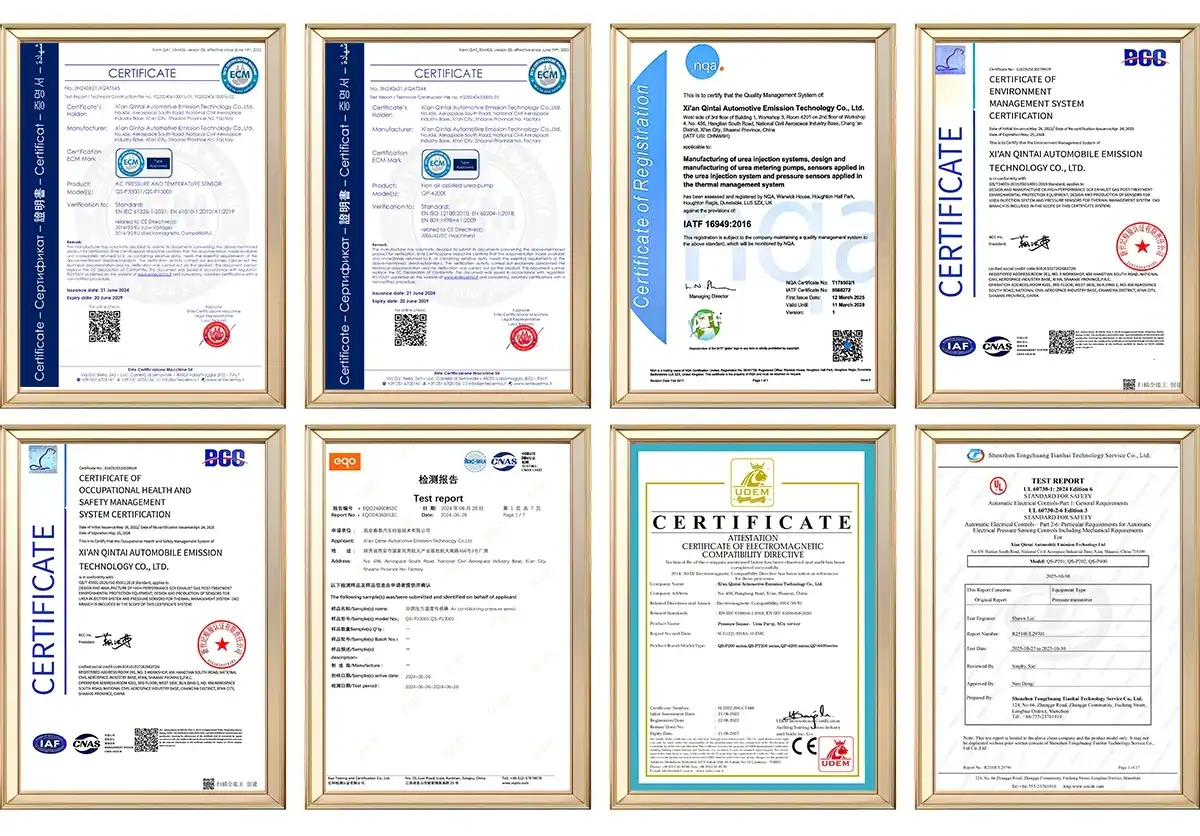
- Certifications: CE, RoHS, UL, and IATF16949 for OEM-grade supply chain compliance
These benchmarks keep your system from breaking down too soon and help you plan for maintenance costs. A sensor that meets all four requirements greatly lowers the risk of having to be replaced unexpectedly or file a warranty claim.
IoT Integration and Real-Time Monitoring
More and more modern pressure tracking devices support IoT connection, which lets data be sent to cloud-based dashboards for proactive maintenance. When used with generator sets at mines or backup power plants, remote monitoring cuts down on the number of times that they need to be inspected by hand and alerts operators to problems with the pressure before they get worse. For SCR aftertreatment integrators, getting real-time data from the coolant and DEF (diesel exhaust fluid) circuits makes it easier to fine-tune the system.
Maintenance and Lifespan Extension
For monitors that are used in continuous-duty situations, testing is usually done once a year. Set-point drift in water pressure sensors is usually caused by mechanical spring fatigue or diaphragm aging. Both of these problems can be avoided by buying from manufacturers whose internal parts have already been aged. Sensors stay correct for a lot longer than their recommended service times if the pressure port is cleaned regularly and the electrical connections are checked.
Comparing Popular Water Pressure Sensors and Their Costs in 2026
Leading Brands and Their Market Positions
Honeywell has strong distribution networks all over North America and offers tried-and-true sensing solutions that are widely used in HVAC and industrial fluid systems. Bosch puts OEM-grade sensors in heavy car systems all over the world. Siemens makes high-precision receivers that are used to automate industrial processes. Dwyer and Omega make models that are competitively priced for the aftermarket and laboratories. Ashcroft makes mechanical switches and gages that work well with industrial pipelines that are under a lot of pressure.
When buying diesel OEM and SCR parts, people usually get them from Chinese companies that are IATF16949 certified. This is because the unit costs are much lower when buying in bulk, and the measurements are still accurate.
2026 Cost Benchmarks by Sensor Category
In 2026, prices are very different depending on the type of output, the range of pressures, and the level of certification:
- Entry-level mechanical switches (0–10 bar): $8–$25 per unit at volume
- Mid-range analog transmitters (4–20 mA, 0–20 bar): $30–$80 per unit
- Industrial-grade electronic sensors (CE/UL certified, IP67): $60–$150 per unit
- Custom OEM sensors (IATF16949, CAN output): Negotiated at MOQ, typically $40–$120
$8 to $25 per unit at volume for entry-level mechanical switches (0 to 10 bar)
$20 to $80 per unit for mid-range analog emitters (4 to 20 mA, 0 to 20 bar)
Electronic vs. Mechanical: Performance Trade-offs
Unit costs usually go down by 15–30% when you buy 500 or more of something at once. Specialized providers can make sensors with particular thread sizes, pressure ranges, or output protocols. This is the most cost-effective option for OEM buyers who know how many sensors they will need in the long run.
How to Choose the Right Water Pressure Sensor for Your Business Needs
Define Your Procurement Scenario First
Make sure you know your working pressure range, fluid medium, output protocol needs, and certification requirements before you start comparing water pressure sensor models. The needs of an SCR aftertreatment integrator who needs to watch the DEF circuit are different from those of a generator set OEM who needs to find one for a remote mine power plant. It saves a lot of time to write a clear technical requirement sheet before getting in touch with providers.
Balance Cost Against Measurement Criticality
Accuracy to within 0.1% is not needed in all situations. When looking for replacement sensors for commercial vehicles, aftermarket repair shops put price and availability ahead of lab-level accuracy. On the other hand, OEM procurement managers have to make sure that they are in line with emission regulation requirements (China VI, Euro VI) and make sure that the accuracy of sensor data supports the integrity of ECU calibration. Set your level of truth before you talk about price.
Evaluate Supplier Credentials and Support Capacity
Production quality systems are checked by ISO9001, IATF16949, CE, and UL certification papers. Ask suppliers for information on their cycle testing, calibration traceability certificates, and promises of lead times. For large-scale projects, make sure the provider can handle mass production and design change (OEM/ODM). One thing that determines whether a provider will be a long-term partner is how quick they are after the sale, which includes calibration support and failure analysis.
Installation, Usage, and Supplier Engagement Best Practices
Step-by-Step Installation Guidance
Make sure that the system pressure is completely gone before you install any pressure sensing equipment. To stop leaks, clean the port thread and use PTFE tape or the right thread sealant. Do not over-torque; most sensors list a torque range of 15–25 Nm. After setting up the system, slowly turn it on and compare the output signal to a measured reference device to make sure it works correctly at the set point.
Source Genuine Sensors from Verified Suppliers
It is known that fake and low-quality sensors can be found in aftermarket buying channels. Test results and batch approval data should always be asked for. Working directly with the manufacturer or an authorized distributor clears up any questions about quality and gives you access to customized products, priority stock allocation, and technical support for installation problems.
Post-Purchase Support and Long-Term Partnership
A trustworthy provider does more than just sell you goods; they also help your business run. As part of your supply agreement, you should talk about getting annual calibration services, failure mode analysis on returned units, and firmware or parameter adjustments for custom models. Strategic relationships with suppliers lower the risk of buying things and keep the costs of your bill of materials stable across generations of products.
Conclusion
In 2026, to choose the best water pressure sensor solution, you will need to make sure that the technical specs match your specific operational environment, check the credentials of the supplier, and build long-term relationships with them for purchasing that go beyond single transactions. It doesn't matter if you're working on a Euro VI heavy truck cooling system, a mine-site generator set, or an SCR aftertreatment assembly line. The rules are always the same: focus on accuracy, check certifications, and work with manufacturers who can support your production scale and timeline.
FAQ
What is the difference between a water pressure sensor switch and a pressure transmitter?
When pressure goes over a certain level, a pressure switch sends an on/off electrical signal. This is great for controlling when a pump starts or stops running. A pressure sensor sends a steady analog signal (4–20 mA) that lets your control system know the pressure in real time across the whole measurement range. A transmitter is usually the best choice for OEM and SCR systems that need to send exact data to an ECU.
What causes set-point drift over time?
Set-point drift is usually caused by the internal spring wearing out or the diaphragm getting old. This risk is greatly reduced by buying devices that are made with parts that have already been aged and have been tested over 100,000 times.
Can pressure switches handle corrosive fluids or seawater?
Yes, but you have to make sure that the materials you buy are wet. For acidic media, you can use titanium, 316L stainless steel, and special EPDM or ceramic diaphragms.
How do I prevent rapid cycling (chatter) in my system?
Choose a switch that has a time delay function or hysteresis that can be changed so that it stays less than 2% of full scale. This stops the switch from going back and forth between the set-point threshold and itself.
How often should I calibrate a water pressure sensor?
For business uses that run all the time, calibration once a year is normal. In places with a lot of cycles, measurements may need to be checked every six months to keep them accurate and meet the standards for regulatory paperwork.

Get a Custom Water Pressure Sensor Quote from Qintai
Qintai has been around since 2001 and is China's top OEM pressure sensor seller. It has IATF16949, ISO9001, CE, UL, and RoHS certifications and has filed 58 idea patents. Weichai Power and Yuchai Power depend on Qintai as a main supplier. Qintai helps global B2B buyers with OEM/ODM customization, mass production, and dedicated technical support. Visit qt-sensor.com or email our water pressure sensor manufacturer team at info@qt-sensor.com right now to get details, bulk pricing, and help with your application.
References
1. Instrumentation & Measurement Magazine, IEEE — 2024
2. Sensors and Actuators A: Physical, Elsevier — 2023
3. SAE International Journal of Engines — 2023
4. ISA (International Society of Automation) Standards Reference, ISA Press — 2024
5. Journal of Pressure Vessel Technology, ASME — 2023
6. Diesel Progress: Engines & Drives, Endeavor Business Media — 2024


Our customers’ satisfaction speaks for our quality — contact us to experience the same reliable service.