- English
- French
- German
- Portuguese
- Spanish
- Russian
- Japanese
- Korean
- Arabic
- Greek
- German
- Turkish
- Italian
- Danish
- Romanian
- Indonesian
- Czech
- Afrikaans
- Swedish
- Polish
- Basque
- Catalan
- Esperanto
- Hindi
- Lao
- Albanian
- Amharic
- Armenian
- Azerbaijani
- Belarusian
- Bengali
- Bosnian
- Bulgarian
- Cebuano
- Chichewa
- Corsican
- Croatian
- Dutch
- Estonian
- Filipino
- Finnish
- Frisian
- Galician
- Georgian
- Gujarati
- Haitian
- Hausa
- Hawaiian
- Hebrew
- Hmong
- Hungarian
- Icelandic
- Igbo
- Javanese
- Kannada
- Kazakh
- Khmer
- Kurdish
- Kyrgyz
- Latin
- Latvian
- Lithuanian
- Luxembou..
- Macedonian
- Malagasy
- Malay
- Malayalam
- Maltese
- Maori
- Marathi
- Mongolian
- Burmese
- Nepali
- Norwegian
- Pashto
- Persian
- Punjabi
- Serbian
- Sesotho
- Sinhala
- Slovak
- Slovenian
- Somali
- Samoan
- Scots Gaelic
- Shona
- Sindhi
- Sundanese
- Swahili
- Tajik
- Tamil
- Telugu
- Thai
- Ukrainian
- Urdu
- Uzbek
- Vietnamese
- Welsh
- Xhosa
- Yiddish
- Yoruba
- Zulu
Why Urea Dosing Pump Accuracy Matters for Long-Term SCR Efficiency
A urea dosing pump controls the quantity of AdBlue or diesel exhaust fluid (DEF) delivered to the SCR injector at any one time. If the pump supplies too little, the NOx goes past the catalyst untreated. Too much and ammonia leaks out, urea crystallizes and injectors get blocked. Dosing mistakes, even little ones, build up to increased fluid usage, catalyst degradation and emissions issues over thousands of hours. This guide is written for system integrators who manufacture SCR assemblies from OEM’s designs. It explains how the pump operates, what erodes accuracy, how to size and test it, and how to purchase it.
How a Urea Dosing Pump Works Inside an SCR System?
Before judging accuracy, we need a clear picture of what the pump does.
What the Pump Does in the SCR Loop?
The AdBlue urea dosing pump, sometimes referred to as a DEF urea pump or urea doser pump, pumps AdBlue from the tank, via the filter, to the dosing module where it is sprayed into the exhaust stream. AdBlue is a 32.5% solution of urea in deionized water as defined in ISO 22241. After injection, the urea decomposes to ammonia, which then interacts with the NOx over the catalyst to generate nitrogen and water. The pump creates and maintains the pressure required by the injector to keep the spray constant. No matter how good the catalyst is, no matter how well the controller is adjusted, if there is no consistent pressure, the NOx goal will not be met.
Common Pump Designs
We find a few different pump designs in diesel applications. Diaphragm pumps cope well with variation in pressure and are good for accurate dosing. This is why many electric AdBlue pumps are using them. Another alternative for systems with various pressure requirements are piston pumps. The broader dosing market also includes gear and peristaltic designs, however the choice relies on the injector and system structure. Some industrial systems employ pneumatic supply, many truck systems use tiny electric units. The pump, filter and heater are in integrated modules, reducing the number of hose connections and possible leak spots. Always match design to OEM drawing, duty cycle and available installation area.
How the ECU Controls the Pump?
The pump does not determine the dosage on its own. The dosage amount is calculated by the engine control unit (ECU) using engine load, exhaust flow and data from the NOx sensors and the pump and dosing module are commanded. Electrical compatibility is thus as important as hydraulics: voltage, connection pinout and communication signals have to fit the control scheme. Qintai urea pumps are intended to meet Bosch ECU for particular SCR control schemes, and connect with ECU to manage dosage amount. For the integrators, this match must be confirmed throughout the drawing and technical agreement phase, preventing late surprises in the commissioning. Before ordering the samples, ask for the signal list and connection diagrams.
How Pump Accuracy Shapes Long-Term SCR Efficiency?
Accuracy is a bigger topic than a single flow number.
What Accuracy Really Includes?
Many data sheets just indicate a maximum flow rate and leave it at that. In practice, precision encompasses pressure stability, repeatability from one dosing cycle to another, reaction time, shut-off performance, pulsation, and behavior over temperature. A pump may develop its rated flow on a bench at room temperature, yet still wander at a cold start or low tank level. I thus urge to evaluate a urea dosing pump across its whole working range and not just on nominal numbers. Request flow-pressure curves at various voltages and temperatures, as the injector reacts to the pressure it gets, not the number on the label.
What Under-Dosing and Over-Dosing Cost?
The consequences are two-way. Under-dosing means no NOx treatment and the U.S. EPA heavy-duty NOx standard for model year 2027 is 0.035 g/hp-hr on the FTP cycle, leaving minimal tolerance for dosing mistake. Over-dosing wastes DEF, which typically accounts for roughly 2% to 3% of diesel fuel utilization. It also results in ammonia slide, deposits on injectors and pipelines, and catalyst contamination. Studies with urea-water sprays have shown that wall wetting and low exhaust temperatures encourage deposit development, and so a pump that overshoots even momentarily may initiate a buildup that increases with each duty cycle.
What Causes Accuracy to Decline?
Accuracy seldom disappears overnight. It eats away at clogged filters, suction-line constraints, air in-leakage and too much back pressure, all of which reduce flow. “Seals and check valves are damaged by overpressure. Urea crystals form up at the pump inlets, in the injectors and return lines, particularly after inadequate fluid management. AdBlue freezes at around -11 °C (12 °F), thus heaters and purge functions are engaged in cold temperatures in northern U.S. states. Rounding out the list are mechanical wear, seal aging, polluted fluid and unpredictable supply voltage. Most of these issues are addressed upstream of the catalyst by using ISO 22241-grade DEF, clean transfer equipment, appropriate wetted materials and planned filter adjustments.

Sizing, Verifying, and Selecting the Right Pump
Good selection starts with engine data and ends with test records.
How to Calculate Flow Rate?
The catalog doesn't initiate the sizing; the engine does. Collect fuel consumption, exhaust flow, engine out NOx concentration, conversion goal, urea concentration, operating pressure, injector capacity and load profile. A simple estimation links the mass of urea needed to the operation time. Sizing at the system level is more extensive and uses the NOx mass flow, ammonia to NOx ratio, estimated losses and a control margin. Choose a pump with a usable range that encompasses both the lowest no-load dosage and the greatest peak dose. A pump intended to handle solely maximum flow will typically not regulate well at low demand. Cross-check the final numbers with the engine maker's calibration staff.
How to Verify Accuracy Before and After Purchase?
Verification should occur at three locations. First request for manufacturing documents such as individual flow results, pressure data, leak testing, electrical inspections and end of line inspection. Second, run a pilot over loads, temperatures, vibration levels, cold starts and shutdown cycles using the true voltage, back pressure and line length for the urea dosing pump. Measure supplied volume, repeatability, leakage and pressure ripple. Third, watch the field data. DEF consumption, NOx sensor values, fault frequency, injector deposits, pressure fluctuations. Write acceptance requirements before testing commences. Record baseline values at commissioning so you can compare suppliers and subsequent outcomes on equal grounds.
Selection Criteria for Your Application
Fit the pump to the task. Trucks generally need small electric units that can handle vibration. Industrial and maritime may require greater duty cycles, corrosion resistance or pneumatic integration. Designs of diaphragm vs piston 12V vs 24V versions Control interfaces Check flow pressure curves, wetted materials, IP rating, EMC performance, temperature range, anti-freeze characteristics, noise, availability of replacement parts and warranty conditions. Qintai urea pumps are compactly designed to integrate the pump, filter and heater, and have built-in freeze prevention and purge function, low energy consumption and low noise These characteristics are a good fit for integrators who construct assemblies to OEM blueprints.
Installation, Maintenance, and Troubleshooting
Accuracy that starts well can still be lost in the field without good habits.
Installation Practices That Protect Accuracy
Mount the pump away from heat, road splash, impact and extreme vibration. Keep suction lift and line length low and prevent needless air-trapping bends. On the electrical side, check the actual loaded voltage, the fuse and relay size, grounding, connection sealing, signal compatibility, and reverse polarity protection. During commissioning examine tank and lines. Fill with acceptable DEF, prime pump, check for leaks, test pressure and flow and validate injector spray pattern. Record these baseline measurements. So if an issue comes up six months down the road, you have a clear reference instead of guessing, and your assembly crew has a defined checklist to follow.
Maintenance and Troubleshooting Steps
We do routine tests on the pump's filters, fluid lines, noise and vibration, leaks, connections, pressure stability, flow output and crystals near the injector. If a pump fails follow an order . First a fuse , then power supply , then voltage under load , then connections , then ground , then fluid level , then suction line , then filter , then pressure build up , then injector , then return line , then ECU signals . Air intrusion, obstruction, wear, improper voltage, excessive back pressure or crystalline urea are generally indicated by poor flow or unstable pressure. A organized sequence also helps distinguish a pump issue from a sensor or wiring fault and keeps you from becoming embroiled in arguments over component quality. After replacement, recalibrate and record performance.
Common Mistakes That Reduce SCR Efficiency
Four errors keep coming back with the urea dosing pump. The maximum flow alone does not take into account stability and control range. Fitting a 12V or 24V pump without evaluating loaded voltage, current requirement and connections results in intermittent functioning. Fluid hygiene problems and incompatible materials increase the rate of crystallization, corrosion and seal deterioration. Finally, changing a pump without evaluating its flow characteristics or recalibrating the system causes dosage discrepancies and repetitive fault codes. It costs little to avoid each error at the design stage and a lot to rectify it after delivery, particularly if the assembler is shown a warranty claim beforehand.
Buying a Urea Dosing Pump for Your SCR Assembly
A purchase decision works best when technical proof and project needs sit side by side.
Questions to Ask Any Supplier
Don’t judge a provider on the unit price, judge their competence. Ask whether the manufacturer builds the pump in-house, if flow-pressure curves and test reports are available, if 12V and 24V variants, custom connections, control signals, installation and OEM Validation are supported. Review material compatibility, traceability, manufacturing consistency, test equipment, export experience, paperwork, replacement parts, warranty and lead time. Also, check what compliance documentation your client needs for U.S. projects, since standards vary by application and OEM. Early technical conversations may save weeks by identifying incompatibilities in connections or signals before samples arrive.
Qintai Experience and Product Features
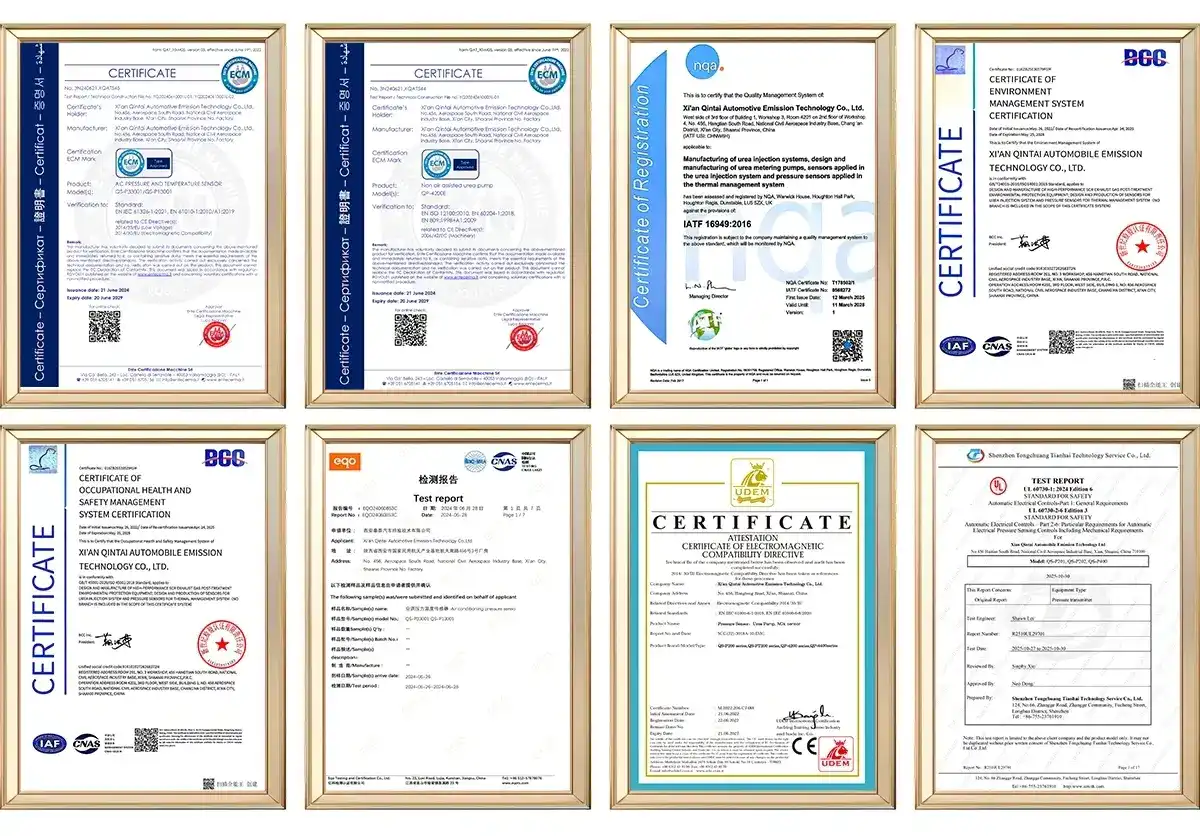
Xi'an Qintai Automotive Emission Technology Co. Ltd was formed in 2001, is a national high-tech firm. Our specialty is the R&D, manufacture, sales and after-sales service of diesel engine SCR aftertreatment and sensors, notably pressure sensors. We obtained ISO9001, IATF16949, CMC, Ex, UL, CE, REACH, RoHS certifications and have filed for 58 innovation patents. We are main supplier for Weichai power, Yuchai power and Quanchai power. Our goods are sold to more than 60 nations and territories. The OEM and ODM works are backed up by an independent R&D team from product design to mass manufacturing, including modification for special applications.
Total Cost of Ownership and Project Fit
The unit price is merely one side of the equation. Total cost includes new pumps, seals, filters, repair kits, downtime and technical support for the life of the device. There are additional hidden expenses to the integrator when a sample is late or a connection does not mate with the harness. Qintai provides OEM/ODM service and modification, you may negotiate unique mounting, flow ranges, connections, heating or branding for your designs. Give them your volume strategy and ask for pricing stages and payment conditions in writing. Fast technical solutions in the sampling process help you meet project goals and limit the risk of redesign late in the program.
Conclusion
The long-term functioning of an SCR system depends on the precision of the urea dosing pump which determines the amount of AdBlue reaching the injector. It needs more than rated flow for accuracy. It also needs pressure stability, repeatability, responsiveness and temperature behavior. Under-dosing means that NOx is not treated, over-dosing means more DEF consumption and ammonia slip, crystallization and deposits. Blockage, contamination, freezing, wear and electrical problems will reduce accuracy. Correct sizing from engine data, testing under actual voltage and temperature, careful installation, systematic maintenance, and a supplier assessment based on capabilities and overall cost safeguard dosing performance. Together, these methods assist an SCR assembly maintain NOx conversion stability and emissions compliance throughout its service life.
FAQ
Q1: What is the function of a urea pump?
A: It delivers AdBlue from the tank to the dosing module at the required pressure, giving precise metering for NOx reduction and steady flow for catalyst performance.
Q2: What are the advantages of Qintai urea pumps?
A: The compact design integrates pump, filter, and heater. Features include accurate dosing across temperature conditions, built-in freeze protection, a purge function, long service life, and low energy use and noise.
Q3: How is the urea pump controlled?
A: It communicates with the ECU, which sets the dosing quantity from engine load, exhaust flow, and NOx sensor feedback.
Q4: Does it comply with Bosch ECU?
A: Qintai urea pumps are designed to comply with Bosch ECU for specific SCR control strategies. Send us your strategy details so our engineers can confirm the match.
Q5: How do I choose the right urea dosing pump?
A: Define flow rate, pressure, voltage, and urea-compatible materials. Then check control features and maintenance needs, and compare designs such as diaphragm and piston.
Work With Qintai, Your Urea Dosing Pump Manufacturer
Qintai supplies a urea dosing pump with an integrated pump, filter, and heater, backed by OEM/ODM service and customization. If you need a urea dosing pump manufacturer that understands drawings, technical agreements, and project timelines, email your flow rate, pressure, voltage, control method, and annual volume to info@qt-sensor.com. Our team will review your requirements and reply with a matching proposal.
References
1. ISO 22241-1, Diesel engines – NOx reduction agent AUS 32 – Part 1: Quality requirements, International Organization for Standardization, 2019.
2. U.S. Environmental Protection Agency, Control of Air Pollution From New Motor Vehicles: Heavy-Duty Engine and Vehicle Standards, Federal Register, 2023.
3. Koebel, M., Elsener, M., and Kleemann, M., Urea-SCR: a promising technique to reduce NOx emissions from automotive diesel engines, Catalysis Today, 2000.
4. Birkhold, F., Meingast, U., Wassermann, P., and Deutschmann, O., Modeling and simulation of the injection of urea-water-solution for automotive SCR DeNOx-systems, Applied Catalysis B: Environmental, 2007.
5. Guan, B., Zhan, R., Lin, H., and Huang, Z., Review of state of the art technologies of selective catalytic reduction of NOx from diesel engine exhaust, Applied Thermal Engineering, 2014.
6. Majewski, W. A., and Khair, M. K., Diesel Emissions and Their Control, SAE International, 2006.


Our customers’ satisfaction speaks for our quality — contact us to experience the same reliable service.